Free · no sign-up · prints on letter or A4
3rd Grade Math Worksheets
Make 3rd grade math practice sheets: 3-digit addition and subtraction, times tables to 10 × 10 and division facts, mixed on one page with an answer key. Free.
Grades 2–4Mixed operationsCCSS 3.NBT.A.2, 4.NBT.B.4, 2.NBT.B.7, 3.OA.C.7
Name: ____________________ Date: ______________
Grades 2–4 · Mixed operations · CCSS 3.NBT.A.2, 4.NBT.B.4, 2.NBT.B.7, 3.OA.C.7
Answer key
k5print.com
Need 20 different versions at once, your own logo, no ads? Teacher Plan is coming — join the waitlist →
Grade levels and Common Core standards for this tool
The grade and standard on each sheet follow your settings. Here is every combination this tool can make:
| Grade | Skill | Common Core |
|---|---|---|
| Grades K–1 | Mixed operations (in a mixed sheet) | K.OA.A.2, 1.OA.C.6 |
| Grades 1–2 | Mixed operations (in a mixed sheet) | 1.OA.C.6, 2.OA.B.2 |
| Grade 2 | Mixed operations (in a mixed sheet) | 2.NBT.B.5, 2.NBT.B.7 |
| Grades 3–4 | Mixed operations (in a mixed sheet) | 3.NBT.A.2, 4.NBT.B.4 |
| Grade 4 | Mixed operations (in a mixed sheet) | 4.NBT.B.4 |
| Grade 2 | Mixed operations (in a mixed sheet) | 2.NBT.B.5 |
| Grades 2–3 | Mixed operations (in a mixed sheet) | 2.NBT.B.7, 3.NBT.A.2 |
| Grade 3 | Mixed operations (in a mixed sheet) | 3.OA.C.7 |
| Grades 3–4 | Mixed operations (in a mixed sheet) | 3.OA.C.7, 4.NBT.B.5 |
| Grade 4 | Mixed operations (in a mixed sheet) | 4.NBT.B.5 |
| Grades 3–4 | Mixed operations (in a mixed sheet) | 3.OA.C.7, 4.NBT.B.6 |
| Grade 4 | Mixed operations (in a mixed sheet) | 4.NBT.B.6 |
- CCSS K.OA.A.2
- Solve addition and subtraction word problems, and add and subtract within 10, e.g., by using objects or drawings to represent the problem.
- CCSS 1.OA.C.6
- Add and subtract within 20, demonstrating fluency for addition and subtraction within 10. Use strategies such as counting on; making ten (e.g., 8 + 6 = 8 + 2 + 4 = 10 + 4 = 14); decomposing a number leading to a ten (e.g., 13 - 4 = 13 - 3 - 1 = 10 - 1 = 9); using the relationship between addition and subtraction (e.g., knowing that 8 + 4 = 12, one knows 12 - 8 = 4); and creating equivalent but easier or known sums (e.g., adding 6 + 7 by creating the known equivalent 6 + 6 + 1 = 12 + 1 = 13).
- CCSS 2.OA.B.2
- Fluently add and subtract within 20 using mental strategies. By end of Grade 2, know from memory all sums of two one-digit numbers.
- CCSS 2.NBT.B.5
- Fluently add and subtract within 100 using strategies based on place value, properties of operations, and/or the relationship between addition and subtraction.
- CCSS 2.NBT.B.7
- Add and subtract within 1000, using concrete models or drawings and strategies based on place value, properties of operations, and/or the relationship between addition and subtraction; relate the strategy to a written method. Understand that in adding or subtracting three-digit numbers, one adds or subtracts hundreds and hundreds, tens and tens, ones and ones; and sometimes it is necessary to compose or decompose tens or hundreds.
- CCSS 3.NBT.A.2
- Fluently add and subtract within 1000 using strategies and algorithms based on place value, properties of operations, and/or the relationship between addition and subtraction.
- CCSS 4.NBT.B.4
- Fluently add and subtract multi-digit whole numbers using the standard algorithm.
- CCSS 3.OA.C.7
- Fluently multiply and divide within 100, using strategies such as the relationship between multiplication and division (e.g., knowing that 8 × 5 = 40, one knows 40 ÷ 5 = 8) or properties of operations. By the end of Grade 3, know from memory all products of two one-digit numbers.
- CCSS 4.NBT.B.5
- Multiply a whole number of up to four digits by a one-digit whole number, and multiply two two-digit numbers, using strategies based on place value and the properties of operations. Illustrate and explain the calculation by using equations, rectangular arrays, and/or area models.
- CCSS 4.NBT.B.6
- Find whole-number quotients and remainders with up to four-digit dividends and one-digit divisors, using strategies based on place value, the properties of operations, and/or the relationship between multiplication and division. Illustrate and explain the calculation by using equations, rectangular arrays, and/or area models.
Standards text quoted from corestandards.org. K5Print is not affiliated with or endorsed by the Common Core State Standards Initiative.
© Copyright 2010. National Governors Association Center for Best Practices and Council of Chief State School Officers. All rights reserved.
This page makes 3rd grade math practice sheets: addition and subtraction with 3-digit numbers, multiplication facts up to 10 × 10 and division facts, mixed on one page with an answer key. It starts with 20 problems, which fit on one page, and the numbers change every time you make a new sheet. It runs in your web browser, it is free, and nothing is uploaded.
Third grade math covers more than arithmetic, including fractions, area, time and measurement. This page covers the number operations, which is the part most families want as a daily practice sheet. The related tools below cover fractions, area and perimeter, time and place value.
You can use what you make here in class or in things you sell, such as Etsy printables and Teachers Pay Teachers, with no credit needed.
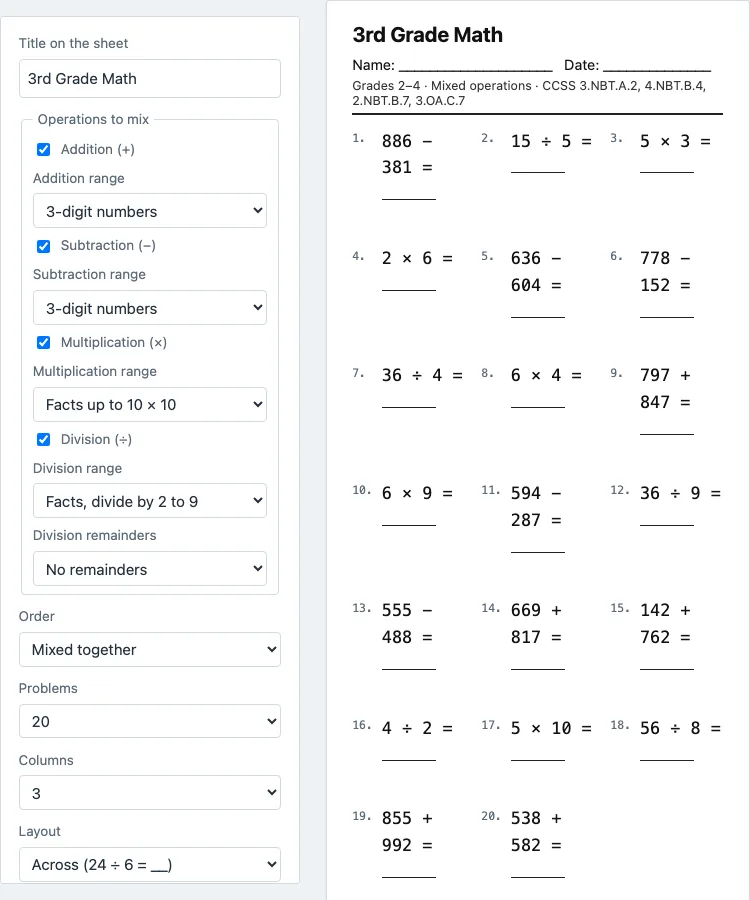
How to make a 3rd grade math worksheet
- Type a heading in Title on the sheet, or keep the one provided.
- Tick the operations you want: Addition (+), Subtraction (−), Multiplication (×) and Division (÷).
- Open each range menu to set how big the numbers are. Addition and Subtraction go from Within 10 to 4-digit numbers. Multiplication goes from Facts up to 5 × 5 to 2 digits × 2 digits. Division goes from Facts, divide by 2 to 9 to 3-digit answers, and Division remainders can be set to Some remainders. Move a range up or down one step to make the sheet easier or harder.
- Set Order to Mixed together or Grouped by operation.
- Set Problems (8 to 40) and Columns (2 to 6), and choose Layout: Across (24 ÷ 6 = __) or Stacked.
- Keep Include answer key ticked to print the key on its own page.
- Select Print or save as PDF. Use New worksheet for new numbers with the same settings, and Reset settings to go back to this page’s starting settings.
- Check the preview before you print: it shows exactly what will print, including the page break if you chose many problems.
Choose US Letter or A4 in the print dialog. The page address stores your settings, so a bookmarked or shared link opens the same sheet again. Every answer is checked a second way before it is used, and the key matches the sheet.
What math do 3rd graders learn?
Third grade math has four main areas: multiplication and division, fractions, measurement and data, and place value arithmetic. In the Common Core standards, 3rd graders multiply and divide within 100 and know all products of two one-digit numbers from memory (3.OA.C.7). They also add and subtract within 1000 (3.NBT.A.2). This page covers those two skills.
The starting settings match them: 3-digit addition and subtraction, multiplication facts up to 10 × 10 and division facts with divisors from 2 to 9 and no remainders.
How can I make the sheet easier or harder?
For a gentler start, change Addition range and Subtraction range to 2-digit numbers and Multiplication range to Facts up to 5 × 5. For a stretch, move Multiplication range to 2 digits × 1 digit, which goes beyond the 3rd grade standard into 4th grade, or set Division remainders to Some remainders.
To work on one skill, untick the others. A sheet of only multiplication and division facts is a good daily warm-up in the weeks before a times table test.
How often should a 3rd grader practice?
Short and regular works better than long and rare. A sheet of 10 to 20 problems is a sensible length for one sitting. Use Grouped by operation to practice one thing at a time, then Mixed together to check that the child can tell which operation each problem needs. If most answers are right, move the range up one step; if many are wrong, go down one step.
What does a good 3rd grade math practice routine look like?
A routine that works for many families is a short sheet of mixed problems on most days, plus one focused sheet a week on the skill that is hardest. Set Order to Mixed together for the daily sheet, so the child has to decide whether to add, subtract, multiply or divide. For the focused sheet, untick the other operations and set Order to Grouped by operation.
Mark the sheet together using the answer key, and ask the child to find their own mistakes. A mistake in the same place twice, for example always forgetting to carry in the tens column, tells you what to practice next.
Why mix the operations on one sheet?
Sheets with a single operation let a child switch off and follow a pattern. A mixed sheet makes them read the sign each time. It also shows whether a child confuses multiplication and division facts, which are easy to mix up in 3rd grade because they come from the same fact families.
Questions teachers and parents ask
Are these 3rd grade math worksheets free?
Yes. The sheets are made in your web browser, nothing is uploaded, and no account or sign-up is needed.
Does this cover all of 3rd grade math?
No. It covers addition, subtraction, multiplication and division. Fractions, area and perimeter, time and money each have their own tool on this site; they are listed under More tools.
Are the answers checked?
Yes. Each problem is checked a second way before it is used, and the answer key prints the same answers as the sheet.
Can I get remainders in division?
Yes. Set Division remainders to Some remainders. A remainder is printed with the letter R in the answer key, for example 7 R3.
Can I change the starting settings?
Yes. Every menu and checkbox can be changed, and Reset settings returns to the 3rd grade starting settings. To save your own settings on this computer, use the Save these settings button.
How many problems fit on one page?
The default of 20 problems in three columns fits on one page. Choose 30 or 40 problems with more columns, or fewer problems with Stacked layout, and check the preview before you print.
Can I sell the worksheets I make here?
Yes. The sheets you make here are royalty-free for personal, classroom and commercial use, including Etsy printables, Teachers Pay Teachers and Amazon KDP workbooks. You do not need to give credit. The only limit is that you may not copy the generator itself to run a competing service; see the [terms](/terms/).
Updated