Ant

Scientific name
- Scientific name
- Formicidae
- Kingdom
- Animalia
- Phylum
- Arthropoda
- Class
- Insecta
- Order
- Hymenoptera
- Family
- Formicidae
How to say it in other languages
- Arabic
- نمل
- Dutch
- Mieren
- French
- Fourmi
- German
- Ameisen
- Italian
- Formiche
- Japanese
- アリ科
- Korean
- 개미
- Portuguese
- Formiga
- Russian
- Муравьи
- Spanish
- Formícidos
Facts from Wikipedia’s “Ant” page and Wikispecies (CC BY-SA 4.0).
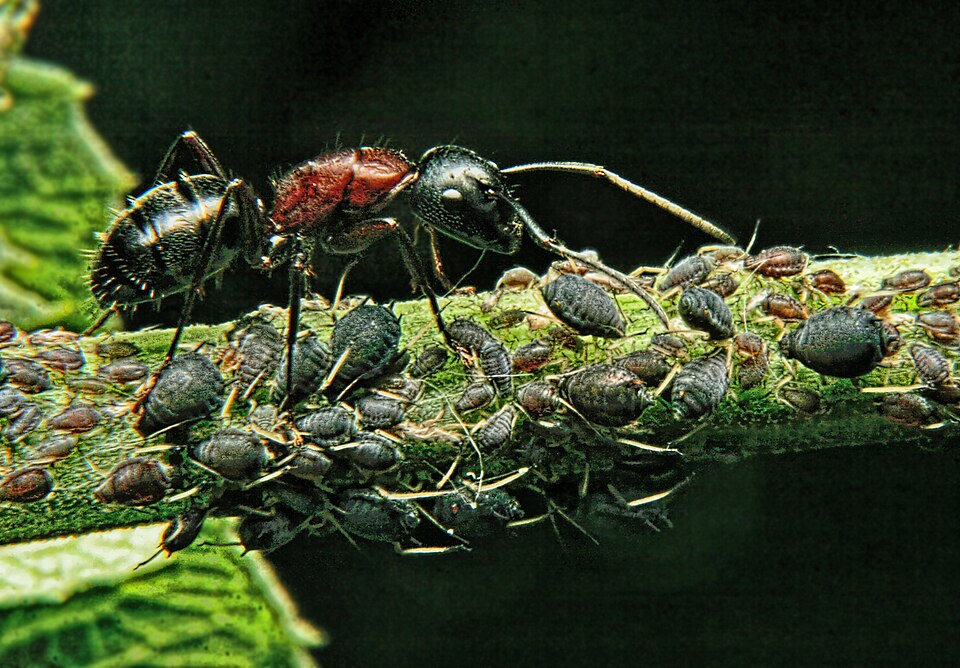
Ants are a species of insect that live together in large colonies. They are in the family Formicidae. it is an authentic animal for organisation.
Overview
Ants are a lot like bees and wasps. They all originate from the same common ancestor a long time ago, but now have evolved into very different forms. Ants are flightless compared to other members of the order Hymenoptera. It is believed that there are about 22,000 different species of ants, but scientists have only documented around 12,500 of them. Every species of ant has a thin middle segment, known as a thorax, as well as two long rods on their head called antennae.
Ants are social animals, and live in colonies that can range wildly in terms of size. Some species of ants live in small groups, and others work together in large groups of millions of ants. Ants are small, but they are very strong. Some ants are strong enough to carry things as heavy as 10 times their body weight.
Most species of ants are omnivores.
Colonies
The groups that ants live in are called colonies. A colony has a female ant called a queen which lays eggs for the colony. Those eggs will grow into more ants. Big colonies of ants have different kinds of ants that grow from the eggs. These are called different castes of ants. Some are workers which do jobs like carrying and digging, and soldiers which fight other animals. Worker and soldier ants are females. Another type of ant are drones which are male ants.
Really big ant colonies are sometimes called superorganisms. This means the ants work together so well that they are like little parts of one big animal. Ants cannot live by themselves for very long because they need to work with other ants.
Ants have colonies almost everywhere on planet Earth. Antarctica lacks ants because it’s very cold and there’s not much food. Small islands may not have ants.
Evolution
The family Formicidae belongs to the order Hymenoptera, which also includes bees, sawflies and wasps. Ants evolved from a lineage within the vespoid wasps. Phylogenetic analysis suggests that ants arose in the Lower Cretaceous period about 110 to 130 million years ago, or even earlier. One estimate from DNA studies places the origin of ants at ≈140 million years ago (mya). Another study puts it in the Jurassic at 185 ± 36 mya (95% confidence limits).
After the rise of flowering plants about 100 million years ago ants diversified. They became ecologically dominant about 60 million years ago.
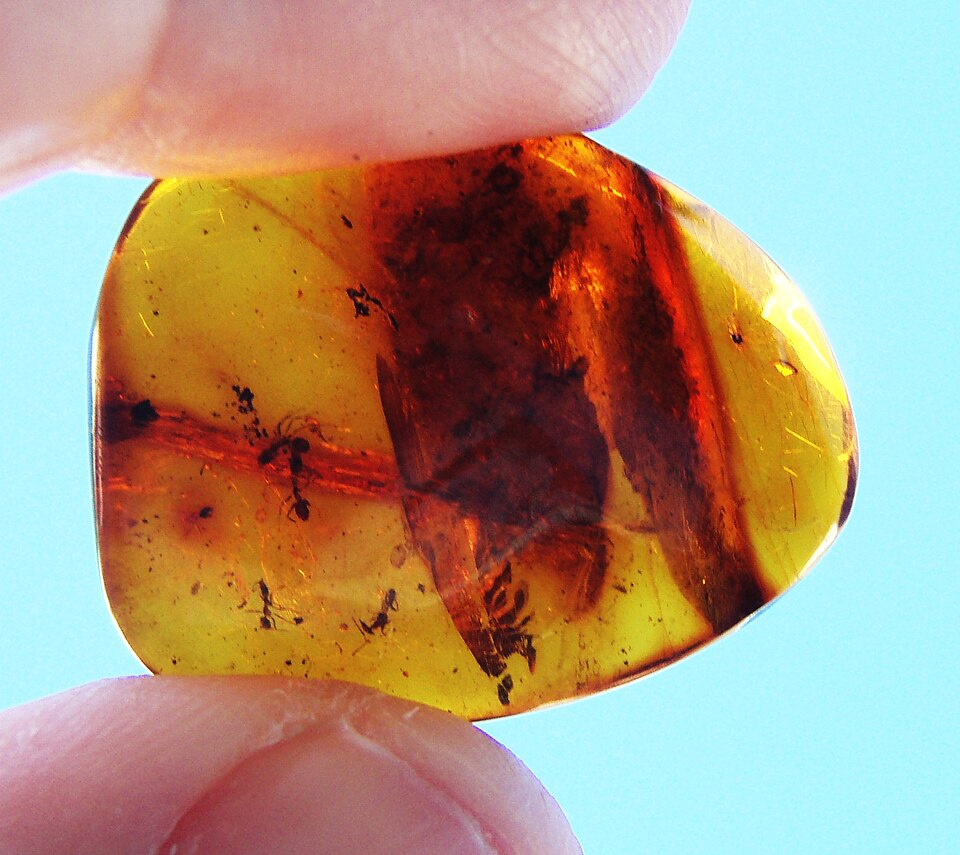
In 1966, E.O. Wilson and his colleagues identified the fossil remains of an ant (Sphecomyrma freyi) from the Cretaceous period. The specimen, trapped in amber dating back to more than 80 million years ago, has features of both ants and wasps. Sphecomyrma was probably a ground forager but some suggest that primitive ants were likely to have been predators underneath the surface of the soil.
During the Cretaceous period, a few species of primitive ants ranged widely on the Laurasian super-continent (the northern hemisphere). They were scarce in comparison to other insects, representing about 1% of the insect population. Ants became dominant after adaptive radiation at the beginning of the Cainozoic. By the Oligocene and Miocene ants had come to represent 20-40% of all insects found in major fossil deposits. Of the species that lived in the Eocene epoch, approximately one in ten genera survive to the present. Genera surviving today comprise 56% of the genera in Baltic amber fossils (early Oligocene), and 92% of the genera in Dominican amber fossils (apparently early Miocene). p23
Termites, though sometimes called white ants, are not ants and belong to the order Isoptera. Termites are actually more closely related to cockroaches and mantids. Termites are eusocial but differ greatly in the genetics of reproduction. The similar social structure is attributed to convergent evolution. Velvet ants look like large ants, but are wingless female wasps.
Development and reproduction
The life of an ant starts from an egg. If the egg is fertilised, the progeny will be female (diploid); if not, it will be male. Ants develop by complete metamorphosis with the larval stages passing through a pupal stage before emerging as an adult. The larva is fed and cared for by workers. Food is given to the larvae by trophallaxis, a process in which an ant regurgitates liquid food held in its crop. This is also how adults share food, stored in the ‘social stomach’, among themselves. Larvae may also be given solid food brought back by foraging workers, and may even be taken to captured prey in some species. The larvae grow through a series of moults and enter the pupal stage.
The differentiation into queens and workers (which are both female), and different castes of workers, is influenced in some species by the food the larvae get. Genetic influences, and the control of gene expression by the feeding are complex. The determination of caste is a major subject of research. p351, 372
A new worker spends the first few days of its adult life caring for the queen and young. It then does digging and other nest work, and later, defends the nest and forages. These changes are sometimes fairly sudden, and define what are called temporal castes. An explanation for the sequence is suggested by the high casualties involved in foraging, making it an acceptable risk only for ants that are older and are likely to die soon of natural causes.
Mating
Most ant species have a system in which only the queen and breeding females can mate. Contrary to popular belief, some ant nests have multiple queens (polygyny). The life history of Harpegnathos saltator is exceptional among ants because both queens and some workers reproduce sexually.
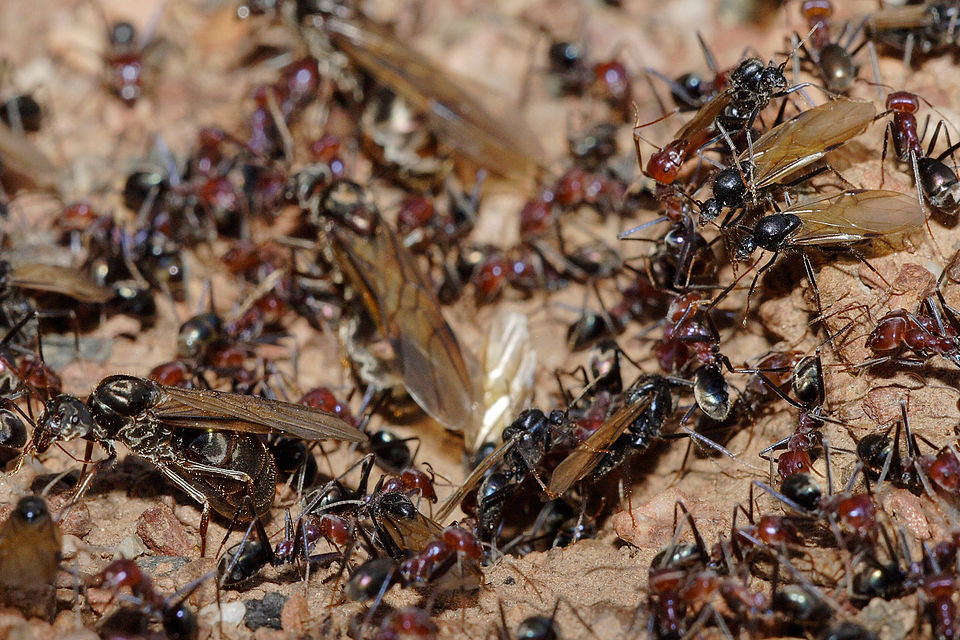
The winged male ants, called drones, emerge from pupae with the breeding females (although some species, like army ants, have wingless queens), and do nothing in life except eat and mate.
Nuptial flight
Most ants produce a new generation each year. During the species specific breeding period, new reproductives, winged males and females leave the colony in what is called a nuptial flight.
Typically, the males take flight before the females. Males then use visual cues to find a common mating ground, for example, a landmark such as a pine tree to which other males in the area converge. Males secrete a mating pheromone that females follow. Females of some species mate with just one male, but in some others they may mate with anywhere from one to ten or more different males. Mated females then seek a suitable place to begin a colony. There, they break off their wings and begin to lay and care for eggs. The females store the sperm they obtain during their nuptial flight to selectively fertilise future eggs.
The first workers to hatch are weak and smaller than later workers, but they begin to serve the colony immediately. They enlarge the nest, forage for food and care for the other eggs. This is how new colonies start in most species. Species that have multiple queens may have a queen leaving the nest along with some workers to found a colony at a new site, p143 a process akin to swarming in honeybees.
A wide range of reproductive strategies have been noted in ant species. Females of many species are known to be capable of reproducing asexually through parthenogenesis, and one species, Mycocepurus smithii is known to be all-female.
Ant colonies can be long-lived. The queens can live for up to 30 years, and workers live from 1 to 3 years. Males, however, are more transitory, and survive only a few weeks. Ant queens are estimated to live 100 times longer than solitary insects of a similar size.
Ants are active all year long in the tropics but, in cooler regions, survive the winter in a state of dormancy or inactivity. The forms of inactivity are varied and some temperate species have larvae going into the inactive state (diapause), while in others, the adults alone pass the winter in a state of reduced activity.
Uses
It may seem strange that ants have uses, but there are some. Some people use ants for food, medicine and rituals. Some species of ants are used for pest control (they eat pests that destroy food for humans). They can damage crops and enter buildings, though. Some species, like the red imported fire ant, live in places where they came to by complete accident.
Written for younger readers
Ant, in simpler words
This version comes from Wikijunior, a set of books written for children aged 8 to 11. It is shorter and uses plainer language than the article above.
From Wikijunior: Bugs
Even though ants can look like small moving dots if you’re standing, when looking closely at an ant, you can see that it has antennae which are curved to look a lot like our own elbows. Ants also have small sharp claws that help them keep hold of things while moving around on objects such as trees.
Ants live in little “cities” called ant colonies. Ant colonies are found in many places: under stones, within living or dead wood, and even underground. More advanced ant species are great builders and create many chambers that are used for different reasons. A chamber may be used as a nursery or to store food. When ant colonies are underground they are often covered with piles of dirt, sand, clay, or pine needles. These piles are called ant hills. Ant hills are used as entrances to the colony and as protection of the colony. Some ant hills are small but others can grow as tall as 3 feet!
Counting on what type of species or role in its ant colony, ants eat many different types of food. Species like the meat-eater ant eat mainly meat like remains of dead animals, but also can eat other foods including honey. Some other ant species, such as leafcutter ants actually “grow” their own food. They do this by collecting leaves and cutting them into pieces on which a type of fungus grows. The ants then harvest and eat this fungus.
Most ants work as a group to defend themselves. Whole colonies working together are sometimes called superorganisms, as the colony can act much like one large whole organism instead of the hundreds of tiny bugs that they really are. Another ant defense system is that some species of ant have venom which they could use for defense. This is also a reason why one particular species of ant is called a ‘killer ant’, even though these ant don’t kill but can cause some damage to their victim.
Ants go through a type of metamorphosis called holometabolism which is a type of metamorphosis that includes a total of four stages. The ant begins life as an egg laid by the only reproducing female ant in an ant colony, called a queen ant. After the egg hatches, it is in its baby stage which is called the larval stage. After a while, the ant larvae goes into a stage in which it cannot move, and is also gaining its adult features; this stage is called the pupal stage. Finally after a few weeks, the pupal casing the young ant was enclosed in is broken and the fully-adult ant comes out.
Most ants live up to 6 to 10 weeks with the exception of some queen ants which may live up to 15 years and some worker ants which may live up to 7 years.
Unlike many other animals, ants use smell instead of noises to talk to each other. Ants use a type of chemical called pheromones that leave a scent to help ants communicate, as well as figure out where each member of the colony is or was last located at. Ants also use their elbow-shaped antennae to smell, as they don’t have nostrils like humans have.
Ants can either help get rid of pests or be the pest itself. Ants can eat smaller insects that can be pests to a human’s backyard or garden, but ants can also be pests as they can destroy some gardens. One species of ant known as the carpenter ant is sometimes a pest to humans, because they eat wood. One kind of ant, the red imported fire ant, which is common in the southern United States, can deliver a very painful bite.
People in some parts of the world eat ants as food! Countries known for having dishes with ants on the menu include Mexico, Colombia and Thailand.
Where this page comes from
The article above is adapted from “Ant” on Simple English Wikipedia, by its contributors. We removed reference markers, navigation boxes and tables, expanded measurement templates into readable numbers, and kept the prose otherwise intact. The simpler version is adapted from Wikijunior on Wikibooks.
Both sources are published under CC BY-SA 4.0, so this page is published under the same licence. You may share and adapt it, including commercially, as long as you credit the original and keep the same licence.
Worksheets, answer keys and printable layouts elsewhere on K5Print are our own work and are not covered by this licence.