Aphid
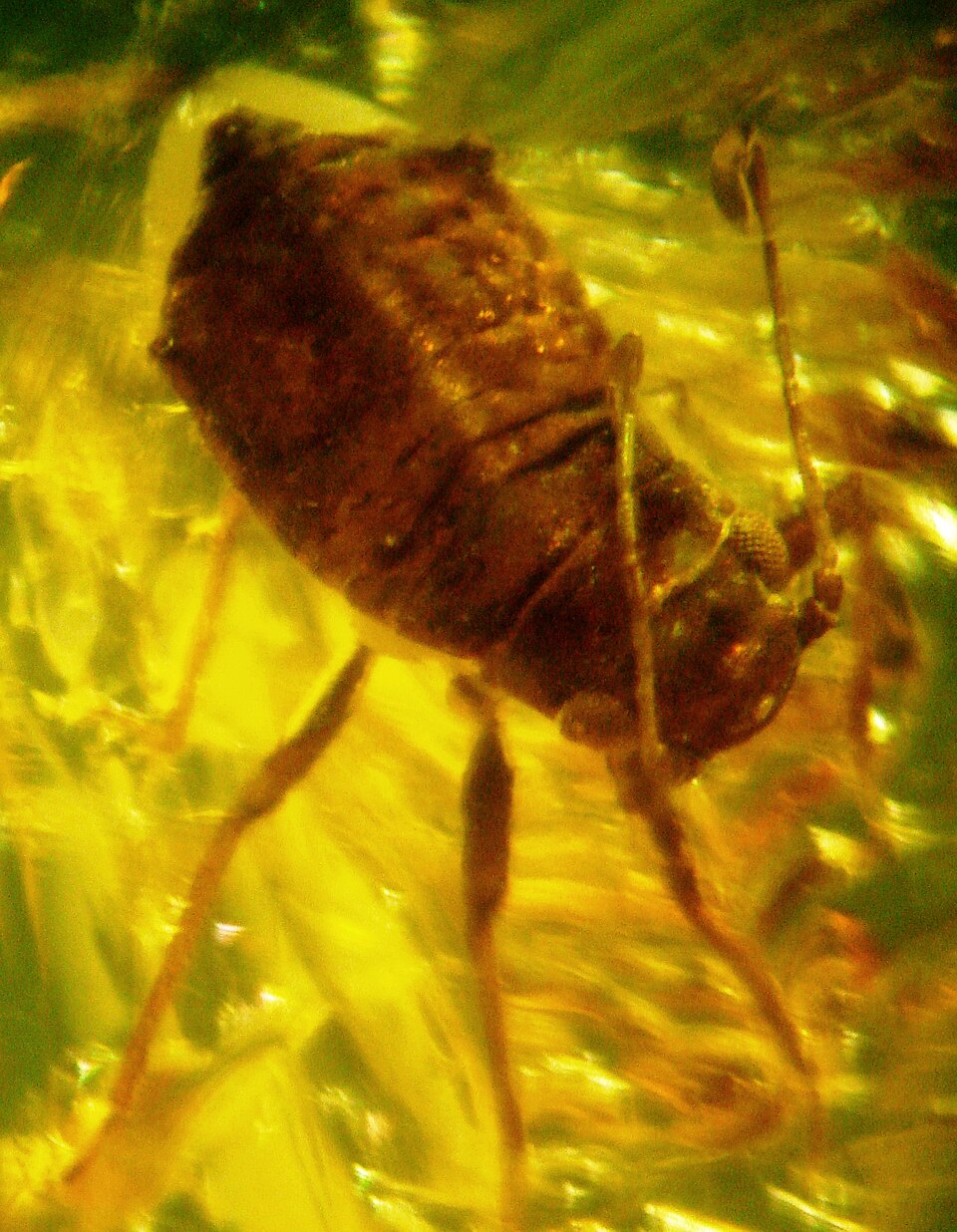

Fast facts
- Phylum
- Arthropoda
Scientific name
- Scientific name
- Aphidoidea
- Kingdom
- Animalia
- Phylum
- Arthropoda
- Class
- Insecta
- Order
- Hemiptera
How to say it in other languages
- Chinese
- 蚜蟲總科
- Dutch
- Bladluizen
- French
- Pucerons
- German
- Blattläuse
- Italian
- Afidi
- Japanese
- アブラムシ上科
- Portuguese
- Afídios
- Russian
- Тли
- Spanish
- Áfidos
Facts from Wikipedia’s “Aphid” page and Wikispecies (CC BY-SA 4.0).
Aphids are small bugs which feed on plants. Aphids cause more plant damage than any other insects. There are over 4,000 different species of aphid.
About 250 species are serious pests for agriculture and forestry as well as an annoyance for gardeners. They vary in size from 1-10 mm long.
Important natural enemies include the predatory lady beetles (Coleoptera: Coccinellidae), hoverfly larvae, lacewings (Neuroptera), larvae of the aphid midge Aphidoletes aphidimyza, crab spiders, and insect-eating fungi like Lecanicillium lecanii. Aphids are the main food source for ladybugs.
Aphids are found many places on earth. Aphids are most common in temperate zones. Aphids can travel far in the air. For example, the lettuce aphid spread from New Zealand to Tasmania. They have also been spread by human transportation of infested plant materials.
Written for younger readers
Aphid, in simpler words
This version comes from Wikijunior, a set of books written for children aged 8 to 11. It is shorter and uses plainer language than the article above.
From Wikijunior: Bugs
Aphids (Ay-fids) are small, pear-shaped insects with small heads and long antennae. Their length ranges from 1/16 inch to 3/8 inch. Some adults have wings, while others do not. The color of their soft bodies may green, yellow, brown, red or black. Some are even pink or lavender. The color depends on the species and the kinds of plants they eat.
Their long, slender mouthparts are adapted for piercing plant parts. A pair of wax-secreting cornicles (little horns) project from the back of the abdomen. Cornicles are a unique feature that distinguishes aphids from other insects. The secretions cause the body surface of some aphid species to appear waxy or woolly.
Green Apple Aphids are relatively small, growing to a length of about 1/8 inch. In spring and summer they are bright green. Their heads are sometimes yellowish and their legs are dark. Rosy Apple Aphids are between 1/16 inch and 1/8 inch in length. They have a wingless form that is rosy brown to purplish in color. The winged form is brownish to brownish-green. Both wingless and winged forms are often covered with whitish powder.
Rose, Pea, and Potato Aphids grow to about 1/8 inch long. They are pear-shaped with light to medium green or pink coloring. They have a darker green or pink midline stripe or have green and pink patches.
Root Aphids are about 1/8 inch long. Their wingless form is checkered yellow and dark colors. Their winged form is usually black. Both wingless and winged Root Aphids are often covered with whitish dust.
Cloudy-winged Cottonwood Aphids also grow to about 1/8 inch in length. They are yellow-green, green-black or blackish-brown in color. Their wings have gray or white cloudlike patterns. The nymphs of this species are translucent amber in color.
Giant Willow Aphids can be up to ¼ inch long. They are brown with black spots. They have a covering of waxy white dust that makes them appear gray. The nymph stage is translucent amber.
Aphids are found almost everywhere. They are usually part of a large group known as a colony. The undersides of tender leaves on trees and shrubs provide a home for aphid colonies. Green Apple Aphids were introduced from Europe in Colonial times. Their habitat is in orchards throughout North America. Rosy Apple Aphids live wherever apple trees grow. Rose, Pea, and Potato Aphids live in crop fields, gardens, and meadows throughout the United States and Canada. Root Aphids are found in trees and on roots of plants, such as asters and goldenrod, that grow in meadows. They also live on crop plants such as alfalfa, wheat and beets.
Cloudy-winged Cottonwood Aphids are found in cottonwood and poplar groves. They range from Montana to New Mexico and west to California. Giant Willow Aphids live in willow groves. They usually live in large colonies near ground level. Rosy Apple Aphids live in orchards in the United States and Canada.
Almost every plant has one or more aphid species which occasionally feed on it. Aphids feed on the juices of plant stems, leaves, and flowers. Green Apple Aphids feed on the sap of apple or pear trees. Rosy Apple Aphids feed on juices of apples or plantains depending on the season. Cloudy-winged Cotonwood Aphids eat sap of poplar or cottonwood trees. Giant Willow Aphids feed on juices of willow trees.
After aphids feed on a plant, they produce sugary, sticky waste called. honeydew. The sugar in honeydew attracts other insects like yellow-jackets that feed on it.
Among aphid enemies are ladybug beetles, fire beetles, and parasitic wasps. Lacewing insects, nicknamed “aphid lions” or “aphid wolves” also feed on them.
Aphids secrete wax from their cornicles. The wax entangles mouthparts and legs of attackers. It may also protect aphids from moisture. Giant Willow Aphids raise their hind legs high above the abdomen and kick vigorously to deter their enemies.
Some ant species are attracted to the sweet, sap-like liquid secreted by aphids. It is called “honeydew” and is valuable to ants as glue for their nests. Ants protect aphid colonies and “milk” them for honeydew.
Camouflage protects some species. Male Green Apple Aphids are grayish yellow and females are dark green. They blend into their surroundings to avoid predators. In the fall, they lay pale green eggs on tree branches. Over winter the eggs turn shiny black to blend with twigs. They hatch when the leaves burst open in spring. The spring and summer color of the Green Apple Aphid is bright green like new foliage.
Aphids undergo simple metamorphosis. Females produce eggs without fertilization (Fur-till-I-zay-shun). The eggs hatch in spring and mature as wingless females. Generations of wingless females are born and mature. During this stage, there are no male aphids. In summer, a generation of winged females is born. In the fall, these produce wingless males and egg-laying females, which mate, and the cycle begins again.
Adult female aphids are capable of producing 40 to 60 offspring. Huge aphid colonies build rapidly. A mere dozen aphid “colonizers” can produce hundreds to thousands of aphids on a plant in a few weeks.
Aphids remember where the first colony of their ancestors was born. When the last generation of winged females is born, it can find and return to the very plant where the first colony of wingless female eggs was hatched.
The huge colonies that aphids produce make them the most destructive of all plant eating insects. Rosy Apple Aphids ruin orchards. Their colonies cause tree leaves to curl and fruit to become gnarled and ripen early. Aphid colonies transmit viruses and spread plant diseases. American Lupin Aphids carry yellow mosaic and other viruses. Green Peach Aphids are known to transmit 150 different kinds of viruses.
Uncontrolled, aphids reproduce so rapidly that entire crops can be destroyed in a short period of time. People often try to find nonchemical ways to control them and make them useful. On mature trees in citrus orchards, aphids and the honeydew they produce attract beneficial insects. Some people like the taste of honeydew and include it as part of their diets. In the Near East the sweetness of honeydew is used in candy making.
Aphids produce honeydew which coats leaves and makes a sticky mess on leaves, outdoor furniture, and car windshields. It is generally harmless, but sometimes sooty mold will grow between leaves that are stuck together with honeydew.
Where this page comes from
The article above is adapted from “Aphid” on Simple English Wikipedia, by its contributors. We removed reference markers, navigation boxes and tables, expanded measurement templates into readable numbers, and kept the prose otherwise intact. The simpler version is adapted from Wikijunior on Wikibooks.
Both sources are published under CC BY-SA 4.0, so this page is published under the same licence. You may share and adapt it, including commercially, as long as you credit the original and keep the same licence.
Worksheets, answer keys and printable layouts elsewhere on K5Print are our own work and are not covered by this licence.