Arachnids Intro

Introduction
Arachnids are a group of creatures related to insects and centipedes – all three are in one large grouping called the arthropods. Arachnids are best known as spiders, but there also arachnids that aren’t spiders – like this vinegaroon (see right). Scorpions are also arachnids, and so are mites and ticks, which look like little spiders. There are 57,000 named Arachnid species. The best known arachnids are spiders, ticks, mites, scorpions and harvestmen. They owe their name to Arachne, a mythological Greek maiden who rashly challenged the goddess Athena to a weaving contest. Athena, jealous of the maiden’s ability, turned her into a spider. Arachne was condemned to spin and weave forever.
What do they look like?
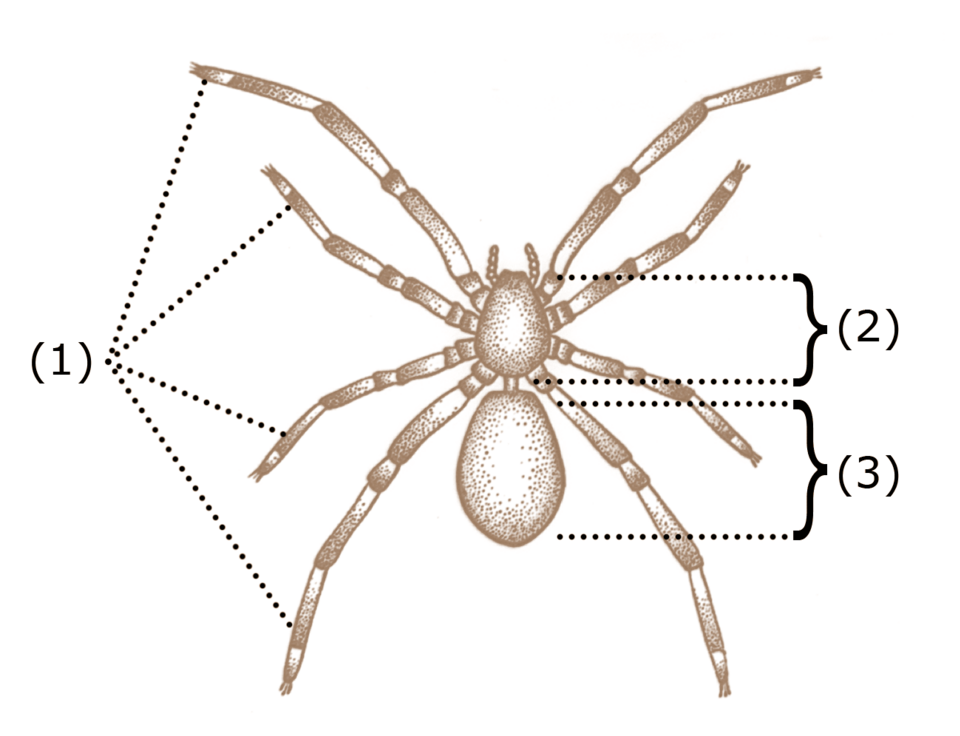
Arachnids, unlike insects, have no wings and four pairs of legs, instead of three. They have no feelers, or antennae. Arachnid bodies are divided into two main parts, the abdomen and what is called the cephalothorax (a head and thorax joined together). Insects, however, have three main body parts: the abdomen and separate heads and thoraxes.
Leggy insects like water striders might resemble spiders, and some bugs and beetles resemble ticks. But adult insects that have legs always have three—and only three—pairs of legs. All arachnids have four pairs of walking legs and several have two claw-like body parts called palps, that look like a fifth pair. Arachnids have a pair of jaws, which are called chelicerae, in front. Each of these has a movable fang often connected to a sac of poison. The next pair of appendages, pedipalps, may resemble legs but have one less segment. They are rarely used for walking. In scorpions, enlarged pedipalps form finger-and-thumb claws. The tiny pseudoscorpions (false scorpions) lack the scorpion’s tail and have miniature fangs on their claws.
Harvestmen might appear to not have separate cephalothoraxes and abdomens, but they actually do. The connection between them is just wide and hard to see, so it looks like their bodies are one big piece. Many harvestmen have extremely long, slender legs. They are often called “daddy longlegs”, but so are a type of spider, and also a type of fly.
Arachnids have between one and six pairs of simple eyes. Unlike most insects, they have no compound eyes – the big, multi-part eyes that flies have. Some breathe like insects by means of air tubes. Others have special breathing organs called book lungs. These are small bags in the abdomen, connected with the outside air by small openings. Each sac contains many layers of tissue, like the pages of a book. The air enters the sac and flows through the “pages”, sending oxygen to the blood.
Where do they live?
Arachnids are found throughout the world in nearly every habitat. They reach their greatest size and are most diverse in warm dry areas and tropical regions.
What stages of metamorphosis do they go through?
Arachnids usually lay eggs which hatch into immatures that resemble adults. Scorpions bear live young. Many arachnids show parental care by guarding their eggs from predators. Some carry their young around on their backs after they emerge from the egg sac.
How do they affect people?
Some arachnids cause harm to people, by inflicting poisonous bites or stings. Others suck blood of humans and animals. The sting at the end of a scorpion’s tail can be dangerous to human life. Several mite species are parasites, and some carry disease. But many arachnids, especially spiders and daddy longlegs, are helpful because they eat harmful insects.
Written for younger readers
Arachnids Intro, in simpler words
This version comes from Wikijunior, a set of books written for children aged 8 to 11. It is shorter and uses plainer language than the article above.
From Wikijunior: Bugs
Arachnids are a group of creatures related to insects and centipedes – all three are in one large grouping called the arthropods. Arachnids are best known as spiders, but there also arachnids that aren’t spiders – like this vinegaroon (see right). Scorpions are also arachnids, and so are mites and ticks, which look like little spiders. There are 57,000 named Arachnid species. The best known arachnids are spiders, ticks, mites, scorpions and harvestmen. They owe their name to Arachne, a mythological Greek maiden who rashly challenged the goddess Athena to a weaving contest. Athena, jealous of the maiden’s ability, turned her into a spider. Arachne was condemned to spin and weave forever.
Arachnids, unlike insects, have no wings and four pairs of legs, instead of three. They have no feelers, or antennae. Arachnid bodies are divided into two main parts, the abdomen and what is called the cephalothorax (a head and thorax joined together). Insects, however, have three main body parts: the abdomen and separate heads and thoraxes.
Leggy insects like water striders might resemble spiders, and some bugs and beetles resemble ticks. But adult insects that have legs always have three—and only three—pairs of legs. All arachnids have four pairs of walking legs and several have two claw-like body parts called palps, that look like a fifth pair. Arachnids have a pair of jaws, which are called chelicerae, in front. Each of these has a movable fang often connected to a sac of poison. The next pair of appendages, pedipalps, may resemble legs but have one less segment. They are rarely used for walking. In scorpions, enlarged pedipalps form finger-and-thumb claws. The tiny pseudoscorpions (false scorpions) lack the scorpion’s tail and have miniature fangs on their claws.
Harvestmen might appear to not have separate cephalothoraxes and abdomens, but they actually do. The connection between them is just wide and hard to see, so it looks like their bodies are one big piece. Many harvestmen have extremely long, slender legs. They are often called “daddy longlegs”, but so are a type of spider, and also a type of fly.
Arachnids have between one and six pairs of simple eyes. Unlike most insects, they have no compound eyes – the big, multi-part eyes that flies have. Some breathe like insects by means of air tubes. Others have special breathing organs called book lungs. These are small bags in the abdomen, connected with the outside air by small openings. Each sac contains many layers of tissue, like the pages of a book. The air enters the sac and flows through the “pages”, sending oxygen to the blood.
Arachnids are found throughout the world in nearly every habitat. They reach their greatest size and are most diverse in warm dry areas and tropical regions.
Arachnids usually lay eggs which hatch into immatures that resemble adults. Scorpions bear live young. Many arachnids show parental care by guarding their eggs from predators. Some carry their young around on their backs after they emerge from the egg sac.
Some arachnids cause harm to people, by inflicting poisonous bites or stings. Others suck blood of humans and animals. The sting at the end of a scorpion’s tail can be dangerous to human life. Several mite species are parasites, and some carry disease. But many arachnids, especially spiders and daddy longlegs, are helpful because they eat harmful insects.
Where this page comes from
The article above is adapted from “Arachnids Intro” on Simple English Wikipedia, by its contributors. We removed reference markers, navigation boxes and tables, expanded measurement templates into readable numbers, and kept the prose otherwise intact. The simpler version is adapted from Wikijunior on Wikibooks.
Both sources are published under CC BY-SA 4.0, so this page is published under the same licence. You may share and adapt it, including commercially, as long as you credit the original and keep the same licence.
Worksheets, answer keys and printable layouts elsewhere on K5Print are our own work and are not covered by this licence.