Archaea
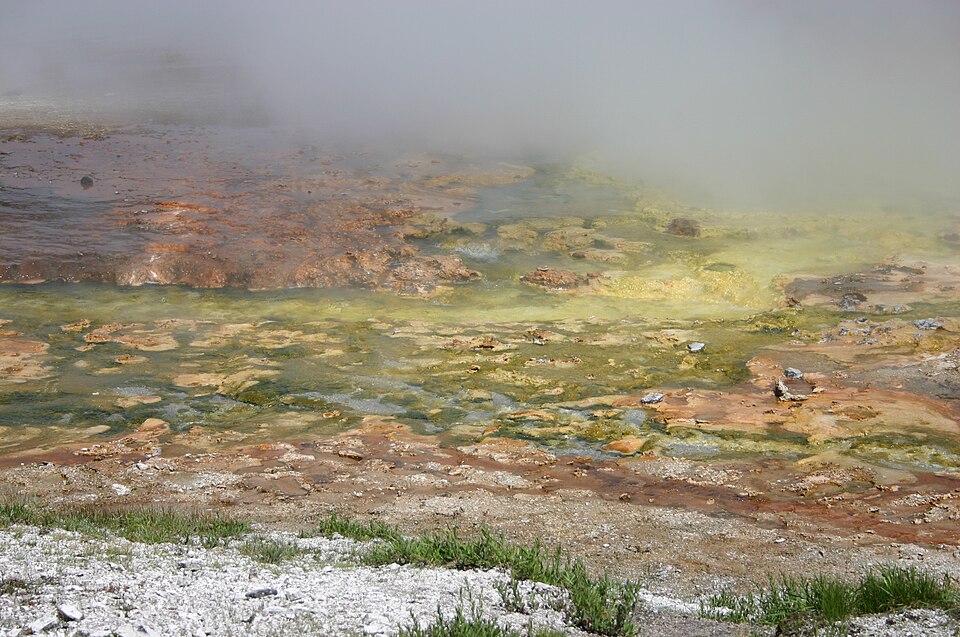

The Archaea (or Archea) are a group of single-celled organisms. The name comes from Greek αρχαία, “old ones”. They are a major division of living organisms.
Archaea are tiny, simple organisms. They were originally discovered in extreme environments (extremophiles), but are now thought to be common to more average conditions. Many can survive at very high (over 80 °f) or very low temperatures, or highly salty, acidic or alkaline water. Some have been found in geysers, black smokers, oil wells, and hot vents in the deep ocean. Recent research has found ammonia-eating archaea in soil and seawater.
In the past they had been classed with bacteria as prokaryotes (or Kingdom Monera) and named archaebacteria, but this is a mistake. The Archaea have an independent evolutionary history and show many differences in their biochemistry from other forms of life. They are now classified as a separate domain in the three-domain system. In this system, the three distinct branches of evolutionary descent are the Archaea, Bacteria and Eukaryota.
Archaea are, like bacteria, prokaryotes: single-celled organisms that do not have nuclei and cell organelles of the eukaryote type.
Comparison to other domains
The following table compares some major characteristics of the three domains, to illustrate their similarities and differences. Many of these characteristics are also discussed below.
= Interesting facts about archaea:
- No archaean species can do photosynthesis.
- Archaea only reproduce asexually.
- Archaea show high levels of horizontal gene transfer between lineages.
- Many archaea live in extreme environments.
- Unlike bacteria, no archaea produce spores.
- Archaea are common in the ocean, and especially in the plankton. They make up to 20% of all microbial cells in the ocean. p475
- Carl Woese discovered the Archaea in 1978.
Written for younger readers
Archaea, in simpler words
This version comes from Wikijunior, a set of books written for children aged 8 to 11. It is shorter and uses plainer language than the article above.
From Wikijunior: Biology
NOTOC
Archaea (Archaeon if there’s only one) are a kingdom of creatures made up of single cells. They have been on Earth for a long, long time - longer than plants, animals, or protists. Their name means “old” in Ancient Greek. They used to be grouped in with bacteria and called “archaeabacteria”, but they were later put into their own kingdom because they’re so different.
Like bacteria, archaea are tiny, microscopic creatures, far too small to be seen with just your eyes. They also have no nucleus, like bacteria as well. Unlike bacteria, however, archaea can live in super hot and super cold climates, and also can’t give you any nasty diseases.
Archaea can live inside of animals - some even inside of humans. Don’t worry though, they can’t hurt you. Many archaea live inside your intestines, feeding on matter your body can’t process. Sometimes, this can even help with digestion! Some other animals use archaea inside them in other ways, too; for example, archaea living inside of termites help them process the wood they chew through.
Where this page comes from
The article above is adapted from “Archaea” on Simple English Wikipedia, by its contributors. We removed reference markers, navigation boxes and tables, expanded measurement templates into readable numbers, and kept the prose otherwise intact. The simpler version is adapted from Wikijunior on Wikibooks.
Both sources are published under CC BY-SA 4.0, so this page is published under the same licence. You may share and adapt it, including commercially, as long as you credit the original and keep the same licence.
Worksheets, answer keys and printable layouts elsewhere on K5Print are our own work and are not covered by this licence.