Armadillo

Fast facts
- Phylum
- Chordata
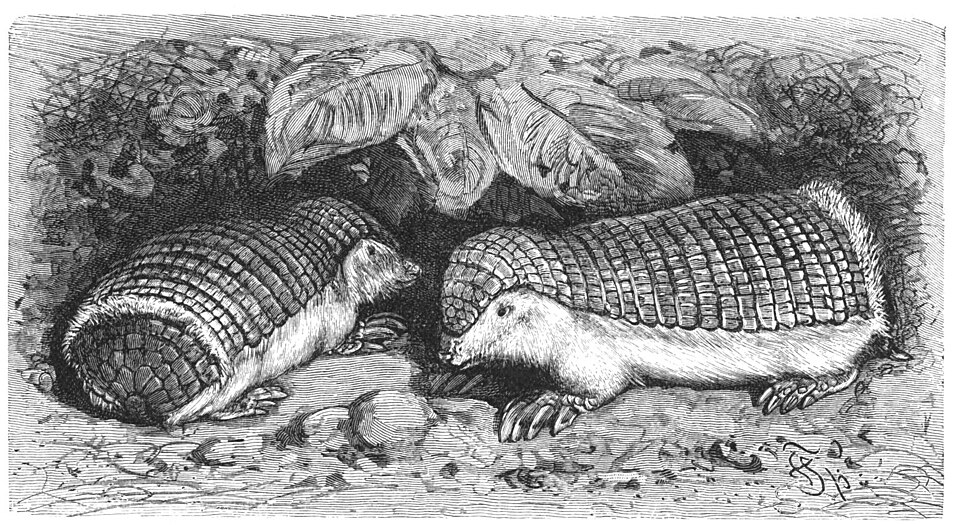
An armadillo is in the Cingulata, an order of New World placental mammals. The living ones have a leathery armored shell. The word armadillo is Spanish for “little armored one”.
There are about 10 living genera and about 20 species of armadillo. Their average length is about 75 centimeters (30 in), including the tail. The giant armadillo grows up to 100 cm (39 in) and weigh 30 kg (66lbs). All species live in the Americas. Most of the 20 species are found in open areas, such as grasslands, but some also live in forests.
Armadillos species are mostly found in South and Central America, especially around Paraguay. Many species are endangered.
Embryology
The nine-banded armadillo has an unusual reproductive system, in which genetically identical quadruplets are born in each litter.
Because they are always genetically identical clones, the group of four young is a good subject for scientific, behavioural or medical tests. They provide the same biological and genetic makeup, and then get different treatment. This is the only regular case of ‘polyembryony’ in the class Mammalia, where one fertilised egg splits into four embryos. It only happens in the genus Dasypus, and not in all armadillos. Other animals which have this reproductive method are parasitoid wasps, certain flatworms and various aquatic invertebrates.
Classification
Order CINGULATA
- †Family Pampatheriidae: giant armadillos
- †Family Glyptodontidae: glyptodonts
- Family Dasypodidae: armadillos
- Subfamily Dasypodinae
- Subfamily Tolypeutinae † indicates extinct taxon
Where this page comes from
The article above is adapted from “Armadillo” on Simple English Wikipedia, by its contributors. We removed reference markers, navigation boxes and tables, expanded measurement templates into readable numbers, and kept the prose otherwise intact.
Both sources are published under CC BY-SA 4.0, so this page is published under the same licence. You may share and adapt it, including commercially, as long as you credit the original and keep the same licence.
Worksheets, answer keys and printable layouts elsewhere on K5Print are our own work and are not covered by this licence.