Bear

Scientific name
- Scientific name
- Ursidae
- Kingdom
- Animalia
- Phylum
- Chordata
- Class
- Mammalia
- Order
- Carnivora
- Family
- Ursidae
How to say it in other languages
- Arabic
- دب
- Chinese
- 熊科
- Dutch
- Beer
- French
- Ursidés
- German
- Bär
- Hindi
- भालू
- Italian
- Orso
- Japanese
- クマ科
- Portuguese
- Ursídeos/Ursos
- Russian
- Медвежьи
- Spanish
- Oso
Facts from Wikipedia’s “Bear” page and Wikispecies (CC BY-SA 4.0).
Bears (singular: bear) are a group of large mammals found all over the world in many different habitats. They form the family Ursidae, in the suborder Caniformia of the order Carnivora. There are 8 living bear species.
- Family Ursidae: Bears
- Giant panda, Ailuropoda melanoleuca
- Spectacled bear, Tremarctos ornatus
- Brown bear, Ursus arctos
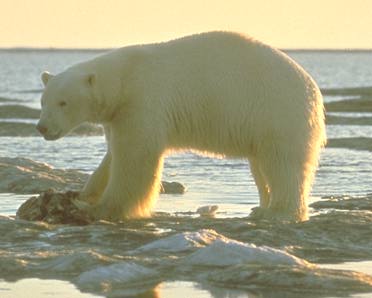
- Polar bear, Ursus maritimus
- American black bear, Ursus americanus
- Moon bear, Ursus thibetanus or Selenarctos thibetanus
- Sloth bear, Melursus ursinus
- Sun bear, Ursus malayanus
Appearance
Bears usually have a big body with short and thick legs. They have a broad head and a very short tail. They have small eyes and round ears. They usually have longer, shaggy fur. On each foot they have five claws, which they cannot pull back. They use their claws for digging, climbing, and hunting. They can stand up on their back legs and their front paws are flexible. Usually bears can climb and swim very well. Males are usually bigger than females. Most bears except the giant panda are only one color. Most bears are russet, brown, or black.
Bears do not have good hearing. They have powerful senses of smell and sight. They have good sight and can see colors, which is different from other carnivores. Bears mostly use their sense of smell to know what is around them. They can smell better than dogs. Bears also have good memory, which lets them remember where they can find food.
Life
They are mostly active at night, except for the Polar Bear. Some bears hibernate, meaning they sleep during the winter to save energy.
Bears are usually omnivorous, which means that they eat plants and meat. They eat berries, grass, and fish. One type of fish is a salmon. An exception is the polar bear, which eats mostly meat.
Bears usually live alone, except when they are mating season or if they have cubs. The father does not raise the cubs. The mother raises the cubs for months or a few years depending on how much food there is. The mother protects her young, even at the cost of her life.
Distribution
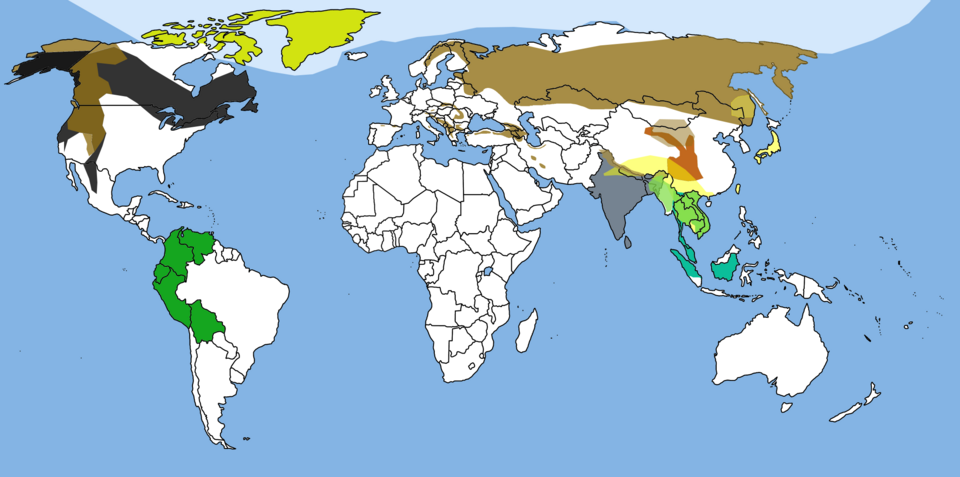
Bears live all over the world, mostly in the Northern hemisphere. They are found in North America, South America, Europe, and Asia. There used to be bears in northern Africa but they are now extinct.
In popular culture
Some fictional bears in popular culture include Yogi Bear, The Berenstain Bears, and Winnie the Pooh.
Teddy bears are popular plush toys that look like a bear. Teddy bears were named after 26th president of the United States Theodore Roosevelt.
Written for younger readers
Bear, in simpler words
This version comes from Wikijunior, a set of books written for children aged 8 to 11. It is shorter and uses plainer language than the article above.
From Wikijunior: Wild Animals
Bears are large animals that like to eat honey and scratch with their claws on trees.
Bears come in lots of colors, including: black, brown and cinnamon. Only black bears are currently found in the western part of the United States. Black bears vary greatly in size and weight. Adult bears vary in weight from 125 to 450 pounds or more and male bears are usually larger than females of the same age. When on all four legs, black bears measure about three feet high at the shoulders and when upright on their hind legs, they may approach five to six feet tall. Black bears are known to live up to 20 years of age in the wild. They are very agile, are good swimmers, climb trees very well, and can run at speeds of up to 35 mph.
Most conflict between humans and black bears arise as the result of human supplied foods. Things that attract bears are human food, human garbage, and pets. Some ways to keep a bear from attacking are: Keep your camp clean, never leave human food, garbage or pet food around or unsecured, don’t cook in your camp or in sleeping area, leave all scented things away from sleeping areas and from bears, remove all scented clothes or articles before going to sleep.
Remain calm, don’t run, slowly back away. Make lots of noise. Stand up straight, don’t kneel or bend, wave everything possible. Don’t try to corner the bear. Back away from cubs, never go near them, or stand between a bear and it’s cub.
Bears are curious, intelligent and potentially dangerous animals, but undue fear of bears can endanger both bears and people. Many bears are killed each year by people who are afraid of them. Respecting bears and learning proper behavior in their territory will help so that if you encounter a bear, neither of you will suffer needlessly from the experience. Most bears tend to avoid people. In most cases, if you give a bear the opportunity to do the right thing, it will.
Where this page comes from
The article above is adapted from “Bear” on Simple English Wikipedia, by its contributors. We removed reference markers, navigation boxes and tables, expanded measurement templates into readable numbers, and kept the prose otherwise intact. The simpler version is adapted from Wikijunior on Wikibooks.
Both sources are published under CC BY-SA 4.0, so this page is published under the same licence. You may share and adapt it, including commercially, as long as you credit the original and keep the same licence.
Worksheets, answer keys and printable layouts elsewhere on K5Print are our own work and are not covered by this licence.