Bee


Scientific name
- Scientific name
- Anthophila
- Kingdom
- Animalia
- Phylum
- Arthropoda
- Class
- Insecta
- Order
- Lepidoptera
- Family
- Choreutidae
- Genus
- Anthophila
Facts from Wikipedia’s “Bee” page and Wikispecies (CC BY-SA 4.0).
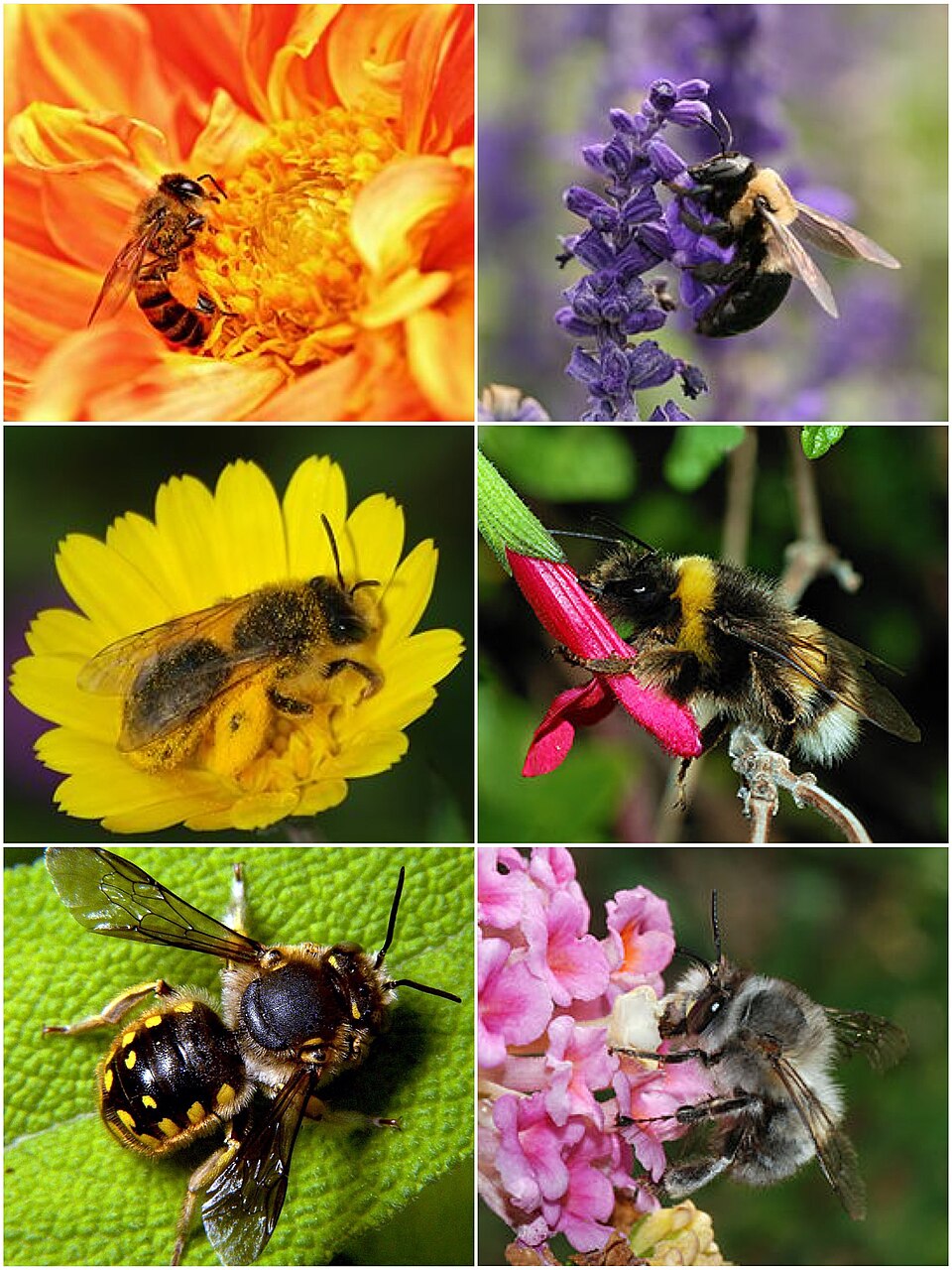
Bees are flying insects of the Hymenoptera, which also includes ants, wasps and sawflies. There are about 20,000 species of bees. Bees collect pollen from flowers. Bees can be found on all continents except Antarctica.
Bees fall into four groups:
- Honeybees, including the Africanized honeybee, are in the genus Apis. The group is first known from Europe, at the EoceneOligocene boundary.
- Bumblebees: 250 species in the Apidae family.
- Stingless bees: 550 species in the Meliponini.
- Solitary bees: solitary in the sense that every female is fertile, and usually lives in a nest she builds herself. There are quite a few of these, for example the carpenter bees, leafcutter bees and mason bees (and there are others).
The European honey bee (called Apis mellifera by biologists), is kept by humans for honey. Keeping bees to make honey is called beekeeping, or apiculture.
Evolution
Flowers were pollinated by insects such as beetles long before bees first appeared. Bees are different because they are specialized as pollination agents. Their body and behaviour make pollination easier. Bees are generally better at the task than other pollinating insects such as beetles, flies, butterflies and pollen wasps. The appearance of such floral specialists is believed to have driven the adaptive radiation of the angiosperms, and, in turn, the bees themselves.
Bees, like ants, evolved from wasps. The ancestors of bees were wasps in a family which preyed on other insects. The switch from insect prey to pollen may have come from the capture of prey insects that were covered with pollen when they were fed to the wasp larvae. Similar behaviour could be switched to pollen collection. This same evolutionary scenario has occurred within the vespoid wasps, where the group known as “pollen wasps” also evolved from predatory ancestors.
A recently reported bee fossil, of the genus Melittosphex, is considered “an extinct lineage of pollen-collecting Apoidea, sister-group to the modern bees”, and dates from the Lower Cretaceous (~100 mya). Features of its morphology place it clearly within the bees. It still has two ancestral traits of the legs which betray its origin. The issue is still under debate, and the phylogenetic relationships among bee families are poorly understood.
Bee bodies
Like other insects, the body of a bee can be divided into three parts: the head, thorax (the middle part), and abdomen (the back part). Also like other insects, bees have three pairs of legs and two pairs of wings. Many bees are hairy and have yellow and black or orange and black warning colours
Many bees have stings (like a hollow needle) on the rear of their bodies. If they get confused, angry, or scared they may sting, and inject venom, which hurts. Once a worker bee has stung someone the bee dies after a short while, but other types of bee and wasp can sting again. Some people are allergic to bee stings and may even die from them.
Social bees
Some bees are eusocial insects; this means they live in organized groups called colonies. Honey bees, the kind of bee used in beekeeping, are eusocial. The home of a bee colony is called a hive. One hive has only one queen.
There are three kinds of bees in a honey bee colony. A queen bee is the most important bee in the colony because she will lay the eggs. The queen bee only uses her stinger to sting other queen bees. The queen is usually the mother of the worker bees. She ate a special jelly called royal jelly from when she was young. Worker bees are females too, and they are the bees that collect pollen from flowers and will fight to protect the colony. Workers do a waggle dance to tell the others where they have found nectar; Karl von Frisch discovered this.
Drone bees (males) mate with the queen bee so that she can lay eggs. The only function of the male drone is to mate. They do no other work in the hive.
Haplodiploidy
In haplodiploid species, females develop from fertilized eggs and males from unfertilized eggs.
Because a male has only one copy of each gene, his daughters (which are diploid, with two copies of each gene) share 100% of his genes and 50% of their mother’s. Therefore, they share 75% of their genes with each other.
It is unclear whether this system is necessary for eusociality. Monogamy (queens mating singly) is the ancestral state for all eusocial species so far known, so it is likely that haplodiploidy contributed to the evolution of eusociality in bees.
Written for younger readers
Bee, in simpler words
This version comes from Wikijunior, a set of books written for children aged 8 to 11. It is shorter and uses plainer language than the article above.
From Wikijunior: Bugs
NOTOC
Bees are flying insects with two pairs of transparent wings. Many common species have colored stripes on their body. Honey bees are the most well-known kind of bee. They live in colonies and make honey. Honey bees have a hairy striped body. Each pair of a honey bee’s legs is designed for certain tasks like cleaning antennae, carrying pollen, or picking wax made by their body. The mouth is suited for chewing solid food like pollen and for lapping up liquids like nectar.
There are other families of bees, though. These other types of bees are different from honey bees in look, feeding, and nesting habits. There are bumble bees, mining bees, leaf cutter bees, mason bees, digger bees, carpenter bees and many others. These other types of bees are common but aren’t as familiar as honey bees.
All bees, wasps, hornets and ants belong to a common insect order Hymenoptera. All these insects have transparent wings and share a similar anatomy.
Many bee species are social, living in small communities. But some are solitary. Bees make their own nests using wax, propolis, plant parts, mud etc. The nests are often built in the open on trees and shrubs, in holes bored into wood, in underground tunnels, or in cracks and crevices in buildings. Bees can make their hives or nests in the open as well as in dark places. Nesting habits differ with species.
Honeybees are social insects and have large colonies. They live in hives made of wax and propolis which they make from plant resins and sap. Female worker bees secrete the wax they use (beeswax) from glands in their abdomen.
Most bees eat nectar and pollen as their primary food. Pollen is a source of protein that helps to build body parts and nectar is a carbohydrate source that provides energy.
In honey bees, there are queen, worker and drone bees. These different types of bees are called “castes.” The main food differs for each caste. The queen and the growing larva are fed with a liquid called royal jelly that is secreted by the worker bees. As a honey bee grows, its food changes from royal jelly to pollen and nectar. The adult workers feed mostly on nectar and pollen. Drones are fed with royal jelly, nectar and pollen. Honey bees convert nectar into honey and store it for times like winter when nectar and pollen are not available.
Female honey bees have stingers. Worker bees sting to defend the colony when they feel threatened. A bee’s stinger is in the last segment of its abdomen. In many species the bee dies after it stings. The stinger is connected to a venom gland. Worker bees have tiny barbs in the stinger like a harpoon. Because of these barbs, the stinger is ripped from the bee while stinging and the bee dies due to the injury. The stinger is left in the body of the victim. If the stinger is not removed, venom continues to be pumped into the wound by pulsing venom gland only if they are allergic to bees
The stinger left in the victim’s body is an alarm signal to the colony. Once it stings, it releases a chemical called pheromones. This attracts other bees in the colony to sting the victim. So when a person is stung by a bee, the stinger should be removed immediately to avoid more stings. Bee stings are painful, but quick removal of the stinger will reduce the pain and swelling. Some species are highly venomous and stings can be life threatening. For some people, even the sting from bee species that are not very venomous can cause allergic reactions. These allergic reactions can lead to intense pain or even death if not treated immediately.
Some species, like killer bees, are highly irritable. They have a reputation of attacking innocent passers-by. These bees are present in North and South America. It is a good idea not to go near a bee colony unless one is has a good knowledge of handling bees. Often it is difficult to tell the difference between killer bees and domesticated bees in the wild. Bee stings can be fatal if there are too many stings or if the species is highly venomous.
A few bee species that do not have stingers bite using the mandibles. Mandibles are mouth parts of the insect that are using for cutting and chewing.
Bees are advanced insects that have all the four stages of metamorphosis. A bee’s life cycle includes egg, larva, pupa and adult stages.
In most bees species the eggs hatch by the third day after laying or within a few days. During the larval stage growth rate is high and hence larvae are hungry and eat a lot. Adult bees take care of the larvae by feeding them. The larval stage lasts for a week or two, after which larvae enter the dormant pupal stage. The pupal stage lasts for anywhere from a week to a couple of weeks. Larvae and Pupae are housed in special cells prepared by adult bees made of wax, propolis or plant parts. Larvae do not forage on their own and require parental care to survive.
In a few primitive species of bees, the adults stuff the cells with reserve food and lay the egg in the cells. The emerging larvae feeds on the stored food till it enters pupal stage.
Each honey bee colony has different castes of bees that look different from each other. Each honey bee colony has a queen. The queen is the only female that can lay fertilized eggs. When the eggs hatch, they become larvae and can develop into an either a queen or worker. Queens are generally larger in size compared to other castes in the colony. There are also a few drones in the honey bee colony which are male bees which have only reproductive function. Drones mate with newly emerged queens. After mating the drones die.
The majority of bees in a honey bee colony are female worker bees. Usually, they cannot lay eggs unless the queen dies. The workers forage for pollen and nectar, and make nectar into honey and royal jelly. They feed the queen, drones and larvae. They also build, maintain and defend the hive.
A major activity of worker bees in a honeybee colony is preparation of honey. The worker bees lap up nectar (which is water like in consistency) from flowers and other plant parts. They store the nectar in their stomach until they return to their hive. In the bee’s stomach water is removed from the nectar to concentrate and thicken the nectar. Some digestive juices also mix with the nectar. When the bee returns to the hive, the concentrated nectar is regurgitated into special honey storing cells. The nectar becomes thicker by evaporation. The worker bees beat their wings to create an air flow in the hive. This is called fanning. When nectar in the cells reaches the required thickness it is called honey and the cells are sealed with wax by the bees.
Honey bees also collect and store pollen in special cells for reserve food.
Bees, like most insects, communicate using chemical signals called pheromones. In addition to this, honey bees also communicate by movement inside the hive. This is called bee dance. The communication by bee dance is symbolic and is thought to convey the direction and distance of a food source from the hive.
Honey is taken from honey bee colonies in the wild and from colonies that are reared in apiaries (bee farms). In addition to honey pollen, bee’s wax, propolis and royal jelly are major apiary products.
Bees are very important pollinators and improve productivity in crops. Many species are reared by farmers to enhance crop productivity by proper pollination.
As noted before bee stings can be extremely painful and can lead to health problems if they are not treated correctly.
Some species of leaf cutter bees and wood borer bees are household or garden pests that eat plant parts like leaves and flowers, or bore into wooden articles in the house hold.
Where this page comes from
The article above is adapted from “Bee” on Simple English Wikipedia, by its contributors. We removed reference markers, navigation boxes and tables, expanded measurement templates into readable numbers, and kept the prose otherwise intact. The simpler version is adapted from Wikijunior on Wikibooks.
Both sources are published under CC BY-SA 4.0, so this page is published under the same licence. You may share and adapt it, including commercially, as long as you credit the original and keep the same licence.
Worksheets, answer keys and printable layouts elsewhere on K5Print are our own work and are not covered by this licence.