Beetle

Fast facts
- Phylum
- Arthropoda
Scientific name
- Scientific name
- Coleoptera
- Kingdom
- Animalia
- Phylum
- Arthropoda
- Class
- Insecta
- Order
- Coleoptera
How to say it in other languages
- Chinese
- 鞘翅目
- Dutch
- Kevers
- French
- Coléoptères
- German
- Käfer
- Hindi
- कंचुकपक्ष
- Italian
- Coleotteri
- Japanese
- コウチュウ目 (鞘翅目)
- Korean
- 딱정벌레목 (초시목)
- Portuguese
- Coleópteros
- Russian
- Жесткокрылые
- Spanish
- Escarabajo
Facts from Wikipedia’s “Beetle” page and Wikispecies (CC BY-SA 4.0).
Beetles, the order Coleoptera, are the largest group of insects. There are 350,000 different species of beetles that have been named: about 40% of all known insects. There are an estimated 800,000 to a million living species. Beetles live almost everywhere, though not in the ocean or in places that are very cold, such as Antarctica.
Beetles went through a massive adaptive radiation early in their evolutionary history. The evolution of flowering plants helped drive the diversification of beetles. Four of the six biggest families of beetles mainly eat flowering plants.
Beetle bodies
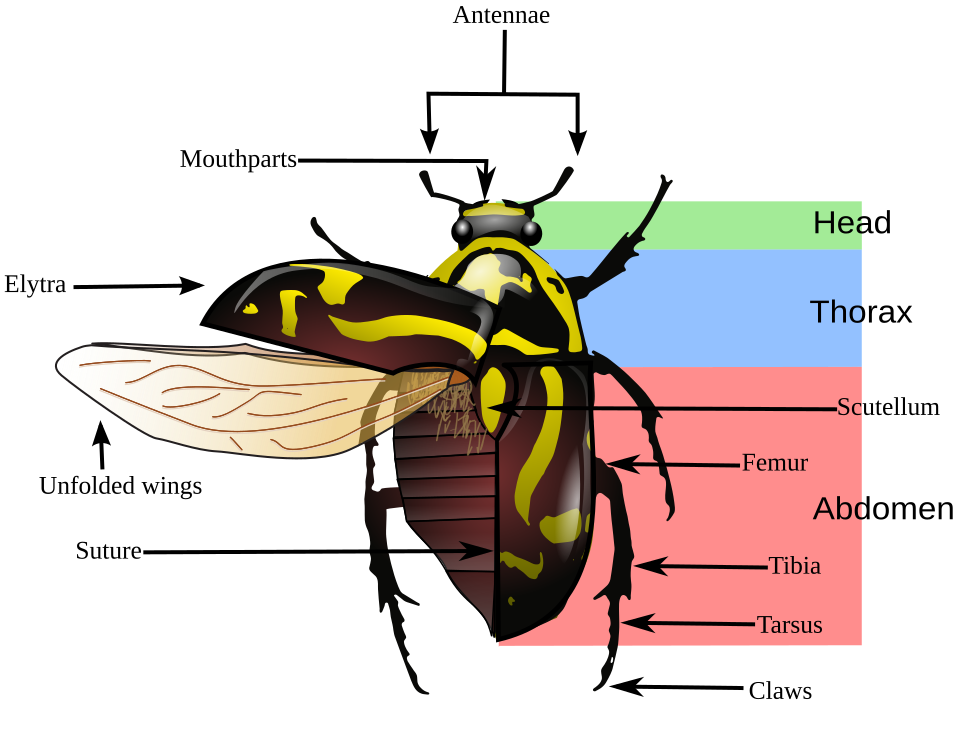
In common with other insects, there are three main parts to a beetle’s body: the head, the thorax (the middle part), and the abdomen (the back part). On the head, beetles have antennae (feelers), eyes, and a mouth. The legs and wings of the beetle are attached to the thorax. The abdomen of a beetle does not usually have special parts on the outside, but it has the beetle’s gut inside. Like other insects, beetles have no internal bones, but instead have a hard and shiny exoskeleton on the outside of the body. The exoskeleton is made of hard plates of chitin.
Wings
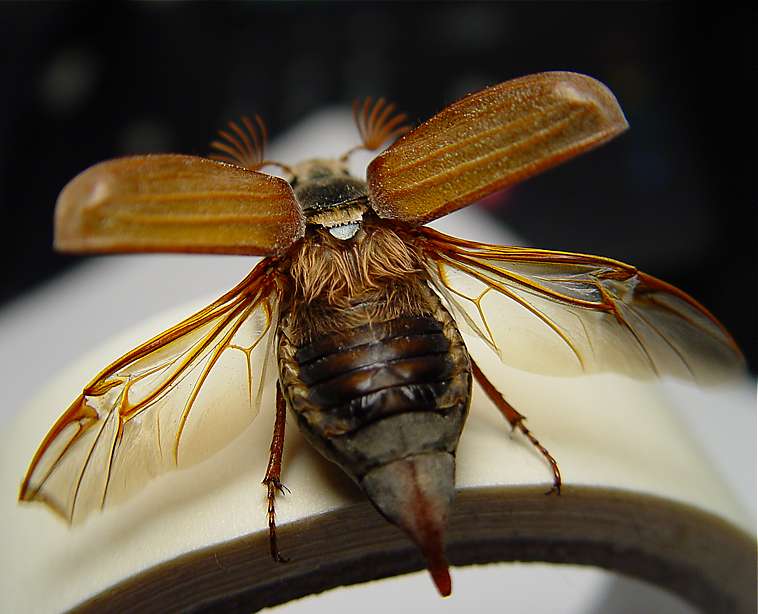
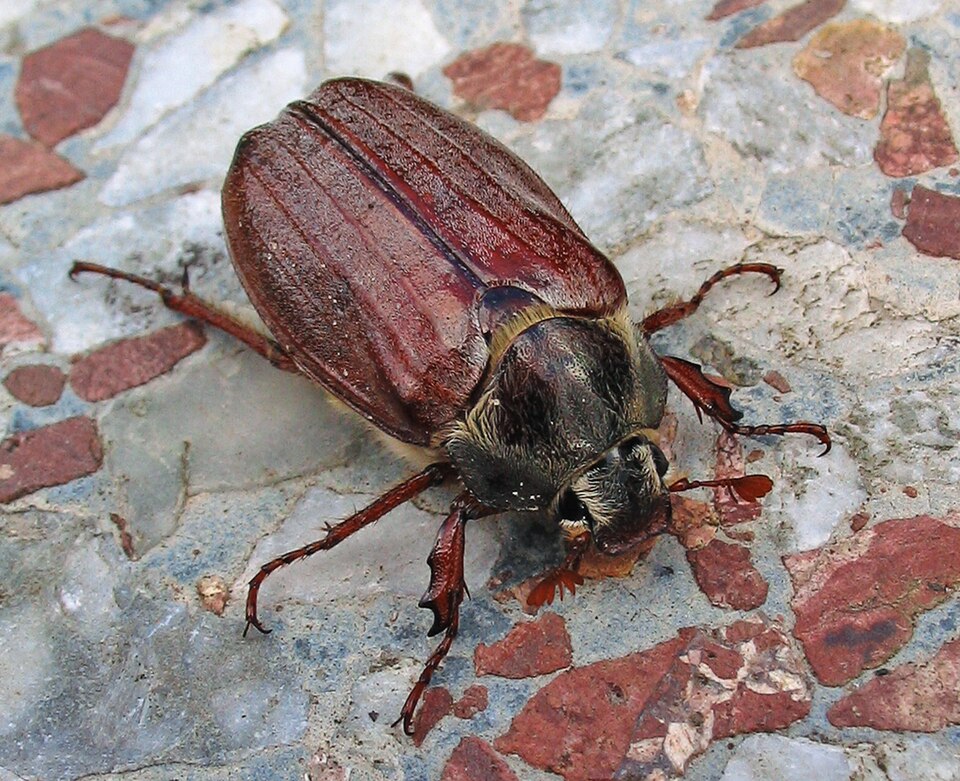
Beetles differ from other flying insects because their front wings have evolved into hard covers, or elytra. The back wings are used for flying. They are thin and are kept under the elytra when at rest. Beetles lift their elytra out of the way in order to fly. A few species of true bugs have a similar arrangement.
Not all beetles can fly. Some beetles do not have back wings, and some cannot lift their front wings out of the way. A few beetles have no wings at all. Some beetles with no wings look like larvae, and are called “larviform”. An example is the family Phengodidae, glow-worms where the females are larviform throughout their lives.
Legs
The legs of beetles help them to walk, run, swim, and dig. All beetles have six legs that is made out of several parts. Each leg ends in two to five small segments called tarsi. The last tarsus (the singular of tarsi) of each beetle “foot” has one or two claws on the end of it. Most beetles use their legs to walk or run. Some beetle legs are flat and have long hairs on them. These kinds of legs are found on water beetles. Beetles that often dig in soil have flat legs with spines or horns at the edges. Flat legs with horns are called fossorial legs. A few beetles have large hind legs, similar to those of grasshoppers, which help the beetle to jump. Flea beetles are an example of jumping beetle.
Sight and smell
Beetles have compound eyes, which means the two big shiny eyes on the head are actually made out of many smaller parts. Sometimes the two eyes are each divided in half and so it looks like there are four eyes. One beetle family, the whirligig beetles, has divided eyes so that when they are swimming, they can see on top of the water and under the water at the same time. A few beetles have extra simple eyes (usually two) called ocelli. The ocelli are on the top of the beetle’s head.
Beetles use their antennae to smell things. Beetles also use their antennae to feel things around them. Beetle antennae do not all look the same. Some antennae are long and thin, while others are short and wide. Thin antennae are called filiform antennae, and antennae that are wide on the end are called clavate antennae.
The mouth
The mouth of a beetle is very different from the mouth of a person. Most beetles have two hard mandibles at the front of their mouth, which are a bit like teeth. Mandibles help the beetle eat by crushing and cutting food. In some beetles, the mandibles look like big pincers. Beetles also have four “fingers” around their mouth that push food into the mouth of the beetle. The fingers are called “palpi.”
Other
Beetles do not breathe; insteadm they have holes called spiracles in the sides of their bodies which lead to trachea, which act like lungs. Beetles do not have blood, but they have something like blood, called haemolymph. It is a green colour because their haemoglobin molecule has a copper atom at its centre; humans’ haemogolobin molecule has an iron atom there.
How beetles grow
Beetles start out as eggs that a female beetle lays. Some beetles can lay thousands of eggs during their lives. A larva comes out when an egg hatches. Most beetle larvae do not look like adult beetles. A beetle larva eats and grows larger until it changes and becomes a pupa. When the pupa opens, an adult beetle, sometimes called an imago, comes out. This way of growing up is called complete metamorphosis.
Beetles eat the most when they are larvae. Some beetle larvae eat the outside of plants; some eat inside plants. Some beetle larvae are predators, which means they hunt for other insects to eat. Other beetle larvae eat dead things, such as dead plants and corpses.
Not all beetle larvae look the same. Some beetle larvae are flat and move very fast. Some beetle larvae look similar to worms with tiny legs. Click beetle larvae have a special name: wireworms. Other beetle larvae are short and very thick and are called grubs. In a few beetles, the larvae change their shape after some time. Blister beetle larvae start out moving fast, such as campodeiform larvae, but end up slow and thick.
Food
Beetles eat many different things including living plants, rotting plants, animals that may be dead or alive, and animal faeces. Some beetles can eat both plants and animals, while others eat just one type of food. Beetles that can only eat one kind of thing are said to be host specific. Many leaf beetles and longhorn beetles are host specific.
Protection
Beetles are tough animals for their size. They are mechanically tough (the elytra), and have a variety of strategies to avoid being attacked by predators or parasitoids. These include camouflage, mimicry, toxicity, and active defence.
Some beetles live in places that are hard for predators to find. Some beetles, such as longhorn beetles, live in tunnels inside tree branches. Only special predators that are small enough to use the long-horned beetle tunnels can eat the longhorn beetles.
Other beetles do not live in special places but they have colours or shapes that make them hard to find. When beetles have colours so that predators cannot see them, this is called camouflage. Some leaf beetles are green so that they can not be seen when they are on green leaves. Some beetles have very complex colours so that they look like bird droppings.
Sometimes beetles use colour to warn predators (warning colouration). Some beetles have black and yellow stripes so that they look similar to bees and wasps. Some beetles even behave similar to bees to confuse predators.
Beetles have a wide range of chemical defences, mostly got from plants their larvae eat. These chemicals make them taste bad when predators eat them. Blister beetles are so poisonous that if a horse eats only a few of them, it may die. Bombardier beetles squirt hot poisonous liquid at attackers. Lady beetles put out a cyanide compound when agitated. Lady beetles also have colours that warn predators that they taste bad. Insects that taste foul use warning colours, which birds learn to avoid. Also, other species that are tasty copy those warning colours. This is a type of mimicry, and is quite common in insects.
Very large beetles sometimes fight predators. Beetles that fight will often use their mandibles to injure their predators.
Reproduction
Beetles have sexual reproduction, and almost all go through complete metamorphosis. Some beetles have complex behavior to get a mate. Pheromones are used, and different species use different pheromones. Before reproduction, some male beetles sometimes fight to claim a female. This especially happens with stag beetles: males will fight using their long mandibles. More often, male and female beetle go through a long routine before mating. The details differ in each species and that is the point. It is essential that mating takes place between beetles of the same species.
Some beetles give special care to their eggs or larvae. Some scarab beetles, called dung beetles, roll balls of dung (faeces) and put them in a hole in the ground. The female lays her eggs in the dung. When the eggs hatch, the larvae will eat the dung that their mother supplied for them.
Beetle evolution
In 2009, a fossil beetle was found in the Pennsylvanian of Mazon Creek, Illinois. This put the origin of the beetles back to . Fossils from this time have been found in Asia and Europe, for instance in the red slate fossil beds of Niedermoschel near Mainz, Germany. Other fossils have been found in Obora, Czech Republic and Tshekarda in the Ural Mountains, Russia. The first discoveries from North America in Oklahoma were published in 2005 and 2008.
After the Permian–Triassic extinction event, the fossil record of insects is poor, but there are some beetles from the Lower Triassic. At the Babiy Kamen site in the Kuznetsk Basin, there are many beetle fossils, including entire specimens of the infraorders Archostemata (e.g. Ademosynidae, Schizocoleidae), Adephaga (e.g., Triaplidae, Trachypachidae) and Polyphaga (e.g. Hydrophilidae, Byrrhidae, Elateroidea).
During the Jurassic (), there was a dramatic increase in the number of beetle families, including the development and growth of carnivorous and herbivorous species. Dung beetles, and herbivorous beetles living on conifers, were common in the Jurassic period. The evolution of flowering plants in the Cretaceous led to the vast numbers of beetle species there are today.
Suborders
There are four living suborders of beetles:
- Adephaga: 40,000 recorded species in 10 families. This is a suborder of specialized beetles, the second largest suborder. Members include ground beetles, tiger beetles, predacious diving beetles, and whirligig beetles. The majority of the species belong to the family of carabids, or ground beetles (Carabidae).
- Archostemata is the smallest suborder of beetles, consisting of fewer than fifty known species in five families. Archostemata is an ancient lineage with a number of primitive characteristics. They are similar in morphology to the first beetles, which appear in the fossil record about 250 million years ago.
- Myxophaga is the second smallest suborder of Coleoptera with 65 species of small to minute beetles in four families. The members of this suborder are aquatic and semi-aquatic and feed on algae.
- Polyphaga is the largest and most diverse suborder of beetles. The name means “eaters of many things”. Polyphaga have 144 families in 16 superfamilies. They have an enormous variety of specialization and adaptation, with over 300,000 described species, or about 90% of the beetle species so far discovered and named. There are five infraorders:
- Bostrichiformia — including furniture beetles and skin beetles.
- Cucujiformia — includes lady beetles and longhorn beetles, weevils, checkered beetles and leaf beetles.
- Elateriformia — includes click beetles and fireflies
- Scarabaeiformia — includes scarab beetles and stag beetles.
- Staphyliniformia — includes rove beetles and water scavenger beetles.
Common families
Different kinds of beetles can be divided into groups called families. There are many beetle families. The biggest families are listed here.
- Ground beetles (family Carabidae) are often black and can be found under rocks. They eat other insects.
- Leaf beetles (family Chrysomelidae) usually eat on the outside of plants.
- Longhorn beetles (family Cerambycidae) have very long antennae. Most longhorn beetle larvae eat on the inside of plants.
- Weevils (family Curculionidae) have long faces that look like the trunk of an elephant. Weevils eat plants.
- Scarab beetles (family Scarabaeidae) have antennae that are wide on the end. Dung beetles are a group in this family. Other scarabs are very colourful and eat plants.
- Rove beetles (family Staphylinidae) have short front wings that do not cover their abdomen. Rove beetles eat other insects.
Popular names
Popular names are often misleading; that is why biologists use scientific names in Latin. People call some beetles by other names. Fireflies (also called lightning bugs) are actually beetles; so are ladybirds/ladybugs/lady beetles.
Largest and smallest
- Nanosella fungi: smallest at 0.35 mm.
- Titanus giganteus: largest at 12 to 20 cm in length.Evans, Arthur V. & Bellamy, Charles 2000. An inordinate fondness for beetles. University of California Press. ISBN 978-0-520-22323-3
Beetles and people
Some beetles cause trouble for farmers and people in forests because they eat crops or trees. These beetles are called pests. One beetle that hurts crops is the Colorado beetle; another is the Maize weevil. One that destroys trees is the Emerald ash borer.
Other beetles help people; lady beetles (also called ladybirds and ladybugs) eat insects that hurt crops and trees.
People who study beetles are called coleopterists.
Written for younger readers
Beetle, in simpler words
This version comes from Wikijunior, a set of books written for children aged 8 to 11. It is shorter and uses plainer language than the article above.
From Wikijunior: Bugs
Beetles come in all shapes and sizes. Some are very large. Some are smaller than a grain of rice. The Goliath Beetle can be 4 or 5 inches long. A Bark Beetle is about 1/4 inch long.
Beetles have a hard, flexible cover called an exoskeleton. They have a head, mid-section (thorax), and abdomen. Thin front plates (elytra) protect the back wings. Beetles have large compound eyes and chewing mouthparts. Antennae may be threadlike or clubbed. Their strong jaws are called mandibles. Beetle bodies can be rounded or long and thin. Most are dull shades of brown or black. Some are shiny with bright rainbow colors. Some have dots and stripes.
Bark Beetles are brownish-black. Some beetles have spots that glow in the dark. The Eyed Beetle has two big spots that look like eyes on its back. Click Beetles are mostly black; some have patterns.
Hercules Beetles are greenish-gray with black blotches. They are about 2 to 2-1/2 inches long. Males are called Unicorn Beetles because they have a horn on the front of the head.
Lady Beetles have oval, dome-shaped bodies. They have short legs and antennae. They are brightly colored. Most have red-orange wing coverings and black spots or stripes. Some are yellow, pink, or brown. Others are black with red, orange, or yellow spots. Some have no markings at all.
Tiger Beetles are brownish-black or green. Many have patterns and bright colors. They have long slender legs.
Beetles can be found all over the earth in all kinds of habitats. They live in dark, moist places under logs, rocks, and leaves. They like gardens, grain fields, ponds and lakes. They have not been found in the frozen areas at the North and South Poles. Most species live on plants. Many tunnel, burrow, or swim.
Bark Beetles live on leaves and flowers, under bark, and in rotting wood. They are sometimes found in firewood. They hide in dark crevices of buildings. Hercules Beetles are found in tropical jungles and rainforests. They are common in Central and South America, Mexico, and southeastern United States. They range as far north as southern Ohio and Indiana. They are found in fallen debris and leaf litter on the forest floor.
Ladybird Beetles are found all over the world in gardens, farm fields, and meadows. They live in grasslands, forests, near rivers, and in cities. Lady Beetles are the official state insect of Delaware, Massachusetts, New Hampshire, New York, Ohio, and Tennessee.
Stag Beetles live in wooded areas and on beaches. Tiger Beetles like bright sunlight and open shade. They are found on sandy beaches and along paths and lanes.
Beetles eat many things besides insects. Some beetles eat both plants and animals. Carnivorous beetles eat earthworms and snails.
A few beetles drink liquids from plants, trees, and fruits. Some can eat only one kind of plant. Bark Beetles eat the inner bark of trees like hickory, walnut, and Douglas fir. They destroy the tree’s food and water tubes that keep it alive.
Click Beetles feed on newly planted seeds. They eat the roots of vegetables, grains, and cotton. Their larvae feed on plants and vegetables.
Lady Beetles eat small insects like mealy bugs and mites. They are best known as aphid eaters. Some eat melons, potatoes, and beans.
Carrion Beetles eat dead animals. Clown Beetles eat the larvae of other insects. Diving Beatles eat tadpoles and other small water creatures.
Beetles have various defense strategies. They use camouflage to blend into their surroundings to hide from predators. They mimic the color and shape of other insects to deceive enemies. Some are poisonous. They have large many-faceted compound eyes to detect small movements. Wing coverings (elytra) make a hard shield to protect the soft body and wings.
Click Beetles use a special body part that clicks and flips the beetle over in the air. The sound startles the predator so the beetle can escape.
Male Hercules Beetles use their long horns to fight other males. Many Longhorn Beetles look like wasps, even though they are harmless. Stag Beetles rear back and open their jaws wide to scare predators. Sometimes they play dead.
Ladybird Beetles fall to the ground and play dead. Their bright colors warn predators away. They secrete a bad tasting fluid from their leg joints. They cluster together in large numbers for protection when they hibernate. The cluster gives off a strong smell to repel predators.
Beetles undergo complete metamorphosis with 4 separate life stages: egg, larva (feeding stage), pupa (resting stage), and adult. Beetles mate in spring or summer. Females lay eggs in protected areas near a food source or inside a ball of food. Some beetles feed their young.
When the larvae hatch from the eggs they are wingless. Later, they enter the pupa or resting stage. Many spend the winter in the pupa stage. They change to adults during the pupa stage. They live about one year after becoming adults.
Ladybird Beetles complete their life cycle in about a month, depending on the weather. Some Lady Beetles live 2 or 3 years.
Bark Beetles chew under the bark to make tubes called galleries. They lay eggs along the sides of the galleries. When the eggs hatch, the larvae bore into the wood to make the galleries bigger. When it is full grown, the adult Bark Beetle bores a hole in the bark to emerge from the tree.
Scarab Beetles push or roll balls of dung to their brood sites. It is thought that this behavior inspired the design in Egyptian art showing the Scarab Beetle pushing the sun across the sky.
Although most beetles have a hard time righting themselves when turned upside down, the Click Beetle does not. It has a special part on the underside of its body to flip it right side up.
Many beetles make noises by tapping on hard surfaces or by rubbing parts of the body together. These beetles seem to have better hearing than beetles that do not make such sounds.
Burying Beetles are known to hide small animal carcasses to feed their young. A small dead animal, such as a mouse, supplies food for a whole brood of larvae that a pair of beetles will care for together.
Horned Beetles are bred for fighting in some parts of the world.
Beetles are important waste recyclers. Many species decompose dead plants and animals and dung. Some beetles help farmers by eating insects that destroy trees and crops. Ladybird Beetles eat aphids and other harmful insects.
Some beetles are very serious pests that can transmit disease. Others cause millions of dollars in damage to plant products. Woodworm Beetles damage furniture and wood floors. Bark Beetles chew inside tree trunks to make tunnels. This opens up the tree to diseases. Bark Beetles have caused thousands of elm trees to die from Dutch Elm Disease.
Click Beetles eat newly planted seeds. They feed on roots of vegetables, grains, and cotton. Their larvae eat plants and vegetables. In the South, Mexican Bean Beetles and Squash Lady Beetles spoil crops.
Where this page comes from
The article above is adapted from “Beetle” on Simple English Wikipedia, by its contributors. We removed reference markers, navigation boxes and tables, expanded measurement templates into readable numbers, and kept the prose otherwise intact. The simpler version is adapted from Wikijunior on Wikibooks.
Both sources are published under CC BY-SA 4.0, so this page is published under the same licence. You may share and adapt it, including commercially, as long as you credit the original and keep the same licence.
Worksheets, answer keys and printable layouts elsewhere on K5Print are our own work and are not covered by this licence.