Bowfin

Fast facts
- Phylum
- Chordata
- Genus
- Amia
- Species
- A. calva
Scientific name
- Scientific name
- Amia calva
How to say it in other languages
- Arabic
- بوفن
- Chinese
- 弓鰭魚
- Dutch
- Moddersnoek
- German
- Kahlhechte
- Japanese
- アミア・カルヴァ
- Russian
- Ильная рыба
Facts from Wikipedia’s “Bowfin” page and Wikispecies (CC BY-SA 4.0).
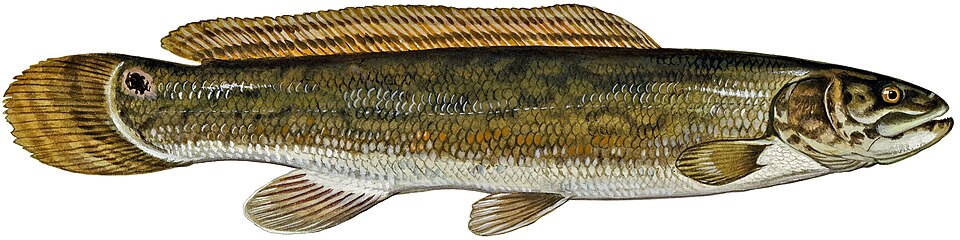
The bowfin (Amia calva) is an ancient species of bony fish in the genus Amia that lives in North America. It is a relict species, last of a group known as the Halecomorphi. That group appeared the Lower Triassic, about 250 million years ago.
The bowfin is described as “primitive” because they have characteristics of their early ancestors. The closest living relatives of bowfins are gars: the two groups make up the clade Holostei.
Their physiology is quite interesting. Like gars, bowfin are bimodal breathers: they can to breathe both water and air. Their gills exchange gases in the water, and they also have a gas bladder. The gas bladder is the secret: it keeps buoyancy, and lets the fish breathe air by a small pneumatic duct which goes from the foregut to the gas bladder. They break the surface to gulp air. This lets them survive conditions of hypoxia which would be lethal to most species.
Bowfin body-shape evolution and development
The first fish lacked jaws and used negative pressure to suck their food in through their mouths. The jaw in the bowfin is a result of their evolutionary need to be able to catch and eat bigger and more nutritious prey. As a result of being able to gather more nutrients, Bowfin are able to live a more active lifestyle. The jaw of a bowfin has several adaptations.
Similar species
Some people mistake northern snakeheads (Channa argus) for bowfin because even if they are in a different genus, they have similarities to them in appearance, most noticeably their elongated, cylindrical shape, and long dorsal fin that runs along their backs.
Diseases
A common parasite of bowfin is the anchor worm from the genus Lernaea. These crustaceans infest the skin and bases of fins, with consequences ranging from slowed growth to death.
Feeding
Bowfin are stalking, ambush predators that move into the shallows at night to prey on fish, and aquatic invertebrates such as crawfish, mollusks, and aquatic insects.
Where this page comes from
The article above is adapted from “Bowfin” on Simple English Wikipedia, by its contributors. We removed reference markers, navigation boxes and tables, expanded measurement templates into readable numbers, and kept the prose otherwise intact.
Both sources are published under CC BY-SA 4.0, so this page is published under the same licence. You may share and adapt it, including commercially, as long as you credit the original and keep the same licence.
Worksheets, answer keys and printable layouts elsewhere on K5Print are our own work and are not covered by this licence.