Brown Recluse

What does it look like?
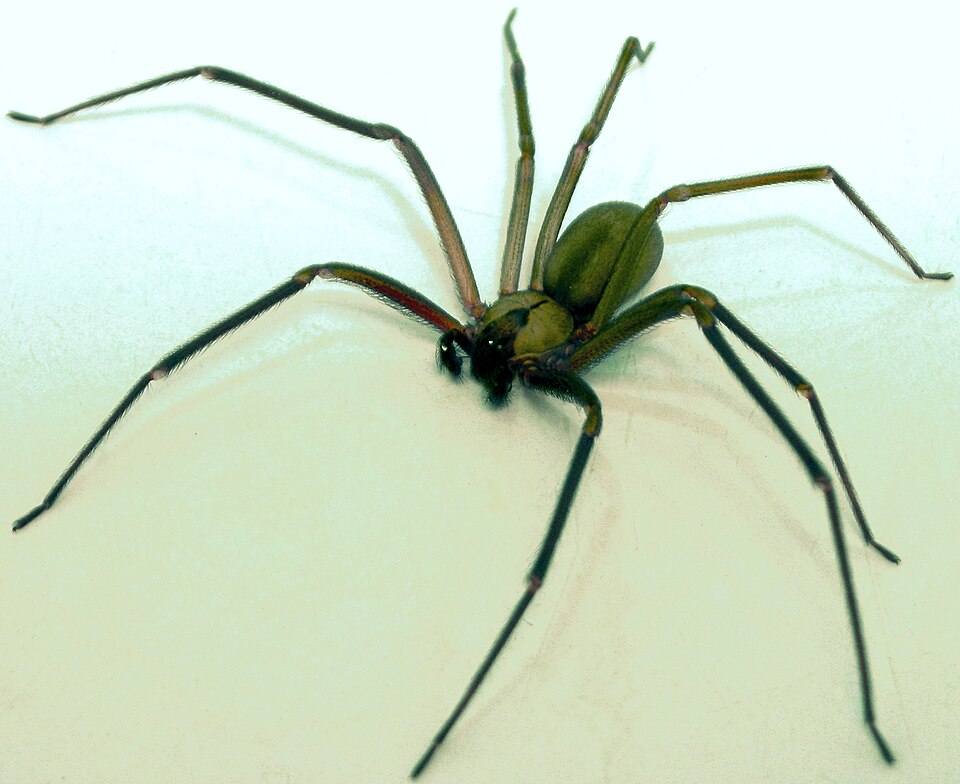
The brown recluse spider abdomen is uniformly colored a dark violet and is bulbous. The spider has dark brown skin and is covered with numerous fine hairs. It has long thin brown legs with a span the size of a quarter and a body that is 10mm long and 5mm wide. Most spiders have eight eyes but the brown recluse has six eyes arranged in pairs. It has small fangs. Most spiders have 8 eyes but Brown Recluse Spider have 6! Their body is a round shape.
Where does it live?
The brown recluse is most common in the southeast corner of North America mainly in the central midwestern states southwards to the gulf of Mexico and occasionally as far north as Ohio. They don’t live on the east coast, or anywhere west of the Rocky Mountains. They make an untidy web that includes a shelter that they stay in during the day. At night they come out to hunt. They make their webs under rotting tree bark in woodpiles, and in places that are undisturbed, like garages and cellars. They seem to like cardboard, perhaps because it is similar to tree bark or rotting wood. These spiders love dry warm places.
What does it eat?
Brown recluse spiders are hunters. They trap some insects in their webs, but most of their prey is caught during their nightly hunts. They prefer to eat cockroaches, firebrats, crickets and other crawling bugs. It will attack dangerous bugs, such as ants and other spiders. It lunges at its prey and bites it, injecting venom. It then retreats and waits for the poison to work. When the prey is paralyzed and unable to defend itself, the spider comes back and eats it. The brown recluse also scavenges dead insects. When prey are scarce the spider can survive for a long period of time provided it can find somewhere cool, but not cold. In the right conditions the brown recluse could last six months without food!
What stages does it go through to mature?
The spiderlings stay with their mother while they are young. She feeds them, and they also eat the eggs of any of their brothers and sisters that didn’t hatch in time. As they grow they have to shed their skins and grow new larger ones. After growing their 4th skin, the spiderlings are big enough to live on their own, and move away to make their own webs.
What is special about the brown recluse spider?
The brown recluse has a powerful venom that can cause damage to humans. People sometimes get bitten when the spider feels threatened and can’t escape. People are sometimes bitten in bed, if they roll over onto the spider. The actual bite doesn’t hurt much at first, and people often don’t go to the doctor straight away. After about 2 to 6 hours the bite may become very painful with blisters and what looks like bruising. The bruising gets worse, with the skin becoming purple around the bite, and eventually turning black as the skin cells die. Eventually the black skin falls off, leaving a large scar. Not every bite is as bad as this, and some bites have no venom at all, and some people think that they have been bitten by a spider when in fact they have a skin disease, or a bite from another type of bug.
Written for younger readers
Brown Recluse, in simpler words
This version comes from Wikijunior, a set of books written for children aged 8 to 11. It is shorter and uses plainer language than the article above.
From Wikijunior: Bugs
The brown recluse spider abdomen is uniformly colored a dark violet and is bulbous. The spider has dark brown skin and is covered with numerous fine hairs. It has long thin brown legs with a span the size of a quarter and a body that is 10mm long and 5mm wide. Most spiders have eight eyes but the brown recluse has six eyes arranged in pairs. It has small fangs. Most spiders have 8 eyes but Brown Recluse Spider have 6! Their body is a round shape.
The brown recluse is most common in the southeast corner of North America mainly in the central midwestern states southwards to the gulf of Mexico and occasionally as far north as Ohio. They don’t live on the east coast, or anywhere west of the Rocky Mountains. They make an untidy web that includes a shelter that they stay in during the day. At night they come out to hunt. They make their webs under rotting tree bark in woodpiles, and in places that are undisturbed, like garages and cellars. They seem to like cardboard, perhaps because it is similar to tree bark or rotting wood. These spiders love dry warm places.
Brown recluse spiders are hunters. They trap some insects in their webs, but most of their prey is caught during their nightly hunts. They prefer to eat cockroaches, firebrats, crickets and other crawling bugs. It will attack dangerous bugs, such as ants and other spiders. It lunges at its prey and bites it, injecting venom. It then retreats and waits for the poison to work. When the prey is paralyzed and unable to defend itself, the spider comes back and eats it. The brown recluse also scavenges dead insects. When prey are scarce the spider can survive for a long period of time provided it can find somewhere cool, but not cold. In the right conditions the brown recluse could last six months without food!
The spiderlings stay with their mother while they are young. She feeds them, and they also eat the eggs of any of their brothers and sisters that didn’t hatch in time. As they grow they have to shed their skins and grow new larger ones. After growing their 4th skin, the spiderlings are big enough to live on their own, and move away to make their own webs.
The brown recluse has a powerful venom that can cause damage to humans. People sometimes get bitten when the spider feels threatened and can’t escape. People are sometimes bitten in bed, if they roll over onto the spider. The actual bite doesn’t hurt much at first, and people often don’t go to the doctor straight away. After about 2 to 6 hours the bite may become very painful with blisters and what looks like bruising. The bruising gets worse, with the skin becoming purple around the bite, and eventually turning black as the skin cells die. Eventually the black skin falls off, leaving a large scar. Not every bite is as bad as this, and some bites have no venom at all, and some people think that they have been bitten by a spider when in fact they have a skin disease, or a bite from another type of bug.
Where this page comes from
The article above is adapted from “Brown Recluse” on Simple English Wikipedia, by its contributors. We removed reference markers, navigation boxes and tables, expanded measurement templates into readable numbers, and kept the prose otherwise intact. The simpler version is adapted from Wikijunior on Wikibooks.
Both sources are published under CC BY-SA 4.0, so this page is published under the same licence. You may share and adapt it, including commercially, as long as you credit the original and keep the same licence.
Worksheets, answer keys and printable layouts elsewhere on K5Print are our own work and are not covered by this licence.