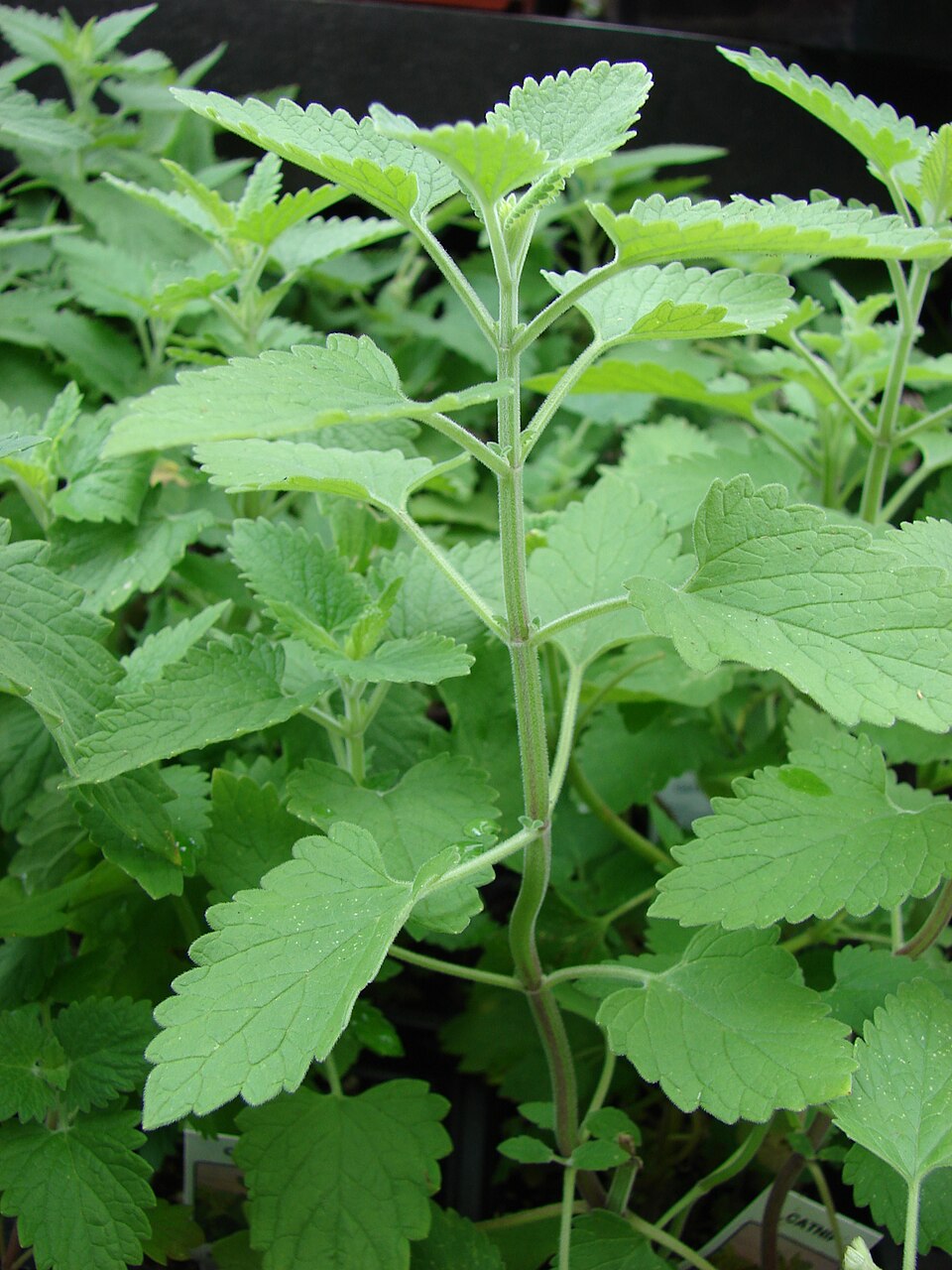
Catnip

Fast facts
- Genus
- Nepeta
- Species
- cataria
Scientific name
- Scientific name
- Nepeta cataria
How to say it in other languages
- Arabic
- قطرم حقيقي
- Chinese
- 貓薄荷
- Dutch
- Wild kattenkruid
- French
- Cataire
- German
- Echte Katzenminze
- Korean
- 개박하
- Portuguese
- Erva-gateira
- Russian
- Котовник кошачий
- Spanish
- Hierba de los gatos
Facts from Wikipedia’s “Catnip” page and Wikispecies (CC BY-SA 4.0).
Nepeta cataria, catnip or catmint, is a species of the genus Nepeta. It is in the Lamiaceae family. The name “catmint” is sometimes used for the genus as a whole. Some plants can cause diarrhea to cats.
Cat behaviour
Catnip, and some other species in the genus Nepeta, is known for its effects on cat behaviour. Cats rub on the plant, roll on the ground, paw at it, lick it, and chew it. Some leap about and purr, some cry out. Cats do it for about five to fifteen minutes, after which olfactory fatigue usually sets in.
The nepetalactone in catnip acts as a feline attractant after it enters the cat’s nose. At the olfactory epithelium, the nepetalactone binds to one or more olfactory receptors.
The catnip effect works on the whole cat family, not just on domestic cats. Several tests showed that leopards, cougars, servals, and lynxes often reacted strongly to catnip in a manner similar to domestic cats. Lions and tigers may react strongly as well, but they don’t react all the time.
With domestic cats, N. cataria is a recreational substance for pets to enjoy. Catnip and catnip-laced products are available to consumers. Not all cats are affected by catnip; roughly one third are not affected by the plant. The behavior is hereditary.
Some other plants also have a similar effect on cats, include valerian (Valeriana officinalis).
Where this page comes from
The article above is adapted from “Catnip” on Simple English Wikipedia, by its contributors. We removed reference markers, navigation boxes and tables, expanded measurement templates into readable numbers, and kept the prose otherwise intact.
Both sources are published under CC BY-SA 4.0, so this page is published under the same licence. You may share and adapt it, including commercially, as long as you credit the original and keep the same licence.
Worksheets, answer keys and printable layouts elsewhere on K5Print are our own work and are not covered by this licence.