Cells
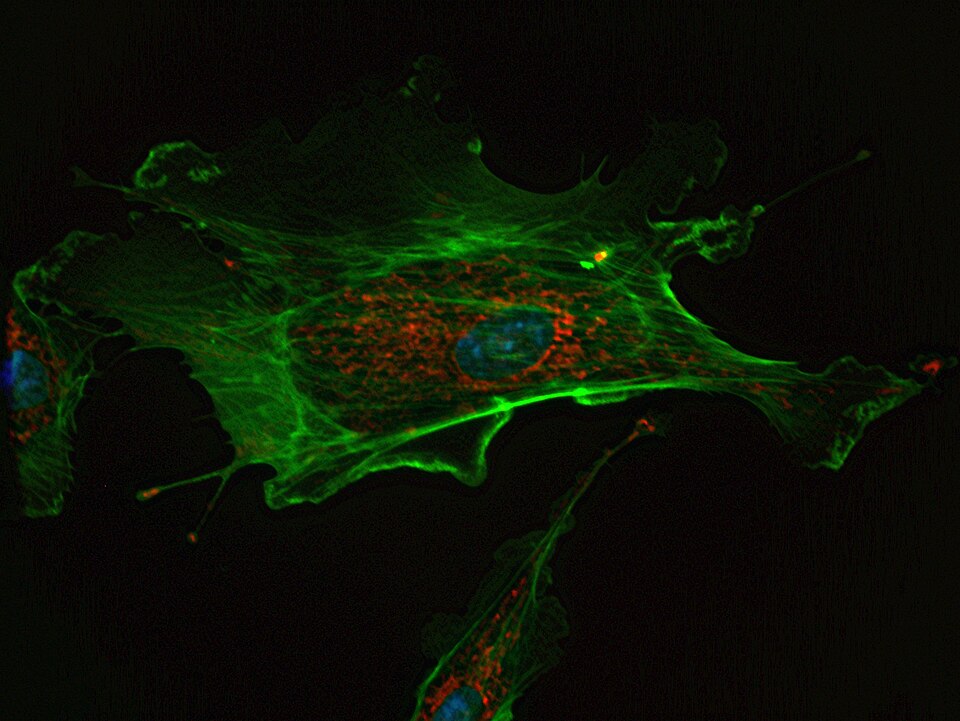

In biology, the cell is the basic structure of organisms. All living things are made up of cells, from the organs in the human body to the parts of plants. All cells are made by the division of cells that already exist (pre-existing cells).
The environment outside the cell is separated from the cytoplasm inside the cell by the cell membrane. Inside some cells, parts of the cell stay separate from other parts. These separate parts are called organelles (like small organs). They each do different things in the cell. Examples are the nucleus (where DNA is), and mitochondria (where chemical energy is converted). Prokaryotes do not have membrane-bound organelles like Eukaryotes.
There are around 37 trillion (3.7 x 10 13 ) cells in the human body. An old saying is that bacteria outnumber the number of cells in the body 10 times over, and there are 10 times more bacteria than cells (3.7 x 10 14 ) but many are debating this.
Kinds of cells
Cell can be divided into different types depending on the structure of the nucleus and the physiological function. In 1957 cells were divided into two types based on the structure of nucleus. These were the prokaryotic cell and the eukaryotic cell. Prokaryotes, such as bacteria and archaea, are simple cells that have no cell nucleus. They do have bacterial microcompartments.
Eukaryotes are complex cells with many organelles and other structures in the cell. They are larger than prokaryotic cells: they can be as much as 1000 times greater in volume. Eukaryotes store their genetic information (DNA) on chromosomes in the cell nucleus. Prokaryotes have all of their DNA on a single circular strand located in the nucloid region. Organisms (living things) which are made up of multiple cells are eukaryotes.
Most cells are small, the largest just being seen by the human eye (egg cell). They need to be small in order to work as they should. In things like cells and mechanical engineering (and other types of mechanic work), the smaller and more simple things are usually means they can survive better. This means that a lot of the thing things are as small as they can be.
Regions of prokaryotic cell
The prokaryotic cell has three regions made up of the envelope, cytoplasmic region and flagella (or pili), called:
- Cell envelope: This consists of the plasma membrane covered by a cell wall. Some bacteria have a third layer called a capsule. Virions might have an envelope called the capsid. Prokaryotes such as Mycoplasma and Thermoplasma only have a cell membrane layer. The envelope gives protection to the cell and separates the inside of the cell from its environment. An example envelope is the nuclear envelope. The nuclear pores on the nuclear envelope allow for things to get in and out.
- Cytoplasmic region: This region is found inside the cell and contains the genome (DNA), ribosomes and other cell inclusions. Since prokaryotes do not have a nucleus, the genetic material is free in the cytoplasm.
- Flagella/Pili: These structures are not present in all prokaryotes. The flagella and pili extends from the surface of the cell, and they help in movement and communication between cells Flagella usually helps the cell move which cilia the cell move other cells (across its surface). Sperm (germ) has a flagella tail for movement and the throat uses cilia to move phloem (phlegm) down the throat.
Unicellular (eukaryotic and prokaryotic)
Unicellular organisms are made up of one cell. Examples of unicellular organisms are:
- Amoeba
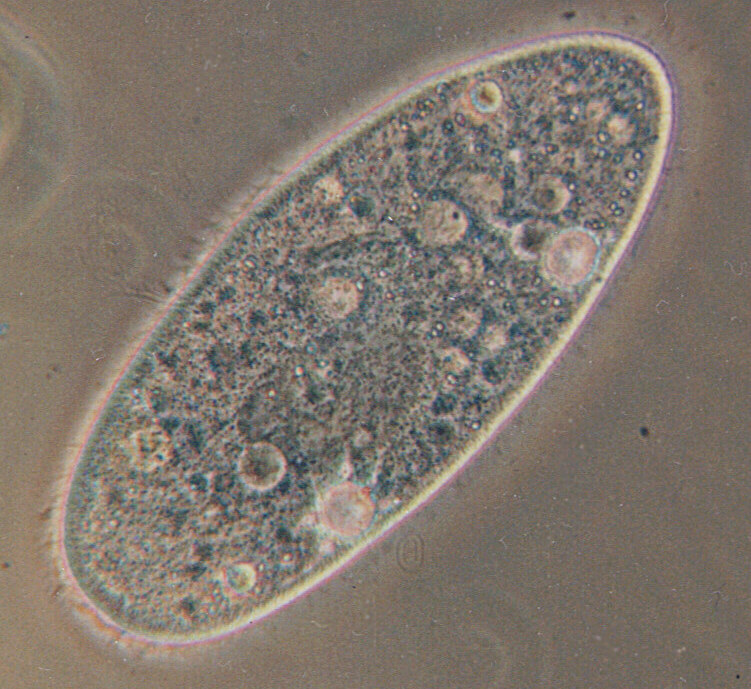
- Paramecium (pictured)
Prokaryotes are almost always unicellular, while eukaryotes can be unicellular or multicellular. The only kinds of prokaryotic organisms are bacteria and archaea. Prokaryotic organisms evolved before eukaryotic organisms, so at one point the world consisted of nothing but prokaryotic organisms. This has made humans think of some theories about how they came into existence.
Unicellular organisms need to: eat, respire (most use oxygen to make sugar into energy), and get rid of waste (discard), like all other life. They need to do this throughout their lifespan to survive. Then they must perform sexual reproduction (make more of itself). Some cells reproduce using binary fission, which is a form of asexual reproduction that allows them to reproduce without a partner. Some unicellular organisms, like germ cells (including our own sperm) reproduce through mitosis, which is splitting in half to produce two germ cells, which are not always identical.
Some may do other things to help them survive, such as:
- move
- sense their environment
- get their energy from the sun (e.g., cyanobacteria), called photosynthesis
- ferment (e.g., yeasts)
- use anaerobic respiration (e.g. Clostridium botulinum)
Movement in response to the environment (the presence of food or dangers, like antibodies) is called chemotaxis. Movement as a response to the sun is called a photonastic response and some plants do this, like the californian poppy (Eschscholzia californica).
Some yeasts, like the yeast used to make beer, first use aerobic metabolism (to grow), then switch to anaerobic metabolism. Aerobic means “with air” and anaerobic is “without air”.
Viruses
There are also viruses, which are biological organisms. Viruses violate the rules that we have for cells (living things) so are not classed as living things. They always reproduce inside the cells of other organisms, meaning they are cellular obligates. A lot of virus strains cannot survive outside of the cell, but some can for a short time, such as Hepatitis B and D (HBV & HDV). Hepatitis B virus can survive in the body for around 7 days.
They cause some important diseases. Viruses are made of RNA, or DNA, contained in a protein, and they reproduce themselves inside the cells of bacteria (bacteriophages) or eukaryotes. Sperm is a lot like a virus.
Multicellular (eukaryotic)
Eukaryotic cells can be unicellular or multicellular. Multicellular organisms are made from many cells. They are complex organisms. This can be a small number of cells, or millions or trillions of cells. All plants and animals are multicellular organisms.
The cells of a multicellular organism are not all the same. They have different shapes and sizes, and do different work in the organism. The cells are specialised, this means they do only some kinds of work. By themselves they cannot do everything that the organism needs to live. They need other cells to do other work. They live together, but cannot live alone.
Alongside prokaryotes and eukaryotes, there were archea. These preferred (or could thrive in) extreme enviroments (like temperature or altitude. It was thought these were always unicellular but there have been multicellular archea, and today mostly eukaryotes are focused on even when they prefer extreme environments.
One theory about these cells is that a prokaryotic cell was eaten by a larger cell, and this helped them to survive and reproduce as they evolved to have what we see today. An example of a prokaryotic cell (like germs on teeth or on surfaces) version of this is a group of cells living together on a biofilm for survival.
Cell history
The cell theory includes these important ideas:
- All living things are made of cells.
- The cell is the basic unit of structure and function in all organisms.
- Every cell comes from another cell that lived before it. There is a 4th idea, because of advancements in biology: Cells carry genetic information in the form of deoxyribonucleic acid (DNA). This genetic material is passed on from parent to daughter cell.
Cells were discovered by Robert Hooke (1635–1703). He used a compound microscope with two lenses to look at the structure of cork, and to look at leaves and some insects. He did this from about 1660, and reported it in his book Micrographica in 1665. He named cells after the Latin word cella, meaning room. He did this because he thought cells looked like small rooms in a cathedral.
Many other naturalists and philosophers tried out the new instrument. The structure of plants was investigated by Nehemiah Grew (1641–1712) and Marcello Malpighi (1628–1694). Grew’s major work was The anatomy of plants (1682). It is not clear who first saw animal cells, Malpighi, Jan Swammerdam (1637–1680) or Antonie van Leeuwenhoek (1632–1723). p17
Leeuwenhoek’s discoveries and drawings of ’little animalcules’ opened up a whole new world for naturalists. Protozoa, and microorganisms generally were discovered, and the discoveries about them are still going on today. Christian Gottfried Ehrenberg’s book Die Infusionsthierchen summarised what was known in 1838. Lorenz Oken (1779–1851) in 1805 wrote that infusoria (microscopic forms) were the basis of all life.
The idea that cells were the basis of the larger forms of life came in the 18th century. Finding out who did the work has taken some time:
Cell reproduction
The body cells of animals divide by simple mitotic cell division. Sexual reproduction is ancestral in eukaryotes, and in animals it is carried out by specialised sex cells. They are produced by a process called meiosis.
Prokaryotic cells reproduce using binary fission, where the cell simply splits in half. For both mitosis and binary fission the cell must replicate (copy) all its genetic information (DNA) so that each new cell will have a copy.
Written for younger readers
Cells, in simpler words
This version comes from Wikijunior, a set of books written for children aged 8 to 11. It is shorter and uses plainer language than the article above.
From Wikijunior: Biology
NOTOC
All living things are made of cells. They are the components and building blocks of life.
What is a cell? A cell is a bag of liquid that holds in the stuff of life.
A cell is the smallest structural and functional unit of a living organism. The word “cell” comes from the Latin word cella, which means small room. If you look at living things under a microscope, you will see that they are made of small squares or balls. Robert Hooke, a biologist from England, saw these small squares in a hard material called cork using a microscope in the year 1665. They looked like rooms, and so he called them cells. He was also the first person to observe dead cells.
What types of cells are there? There are two kinds of cells: eukaryotes, which have a large ball in them called a nucleus, and prokaryotes, which do not.
Most prokaryotes are very small. Two of the six kingdoms, Bacteria and Archea, are made up of prokaryotes. All of the rest of the kingdoms – Animalia, Plantae, Fungi, and Protista – are made up of eukaryotes.
Every human being is a living being. But each one is made up of a large number of tiny living things called cells. But that’s not all! Smaller creatures live in every cell of our body. The larger cell nourishes the smaller cells inside, and the small cells perform important functions.
Working together for mutual benefit is called symbiosis. According to the endosymbiont theory, single-celled organisms were taken up by the large cells long ago. The mitochondria are derived from aerobic bacteria. The mitochondria gain energy from food and oxygen. The chloroplasts found in plant cells are derived from cyanobacteria. The chloroplasts gain energy from light. File:Euglena mutabilis - 400x - 1 (10388739803).jpg|thumb|Euglena File:Euglena viridis TK-UT.svg|thumb|Euglena File:Endosymbiosis.svg|thumb|Endosymbiosis File:Serial Endosymbiosis Theory.png|thumb|Endosymbiosis Theory
Cells are surrounded by a thin layer of oil called the cell membrane. It separates the inside of the cell from the outside. Some cells also have a firm box around them called a cell wall that keeps it from breaking. The water that fills a cell is called the cytoplasm. Inside a cell, knowledge is stored in something called a chromosome. It tells the cell how to work, like steps in a book.
Eukaryotic cells hold their chromosomes in a structure called a nucleus, which has its own oily membrane around it. Cells also have many other things with membranes called organelles, which means “little organs”. Some organelles found in eukaryotic cells are called ribosomes, vacuoles, mitochondria, and chloroplasts.
Cells that do different things have different shapes. A plant leaf cell takes light and uses it to make sugar. To do this, it has green organelles called chloroplasts. To get the most light, it pushes cytoplasm in circles around a hollow bubble of water in the center of the cell called a vacuole.
A human sperm cell carries its chromosomes, found in the nucleus, to an egg cell in order to make a new baby. It has a large tail called a flagella that helps it to swim. It also has many organelles called mitochondria that give it power, like how gasoline powers a car.
Where this page comes from
The article above is adapted from “Cells” on Simple English Wikipedia, by its contributors. We removed reference markers, navigation boxes and tables, expanded measurement templates into readable numbers, and kept the prose otherwise intact. The simpler version is adapted from Wikijunior on Wikibooks.
Both sources are published under CC BY-SA 4.0, so this page is published under the same licence. You may share and adapt it, including commercially, as long as you credit the original and keep the same licence.
Worksheets, answer keys and printable layouts elsewhere on K5Print are our own work and are not covered by this licence.