Cheetah

Fast facts
- Conservation status
- Vulnerable
Scientific name
- Scientific name
- Acinonyx jubatus
How to say it in other languages
- Arabic
- فهد
- Chinese
- 猎豹
- Dutch
- Jachtluipaard
- French
- Guépard
- German
- Gepard
- Italian
- Ghepardo
- Japanese
- チーター
- Korean
- 치타
- Portuguese
- Guepardo
- Russian
- Гепард
- Spanish
- Guepardo
Facts from Wikipedia’s “Cheetah” page and Wikispecies (CC BY-SA 4.0).
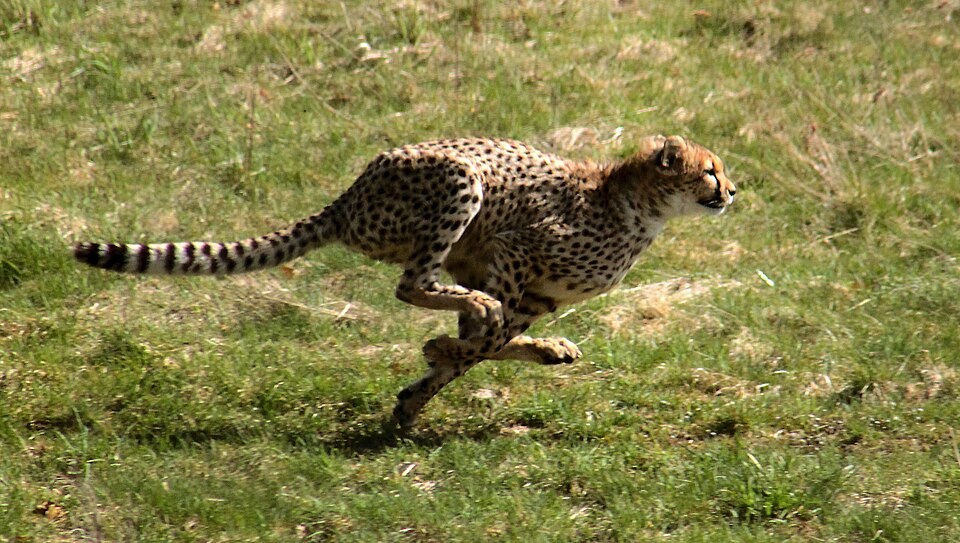
A cheetah (Acinonyx jubatus) is a medium large cat which lives in Africa and Asia. It is the fastest land animal and can run up to 65 miles per hour (100 km/h), and accelerate from 0 to 60 miles per hour (97 km/h) in less than 3 seconds. Most cheetahs live in the savannas of Africa. There are a few in Iran. Cheetahs are active during the day, and hunt in the early morning or late evening.
Characteristics
The cheetah compared to other big cats is light and slimly built. Its long thin legs and long spotted tail are necessary for fast running. Its lightly built, thin form is in sharp contrast with the robust build of other big cats. The head-and-body length ranges from 112–150 centimetres (44.1–59.1 in). The cheetah stands 70–90 centimetres (28–35 in) at the shoulder, and weighs 21–72 kilograms (46–160 lb).
The slightly curved claws are only weakly retractable (semi-retractable). This is a major point of difference between the cheetah and the other big cats, which have fully retractable claws.
Diet and behavior
Cheetahs are active during the day, and hunt in the early morning or late evening. Cheetahs are carnivores. They prey on Thomson’s gazelle, impala, gerenuk, Grant’s gazelles, Speke’s gazelles, greater kudus, springbok, red hartebeest, puku, oribi, steenbok, elands, blue wildebeest, Grevy’s zebras, Grant’s zebras, warthogs, hares, ostrichs, and even kills hunting prey.
When the cheetah hunts, it slowly and secretly moves toward its prey. When it is close to the prey (about 10–30 metres (33–98 ft)), it runs after it very quickly. Cheetahs kill their prey by tripping it during the chase. To kill medium- to large-sized prey, the cheetah bites the prey’s throat to suffocate it to death. A bite on the back of the neck or the snout is enough to kill smaller prey.
The cheetah cannot defend itself against lions or hyenas who would take the cheetah’s prey away. The prey is taken to a shaded place. The cheetah, exhausted after the chase, rests beside the attack and pants heavily for some time. Once they recover, cheetahs eat quickly, and consume large quantities as soon as they can.
Reproduction
Pregnant females give birth to about 3 to 5 cubs or kittens after three months pregnancy. It takes two years of full-time supervision by the mother before the cubs are ready to live independent lives. They need to learn how to catch prey, and that takes time. The young are vulnerable to larger predators: lions especially try to kill cheetahs.
Genetics
The cheetah has unusually low genetic variability and a very low sperm count. Their sperms also suffer from deformed flagellae, and so their movement is damaged. Apparently, cheetahs went through a great reduction in numbers during the last ice age. Inbreeding after the event further reduced the variation (genetic drift).
Cheetah as a pet
Due to the fact that cheetahs never attack and kill humans they were extremely popular as hunting pets since antiquity and especially in medieval times in the Near and Middle East.
In modern times, cheetahs probably are the most difficult wilds cats to have as pets, due to the necessity for wide open spaces for cheetah for them to run at full speed . It’s very important to feed them properly, because cheetahs in captivity must eat only lean steamed meat so they do not get sick and die.
Interesting facts
The cheetah is the fastest land dweller. The acceleration of a cheetah allows it to reach speeds of up to a 100 kilometres per hour (62.1 mph) per hour in three seconds (its maximum speed is 112 kilometres per hour (69.6 mph)). The speed that a cheetah can develop from the start in three seconds cannot be matched by any sports racing car.
The nearest challenge to the cheetah’s speed comes from the pronghorn and springbok.
Written for younger readers
Cheetah, in simpler words
This version comes from Wikijunior, a set of books written for children aged 8 to 11. It is shorter and uses plainer language than the article above.
From Wikijunior: Big Cats
NOTOC
Cheetahs are built for speed, with a whip-like spine, long legs, and a long tail that acts as a rudder for sharp turns. As the world’s fastest land animal (the fastest animal overall is the peregrine falcon) the cheetah can chase its prey for up to 559 meters (more than a third of a mile) at the speed of about 100 kilometers (roughly 62 miles) per hour at the fastest. Both the male and the female of the species are referred to as “cheetahs,” unlike in the case of many other animals. Cheetahs can generally live up to seven years. They can also see as far away as 5 kilometers (about 3 miles), which helps with hunting.
Today, most cheetahs are found in sub-Saharan Africa (the Eastern and Southern region of the continent), though a few are still seen in Iran. In the past, cheetahs were found throughout northern India and Iran, as well. They prefer to live in semi-arid deserts, savannas, prairies, and thick shrublands. As they rely upon speed to hunt, they avoid dense forests. Conservation efforts are required in order to prevent cheetahs from becoming an endangered species. As humans build more towns and cities in cheetah habitats, there has been an increase in cheetahs coming into contact with humans, and sightings of the big cats in urban areas.
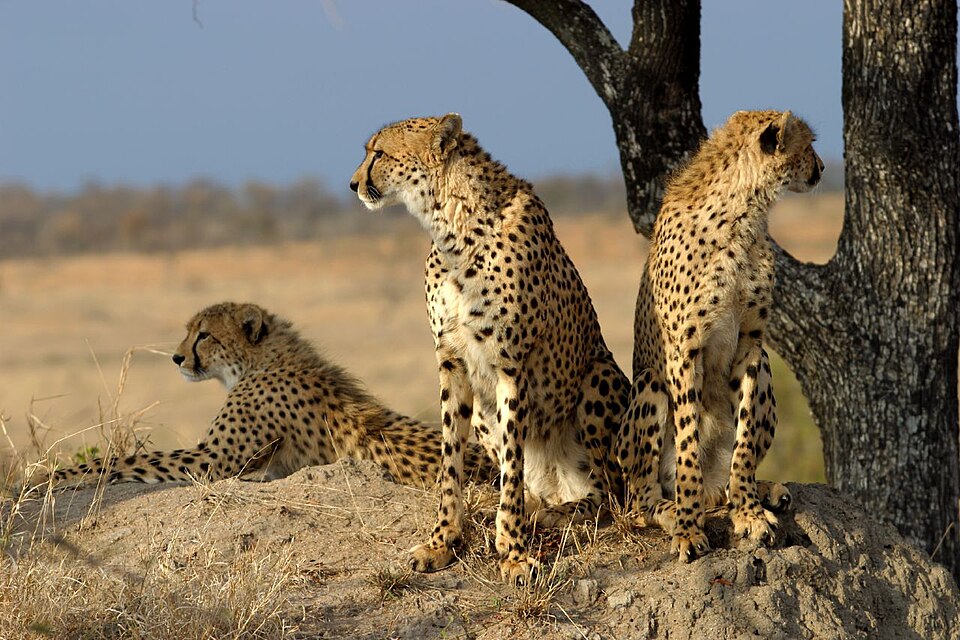
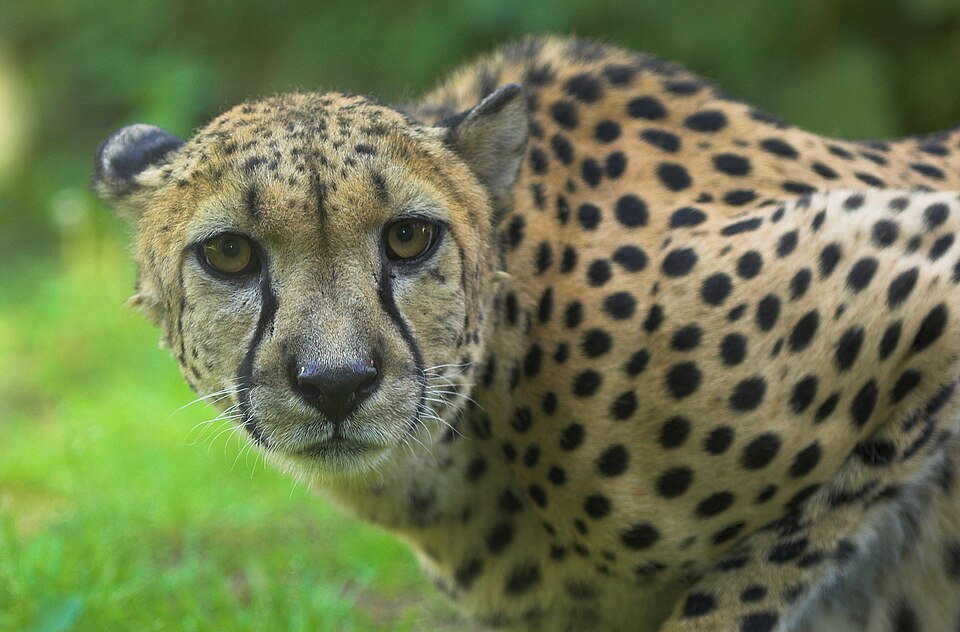
Cheetahs are medium-sized spotted cats with long legs and slender, but muscular, bodies. They have white bellies, and dark stripes that looks like tear stains on both sides of their faces. In contrast to leopards, which have rosette shaped spots, cheetahs have dark, round spots on their fur. Adult cheetahs weigh between 40 to 65 kilograms (90 to 140 pounds), and are around 112 to 135 centimeters (four to five feet) in length. Cheetahs are built to do what they are most known for: to run! Their long tail provides them with balance. They have a large chest, a narrow waist, and powerful muscles in their hind legs. They have small heads and muzzles; large nostrils for increased oxygen intake; and small, round ears. All of this makes the cheetah more aerodynamic, which helps them to run faster than most other animals.
Cheetahs mostly eat herbivore mammals like gazelles, impalas, gnu calves, and hares, which are all about the same size or smaller than an adult cheetah.
Cheetahs stalk their prey until they are within about thirty meters, and then begin to chase them. The chase is usually over in less than a minute, and if the cheetah doesn’t catch its prey quickly it will often give up, rather than waste energy. This is because cheetahs use a lot of energy when chasing prey at high speeds. About half of all cheetah chases are successful.
Cheetahs must eat their catch quickly or risk losing their food to other stronger predators. They will not usually fight with a larger animal (such as a lion or hyena), as risking an injury means starvation—if a cheetah breaks its leg, it cannot chase its prey.
Cheetahs are well-adapted to living in dry environments. In the Kalahari desert, they have been estimated to travel an average of 82 kilometers (51 miles) between drinks of water. They have been seen getting their water from the blood or urine of their prey, or by eating Tsamma melons.
See how much you know about the world’s fastest land mammal:
After running at full speed, a cheetah must rest at least 15 minutes before running again.
Cheetahs do not roar, but they make a number of very un-catlike sounds, many of which resemble bird chirps. These chirps can be heard from a mile away (more than 1.5 kilometers)!
Other cheetah sounds include purrs, bleats, barks, growls, and hisses.
Cheetahs and pumas are the only big cats that purr.
Cheetahs were called “leopards” before leopards were! In the past, cheetahs were called “leopards”, and leopards were simply “pards”. “Leo-pard” comes from a mix between the Latin word for lion, “leo,” and “pard,” then the name of leopards.
Many cheetah cubs are killed by a lack of food, or by their natural enemies: lions, leopards, and hyenas. An old African legend says the tear stain marks on the cheetah’s face are from the mother weeping for her lost cubs.
Cheetahs do not usually eat the skin or bones of their prey.
Occasionally, hyenas, leopards, and lions steal the cheetah’s prey after the cheetah has killed it.
Wikipedia: Cheetah Next Topic: Pumas
ca:Viquijúnior:Grans felins/Guepard de:Wikijunior Großkatzen/ Gepard fr:Wikijunior:Les félins/Les guépards it:Wikijunior_Grandi_felini/Ghepardo
Where this page comes from
The article above is adapted from “Cheetah” on Simple English Wikipedia, by its contributors. We removed reference markers, navigation boxes and tables, expanded measurement templates into readable numbers, and kept the prose otherwise intact. The simpler version is adapted from Wikijunior on Wikibooks.
Both sources are published under CC BY-SA 4.0, so this page is published under the same licence. You may share and adapt it, including commercially, as long as you credit the original and keep the same licence.
Worksheets, answer keys and printable layouts elsewhere on K5Print are our own work and are not covered by this licence.