Clouded leopard

Fast facts
- Conservation status
- Vulnerable
- Genus
- Neofelis
- Species
- nebulosa
Scientific name
- Scientific name
- Neofelis nebulosa
- Kingdom
- Animalia
- Phylum
- Chordata
- Class
- Mammalia
- Order
- Carnivora
- Family
- Felidae
- Genus
- Neofelis
- Species
- Neofelis nebulosa
How to say it in other languages
- Chinese
- 雲豹
- Dutch
- Nevelpanter
- French
- Panthère longibande
- German
- Nebelparder
- Italian
- Leopardo nebuloso
- Japanese
- ウンピョウ
- Portuguese
- Pantera-nebulosa
- Russian
- Дымчатый леопард
- Spanish
- Pantera nebulosa
Facts from Wikipedia’s “Clouded leopard” page and Wikispecies (CC BY-SA 4.0).
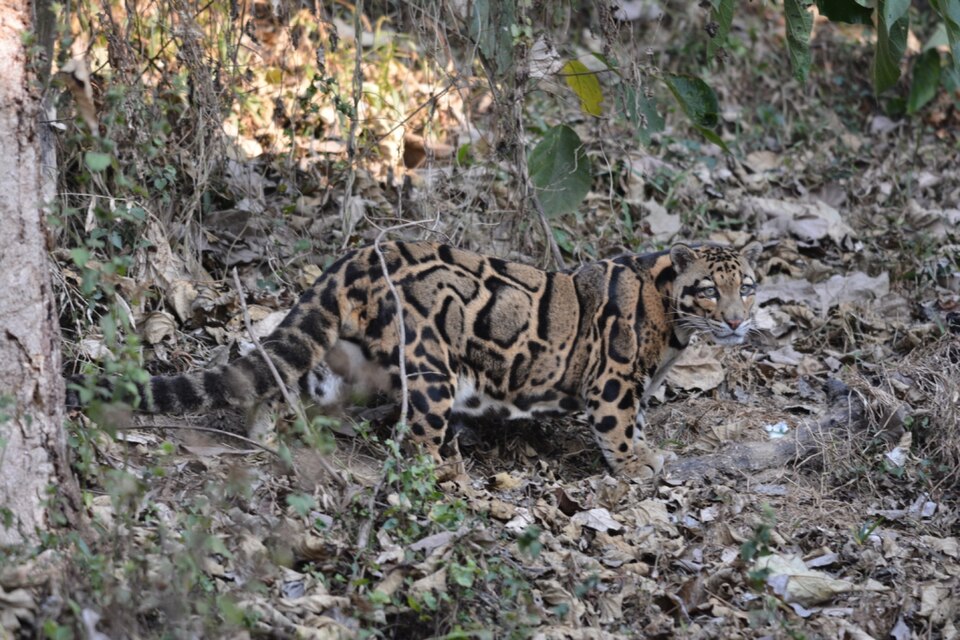
The Clouded leopard (Neofelis nebulosa) is a rare cat species. It is a medium-sized felid, found from the Himalayan foothills through mainland Southeast Asia into China. It is 55 to 110 cm (2 ft to 3 ft 6 in) long and weighs between 15 and 23 kg (33 to 50 lb). It is classified as vulnerable in 2008 by IUCN. Its total population may be fewer than 10,000 mature individuals.
Clouded leopards hunt in trees as well as on the ground. Their prey are monkeys and birds. They are one of the few cats who are arboreal.
The genetic analysis of specimens of Neofelis nebulosa and its close relative Neofelis diardi suggests the two species diverged 1.4 million years ago. A group crossed a now submerged land bridge to Borneo and Sumatra from mainland Asia. And, the Sunda clouded leopard is different enough on the two large islands to be classed as two subspecies.
The split between the two subspecies corresponds roughly with the catastrophic eruption of the Toba supervolcano in Sumatra 69,000–77,000 years ago. A probable scenario is that Sunda clouded leopards from Borneo recolonized Sumatra during periods of low sea levels in the Pleistocene, and these were later separated from their source population by rising sea levels.
Written for younger readers
Clouded leopard, in simpler words
This version comes from Wikijunior, a set of books written for children aged 8 to 11. It is shorter and uses plainer language than the article above.
From Wikijunior: Big Cats
NOTOC
Clouded leopards are not truly leopards at all but they spend a great deal of time in trees, just as the true leopards of Africa do.
Clouded leopards live throughout southern China, the eastern Himalayan Mountains, south-east Asia, and some parts of Indonesia. They prefer to live in tropical or subtropical forests, yet they can also be found living in mangrove swamps and grasslands.
The clouded leopard is a medium-sized wild cat found in the forests of Asia. Little is known about the wild behavior of clouded leopards due to their extremely secretive nature. Much of our understanding of this cat’s natural history and behavior is a result of observations of them in captivity.
At adult age a clouded leopard will range from somewhere between two and a half feet, nose to rump, to three and a half feet. The clouded leopard has short legs for its size. It also has the longest canine teeth (2-inch fangs) for any similarly sized cat species that lives today. Only the extinct sabretooth cats had longer canine teeth for their body size.
Clouded leopards are excellent climbers and their major prey animals live in trees. Short flexible legs, large paws, and keen claws combine to make them very sure-footed in this environment. The clouded leopard’s tail can be as long as the rest of its body and helps to maintain the cat’s balance while moving through the trees. Amazingly, these cats can hang upside-down under branches, and can even climb down tree trunks head-first. Other cats cannot do this because their claws are not shaped in the same way.
The beautiful pattern of the clouded leopard’s fur is its most interesting feature. The large square rosettes look like clouds to some people, and that is how they got the name “clouded leopard.” Other people think the blotches look more like mint leaves, so they are also called “mint leopards.”
While not much is known about their behaviour in the wild, their prey is thought to be mostly mammals that live in trees, particularly monkeys, along with small mammals, deer, birds, porcupines, goats, wild boar, young buffalo, and domestic livestock. Clouded leopards will stalk their prey in the trees, then jump down from their perch and attack from behind, but clouded leopards are also skilled at hunting on the ground.
See how much you know about the clouded leopard:
They can climb down tree trunks head first.
Like marbled cats and margays, they will sometimes hang head-down from branches using their hind legs.
Young clouded leopards are born with spots that become open squares as they grow older.
Clouded leopards have extremely flexible ankles in their hind legs, which aids them in climbing.
Clouded leopards have the longest canine teeth in proportion to its skull and body size, in similarity to the extinct saber-toothed tiger.
Wikipedia: Clouded leopard Next Topic: Marbled Cats
de:Wikijunior Großkatzen/ Nebelparder
Where this page comes from
The article above is adapted from “Clouded leopard” on Simple English Wikipedia, by its contributors. We removed reference markers, navigation boxes and tables, expanded measurement templates into readable numbers, and kept the prose otherwise intact. The simpler version is adapted from Wikijunior on Wikibooks.
Both sources are published under CC BY-SA 4.0, so this page is published under the same licence. You may share and adapt it, including commercially, as long as you credit the original and keep the same licence.
Worksheets, answer keys and printable layouts elsewhere on K5Print are our own work and are not covered by this licence.