Crane Fly

Scientific name
- Scientific name
- Tipuloidea
- Kingdom
- Animalia
- Phylum
- Arthropoda
- Class
- Insecta
- Order
- Diptera
How to say it in other languages
- Chinese
- 大蚊总科
- Japanese
- ガガンボ上科
Facts from Wikipedia’s “Crane fly” page and Wikispecies (CC BY-SA 4.0).
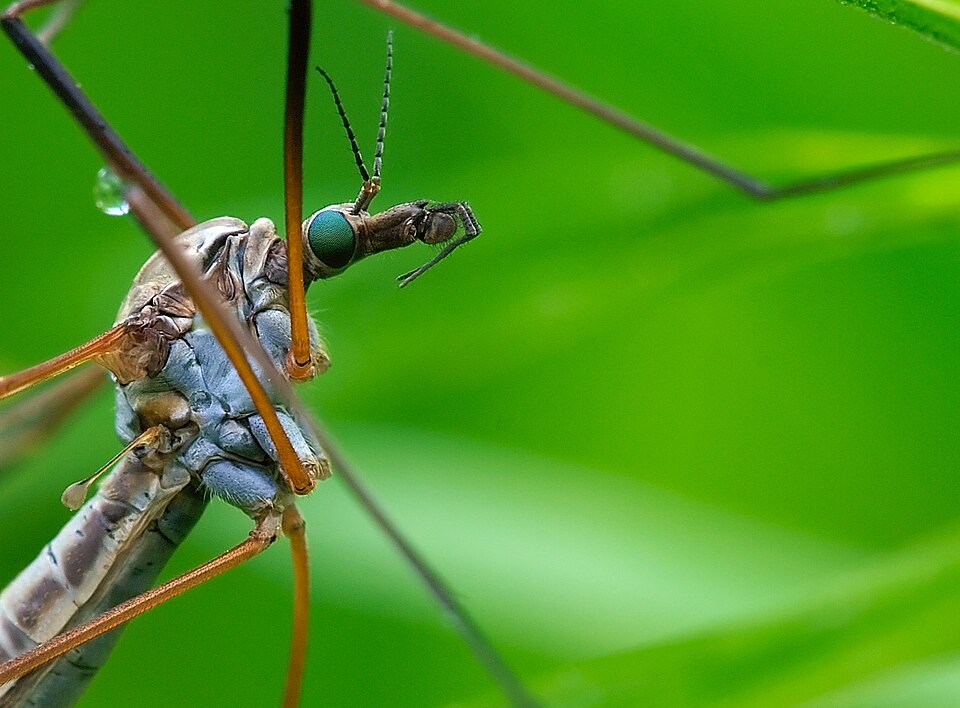
Crane flies are flies in the family Tipulidae. They are insects. Crane flies look similar to large mosquitoes but, unlike mosquitoes, crane flies do not bite people or animals. Crane flies occasionally eat nectar.
They are also known as daddy longlegs around the world. The term ‘daddy-long-legs’ is also given to arachnids of the order Opiliones or the family Pholcidae. The larvae of crane flies are known commonly as leatherjackets.
There are about 15,000 different species and 525 genera of crane flies. This means that the Tipulidae (crane flies) are the largest group of flies. Most crane fly species (75%) were found by Charles P. Alexander.
The adult only lives to mate and lay eggs: 10 to 15 days is all. In some species the adult does not eat at all.
Larvae
Most of the crane fly’s life is spent as a larva. Crane fly larvae are called leatherjackets or ’leatherjacket slugs’ because of the way they move and eat roots (such as those of grass in lawns) and other vegetation. Some leatherjackets are aquatic.
Leatherjackets can cause damage to plants. Because of this, crane flies are a pest of lawn grass in some areas. Invasive (European) crane flies (Tipula paludosa) cause extensive damage to turfgrass.
Larvae of crane flies are divided into segments. They have a distinct head capsule on the front. The segments on the rear portion of the larva (the abdominal segments) often have long fleshy projections (like tentacles). Scientists have never seen the larvae from most crane fly species: less than 2% of the larvae are known.
Appearance
Adult crane flies have very long legs and a long, thin abdomen. It is very easy to accidentally break off their delicate legs when catching crane flies. Their thin legs and abdomen may help them to escape from birds who try to eat them. Females have larger abdomens in comparison to the males. The female abdomen also ends in a pointed ovipositor that looks a bit like a stinger. Crane flies cannot sting.
The wings are often held out from the body when the crane fly is not moving. When the wings are held out, the large halteres (balancers) can be seen behind the wings. Unlike mosquitoes, crane flies can not fly well. They will sometimes “wobble” when flying.
Crane flies that live in temperate places, such as Tipula species, may grow as big as 60 mm in size. Tropical crane flies may grow to more than 100 mm. The giant crane fly (Holorusia rubiginosa) that lives in the western United States can reach 38 mm (1-3/8 inches). There are also small crane flies, the size of mosquitoes.
Written for younger readers
Crane Fly, in simpler words
This version comes from Wikijunior, a set of books written for children aged 8 to 11. It is shorter and uses plainer language than the article above.
From Wikijunior: Bugs
The adult crane fly is large and fragile with long slender legs. Its body length varies from 1/8 inch to 3 inches. It looks a little like a huge mosquito. Its long legs make it a relatively poor flier compared to other flies. Just behind and at the base of the wings is a pair of balancing organs, called halteres.
Because of its unusual appearance, there are many different names for the crane fly. Among the names are gallinipper, gollywhopper, jimmy spinner and mosquito hawk. Its common name in the United Kingdom, and Ireland is daddy long-legs.
Scientists consider the crane fly to be a “true fly” because it has only one pair of wings.
The female abdomen ends in an ovipositor for laying eggs. The ovipositor is pointed and looks like a stinger but is completely harmless.
Crane flies are found all around the world in temperate or tropical climates. At least 14,000 species of crane flies have been described worldwide. They can be found in lawns and turf, and in moist soil around ponds and streams. Compost piles provide an attractive home for crane flies. They rest on the soil surface just below the decaying vegetation.
This species has a broad range of habitats. It lives in cold arctic tundra and sub-arctic spruce forests. It likes white pine, jack pine and other evergreens in the northern Great Lakes region. East of the Mississippi River and southward along the Appalachian Mountains, it lives in forests of beech, maple, hemlock, and birch.
The crane fly usually likes moist environments such as woodlands, streams and flood plains. But some species inhabit open fields, dry rangeland, and even deserts.
The crane fly is sometimes called “mosquito hawk” or “mosquito lion.” Despite this ferocious name, it does not actually eat mosquitoes. The larvae of crane flies occur in moist soil, forest leaves and wood litter and in aquatic habitats associated with organic matter, depending on the species. Most species are generalist detritivores, but a few may feed on living plant tissue, such as grass roots.
Many adult crane fly have no mouthparts, so never eat at all. Those species that do have mouthparts will lap up sugar-rich plant nectar.
The adult crane fly has little in the way of defense. It falls prey to birds, bats, cats and yellow jackets. Unlike most flies, it is a weak, poor flier with a tendency to “wobble” in unpredictable patterns during flight. It can be caught without much effort.
The way its delicate legs break off, even without direct contact, may help it evade predators.
In its larval form, the crane fly is defenseless. The larvae are often eaten by birds, such as robins and starlings. In addition to birds, there are many natural enemies beneath the soil. Tiny parasites, beetles, frogs, and small mammals attack the larvae in the wintertime.
The crane fly goes through a complete metamorphosis. The adult emerges from late August to mid-September, mates and lays eggs. The female lays most of her eggs before making her first flight.
The eggs hatch quickly in the soil. As they develop, the gray-brown, worm-like larvae begin feeding on roots in moist soil. The feeding is slow in the winter, speeds up in early spring, and ends in mid-May. The larvae change to quiet pupa in July and August. The leathery, shiny pupal case is called a “leatherjacket.” The adult crane fly comes out of the ground in August and September, living just long enough to mate and lay eggs.
Crane fly larvae are called “leatherjacket slugs" because of their movement and the way they sometimes damage plants.
The adult snow crane fly is unusual because it emerges from snow in very cold temperatures. It is frequently seen crawling sluggishly on the surface after a fresh fall of snow. Some scientists believe it lives in nests of small mammals, such as mice and chipmunks. Its natural history is still largely a mystery.
The crane fly is an insect that appears to be a giant mosquito, but it does not bite. It is not generally considered a pest. In certain circumstances, the crane fly can be a problem in lawns and landscape plants, but not often.
Some crane fly larva feed on roots in nurseries that sell turf and seedlings. Cereal and grain crops are sometimes damaged by crane fly larvae. Most of the time, healthy lawns and plants can tolerate their presence as long as natural enemies keep populations down.
The crane fly is an important food source for birds, fish, and other animals. As an aquatic insect it can be an indicator of good water quality. Its larvae are important decomposers that break down waste in streams and soil. This activity creates rich organic material used by other organisms. Crane fly larvae attract fish looking for food. Fishermen even design their lures to mimic crane fly larva.
Where this page comes from
The article above is adapted from “Crane Fly” on Simple English Wikipedia, by its contributors. We removed reference markers, navigation boxes and tables, expanded measurement templates into readable numbers, and kept the prose otherwise intact. The simpler version is adapted from Wikijunior on Wikibooks.
Both sources are published under CC BY-SA 4.0, so this page is published under the same licence. You may share and adapt it, including commercially, as long as you credit the original and keep the same licence.
Worksheets, answer keys and printable layouts elsewhere on K5Print are our own work and are not covered by this licence.