Dodo

Fast facts
- Conservation status
- Extinct
- Genus
- Raphus
Scientific name
- Scientific name
- Raphus cucullatus
How to say it in other languages
- Arabic
- دودو
- Chinese
- 渡渡鳥
- Dutch
- Dodo
- French
- Dronte de Maurice
- German
- Dodo
- Hindi
- डोडो
- Italian
- Dodo
- Japanese
- ドードー
- Korean
- 도도
- Portuguese
- Dodó
- Russian
- Дронт
- Spanish
- Dodo
Facts from Wikipedia’s “Dodo” page and Wikispecies (CC BY-SA 4.0).
Dodo (Raphus cucullatus) is an extinct species of flightless bird from Mauritius. Dodos were in the same family as the pigeon. They became extinct in the late 17th century. Like many other island birds, they could not fly because it was no advantage where they lived.
The Dodo has become a symbol of extinction caused by the arrival of humans in ecosystems where humans had never before lived.
The name ‘Dodo’
The history of the word ‘Dodo’ is not clear. Dutch admiral Wybrand van Warwijck discovered the island and the bird in 1598 during an expedition to Indonesia. He called the bird ‘walgvogel’, meaning “disgusting bird” because he disliked the taste of the meat. Four years later, the Dutch captain, Willem van Westsanen, used the word ‘Dodo’ for the first time.
The Encarta Dictionary and the Chambers Dictionary of Etymology say “dodo” is a Portuguese word, coming from doido. It means “fool” or “crazy”. Another idea is that ‘dodo’ was a copy of the bird’s own call, a two-note pigeon like sound, “doo-doo”. In 1606 Cornelis de Jonge wrote a description of the Dodo, and of other animal and plants on the island .
Description
The dodo was the largest bird of the Columbiformes, and weighs about 50 lb (23 kg). They had grey feathers and yellow feet. Their big hooked bill was a green/yellow color. It had short wings that were only stubs. They ate fruit, seeds and nuts. Portuguese sailors said that they saw the Dodos eating fish. They also ate rocks and stones which might have helped them digest food. They were eaten by humans who came in the search of treasure or spouting.
Extinction
The dodo was not scared of people which made it easy to hunt and kill. Dogs, cats, rats and pigs were left on the island and also killed the dodos. Because dodos built their nests on the ground, the new animals ate their eggs. The forests were chopped down and the dodo lost its habitat. Within 80 years, the dodo was extinct. The last confirmed dodo sighting in Mauritius was 1662, but a 2003 research by David Roberts and Andrew Solow estimated that the dodo lived another few decades unnoticed until around 1690.
The last known stuffed bird was at Oxford University and was thrown out as rubbish. Only a foot and a head are left. The American Museum of Natural History in New York has a skeleton showing. It was put together out of bones from several different Dodos. The Natural History Museum of Mauritius has the only complete skeleton of a dodo, found in a swamp.
Written for younger readers
Dodo, in simpler words
This version comes from Wikijunior, a set of books written for children aged 8 to 11. It is shorter and uses plainer language than the article above.
From Wikijunior: Extinct Birds
The Dodo (Raphus cucullatus) is a flightless, extinct bird which inhabited the island of Mauritius, an island 1,200 miles south of the African Subcontinent. Very little information about the Dodo is present due to a lack of fossils.
It is believed that the Dodo was found by a Dutch Sailor in 1598 in Mauritius. The name, Dodo, means “Ugly, Disgusting Bird”. It was named that because of the bird’s abnormal appearance. Many believe that the Dodo only lived in Mauritius.
The main reason why the Dodo is extinct is because it was a real target for food. Not only alive were they killed, but some of their eggs were eaten. Usual Dodo eggs were main food for vultures and coyotes. Which led up to the big extinction. It is to be believed that the last dodo was spotted, or seen, in around the 1660s or the early 1670s. There have also been various other animals that are extinct from Mauritius
The main predators are mankind. Dodos went extinct because of Dutch sailors hunting them for food. Dodo eggs were also hunted by birds and other land animals on the island of Mauritius, which prevented new Dodos from coming about. The dodos also became prey to the Dutch sailors’ animals, such as pigs, monkeys, and rats.
The famous extinct Dodo, which has a pitiful reputation as a stupendously overweight idiot of a bird that couldn’t even fly, has DNA related to the pigeon. Which DNA examinations show. “Island taxa such as the dodo and solitaire often represent extreme examples of evolution—and if we want to examine how we, or the life around us, evolved then such animals are very educational, By examining island birds we can investigate how evolution works—because extreme examples are often the best views of how something works”
–Alan Cooper, a zoologist at the University of Oxford and one of the co-authors of the study.
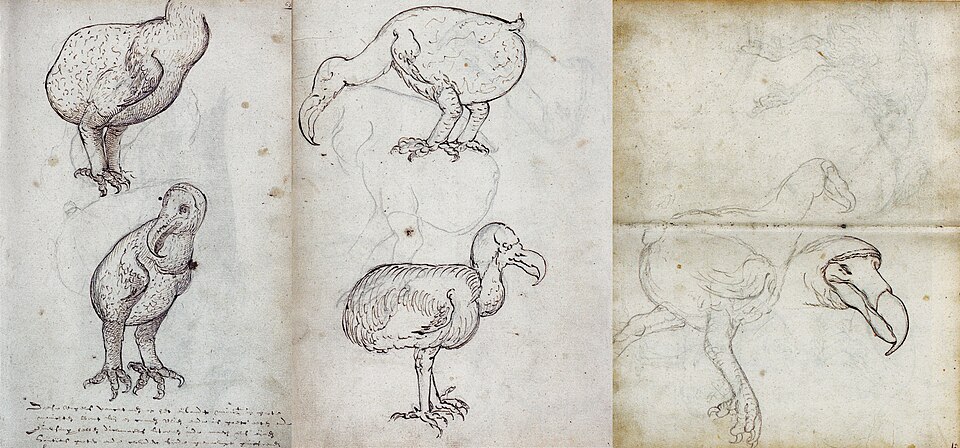
The only traces of the Dodo’s past are pictures and bones, which are preserved mostly in museums.
Where this page comes from
The article above is adapted from “Dodo” on Simple English Wikipedia, by its contributors. We removed reference markers, navigation boxes and tables, expanded measurement templates into readable numbers, and kept the prose otherwise intact. The simpler version is adapted from Wikijunior on Wikibooks.
Both sources are published under CC BY-SA 4.0, so this page is published under the same licence. You may share and adapt it, including commercially, as long as you credit the original and keep the same licence.
Worksheets, answer keys and printable layouts elsewhere on K5Print are our own work and are not covered by this licence.