Dragonfly

Scientific name
- Scientific name
- Anisoptera
- Kingdom
- Animalia
- Phylum
- Arthropoda
- Class
- Insecta
- Order
- Odonata
How to say it in other languages
- Chinese
- 差翅下目
- Dutch
- Echte libellen
- German
- Großlibellen
- Japanese
- トンボ亜目(不均翅亜目)
- Korean
- 잠자리아목
Facts from Wikipedia’s “Dragonfly” page and Wikispecies (CC BY-SA 4.0).
Dragonflies are flying insects of the order Odonata. There are about 5,300 species of dragonfly. The adults eat other flying insects.
Dragonflies have large compound eyes, which is their main sense organ. They have four strong transparent wings, and a long body.
Dragonflies are usually found around pools, lakes, ponds, streams and wetlands. They are predators which eat mosquitoes, and other small insects such as flies, bees, ants, and butterflies. Their larvae, known as ’nymphs’, are aquatic. They are also carnivorous.
Because their legs are adapted to grab prey in the air, they are not adapted for moving on land. Once they perch, they rarely use their legs for walking.
Dragonflies have been around for 300 million years. In the rain forests of the Carboniferous and Permian periods, some species had wingspans of over 2 ft (61 cm). Oxygen levels were quite high at that time.
Dragonflies and damselflies
Dragonflies are in one suborder of the Odonata, and their relatives, the damselflies, are in another suborder. Some people mistake the damselfly for the dragonfly, because they look similar.
Adult damselflies have thinner, more delicate bodies than those of dragonflies. This you can see even when they are flying. When at rest, most damselflies hold their wings together above the body. Most dragonflies hold their wings horizontally. The eyes of dragonflies are larger, and touch each other. The eyes of damselflies are separated. Many damselflies live in groups close to a river. Taken together, these points are usually enough to distinguish the two groups.
Reproduction
Female dragonflies lay eggs in or near water, often on plants. When laying eggs, some species go under the water to lay their eggs on a good surface. The eggs then hatch into nymphs. While in the nymph stage they eat mosquito larvae and other things.
Most of a dragonfly’s life is spent in the nymph form, beneath the water’s surface. It is quite active. It can extend its jaws in front of its mouth to catch prey. Tiny vertebrates such as tadpoles and fish are part of its diet. Some nymphs even hunt on land. They draw water in and out of their rectum. They can move fast by squirting water out of the anus. They also have gills in their rectum.
Larvae
The larval stage of large dragonflies may last as long as five years. In smaller species, this stage may last between two months and three years. When the larva is ready to metamorphose into an adult, it climbs up a reed or other emergent plant. Exposure to air causes the larva to begin breathing. The skin splits at a weak spot behind the head and the adult dragonfly crawls out of its old larval skin, pumps up its wings, and flies off to feed on midges and flies. The adult stage of larger species of dragonfly can last as long as five or six months.
Dragonflies experience incomplete metamorphosis: the nymphs (called naiads) swim and live underwater, like fish. The female dragonfly lays her fertilized eggs near or right in the water. The naiads – which do not look much like dragonflies at all – hatch and immediately take to the water. While living in the water, the naiads eat as many aquatic insects as possible, as well as other small creatures like tadpoles and minnows. Hidden among the plants, a naiad will lie in wait for prey to swim by. It can then squeeze water out of the rear of its abdomen like a jet stream. This moves the naiad forward very quickly, allowing it to snatch its prey with its powerful jaws. Some naiads even have a long lower jaw that can shoot out and grab prey.
Naiads live in the water for weeks (or even years in some species) and undergo a series of moults to grow. When a naiad is ready for its final moult, it finds a stick or other object sticking out of the water. It use this to crawl out of the water, and wait for its exoskeleton to dry. As the exoskeleton cracks open at the seam, the adult dragonfly crawls out.
Eyesight
Dragonflies have tremendous eyesight. Their compound eyes are very large and have up to 50,000 individual lenses. Their eyes wrap around the top of the head. As a result, they have a wide field of vision: they can see almost everywhere at once. Sight is by far their most important sense, used to catch flies and avoid birds.
Flight
In flight the adult dragonfly can move in six directions; upward, downward, forward, back, and side to side. They can also hover quite well in midair, and then they can take off at speeds of up to 35 mph (56 km/h). Scientists discovered dragonflies can move each of their four wings independently which gives them their flying abilities. Dragonflies bend and twist their wings to cause little whirlwinds that move the air even faster over the upper part of the airfoil, reducing air pressure even more than most flying animals can. This gives them a lot of lift, even in the face of powerful winds.
The flight style of different families of dragonfly is one of their distinguishing features. It gives rise to some terms which are widely used by dragonfly observers:
Hawkers (family Aeshnidae). They are among the largest and fastest flying dragonflies. The adults live mostly in the air, and even mate in flight. They have large and powerful wings, and can fly forwards or backwards or hover like a helicopter. The wings are always extended horizontally.
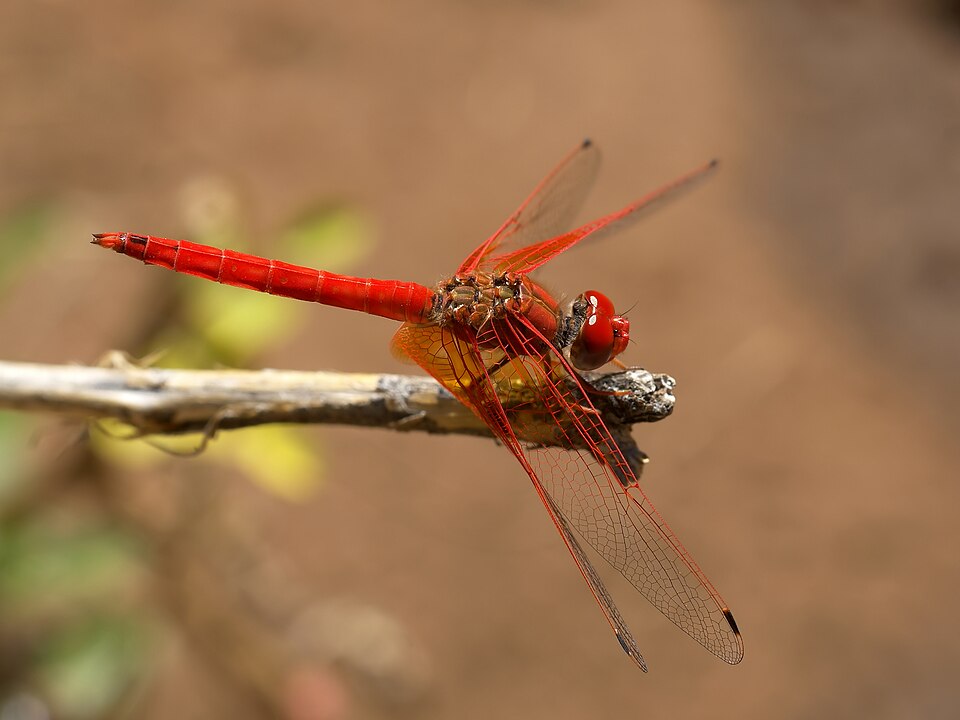
Skimmers or perchers are the very large family Libellulidae. There are several flight styles amongst its genera. The genus Sympetrum lives in the northern hemisphere and has 50 species. It breeds in ponds and searches over meadows. There are at least 100 other genera.
Cruisers (family Macromiidae). They usually fly over bodies of water (and roads) straight down the middle. They have green eyes which just barely meet at the top of the head. Females of this family lack an ovipositor at the end of the abdomen and lay their eggs by dipping the abdomen in the water as they fly over.
Thermoregulation
Some dragonflies adjust their resting position to prevent overheating. They may use a handstand-like position to prevent overheating on sunny days. The abdomen is raised until its tip points at the sun, minimizing their surface area exposed to the heat. The position is called the obelisk posture. The species that do this are called ‘perchers’; they are “sit and wait” predators which spend much of their time keeping still.
Predation
There are predators which eat dragonflies. The birds known a bee-eaters do regularly take dragonflies. Also, despite their good eyesight, dragonflies apparently cannot see spiders’ webs, so they get caught there.
Written for younger readers
Dragonfly, in simpler words
This version comes from Wikijunior, a set of books written for children aged 8 to 11. It is shorter and uses plainer language than the article above.
From Wikijunior: Bugs
Dragonflies are large, slender insects that are up to 5 inches long. Dragonfly colors are brilliant blue, green, or brown. Compound eyes are large and hemisphere-shaped. Each compound eye has up to 28,000 separate lenses (ommatidia). The thorax is just behind the head and is the power center. Its strong muscles control the two pairs of wings.
Dragonflies belong to the Order Odonata. They have wings that extend horizontally to the side. They are unable to fold their wings flat against the body. Some smaller species are less than 1 inch long. Dragonfly legs are not made for walking. They bend, but are not very flexible. They have claws on the ends for grasping prey in flight and perching on leaves and twigs.
Darners are large and fast-flying dragonflies belonging to the family Aeschnidae. They are 2-3/4 to 4-3/4 inches long. They have large, clear wings with a span as wide as 5-7/8 inches. Darner naiads are 2 to 2-1/2 inches long with relatively short legs. Their flat lower lip lacks grasping bristles.
Green Darners are dark greenish-brown with green thorax. The abdomen is blue to purplish-gray. The pale wings have light yellow tips. Green Darners have a target-like mark on the face. Naiads can be as long as 1-7/8 inches.
Brown Darners have brown bodies and 2 large, pale yellow spots on each side of the thorax. There is a brown spot at the base of each wing and a yellowish spot on the front wing margin.
Biddies are brownish-black with yellow markings. Most have a very long abdomen. Their heads are wide with eyes that are slightly separated or meet at a single point. Antennas have 7 segments. Biddies are large and hairy with wings that are clear or smoky. Wings have a black spot (stigma) along the front margin. Naiads are stout and hairy with huge spoon-shaped lower lips.
Green-eyed skimmers belong to the Family Corduliidae. They are often quite hairy. Many are brownish-black in color with a red, green, or blue metallic sheen. The abdomen is metallic green and may be long and cylindrical or flat. On the head, eyes touch each other. The thorax is hairy and wings have yellow marks.
“Downy Emerald” dragonflies (Cordelia aenea) are named for their hairy bodies and green abdomens. Their wingspan can be up to 2 inches.
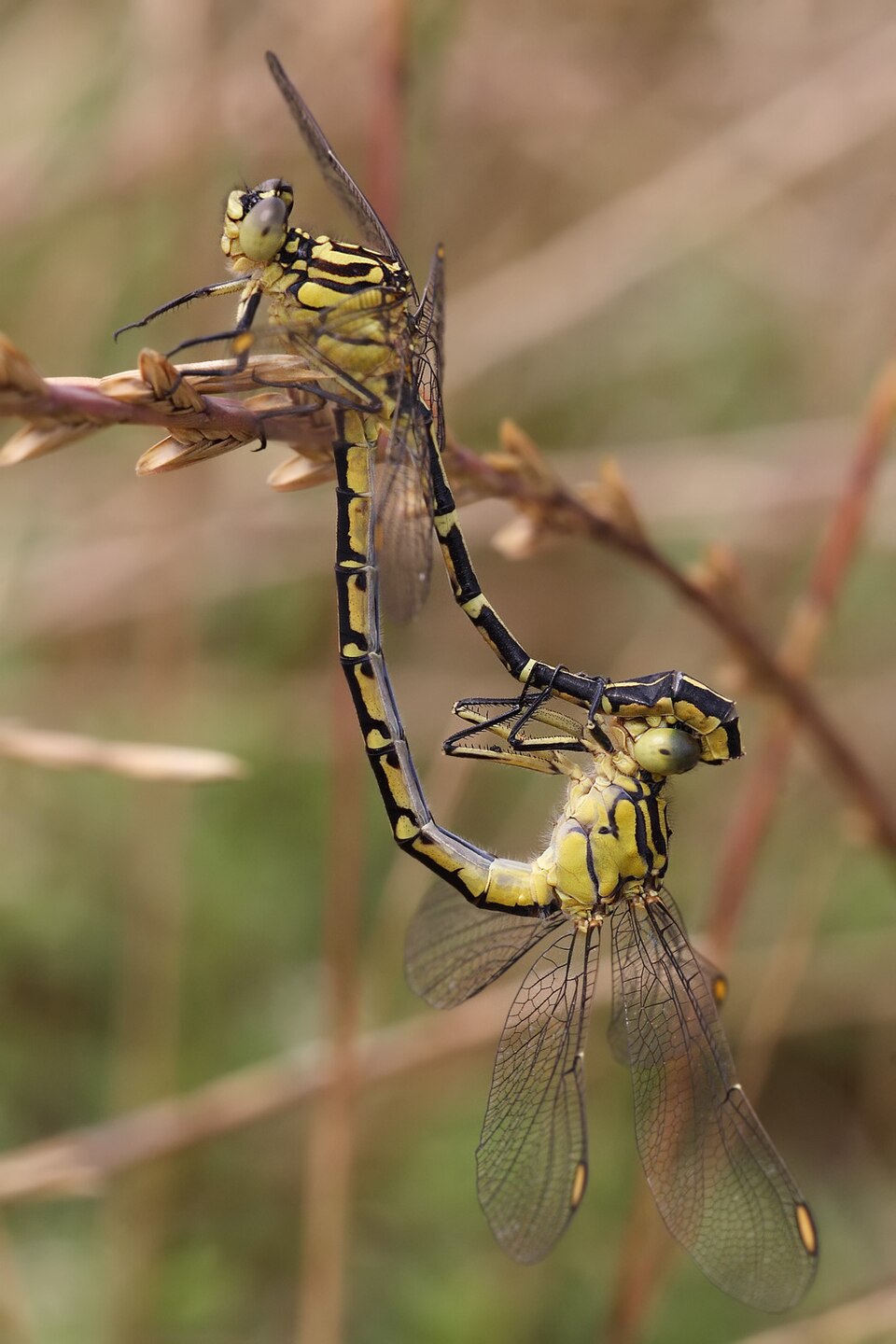
Small Western Gomphids are about 2 inches long and have a 4-inch wingspan. They have a yellowish face and a thorax that is black with yellow markings. The abdomen is black with a yellow tip and base. On the abdomen, there is a thick yellow stripe that narrows to a thin line. The wings are clear. The naiads are dark brown in color and about 1 inch long.
Club-tailed dragonflies have brightly colored bodies. The thorax is yellowish with dark markings. The body has various patterns and color combinations of black, yellow, or green. In males, the end of the abdomen is swollen, giving the appearance of a club. Females sometimes have this feature as well.
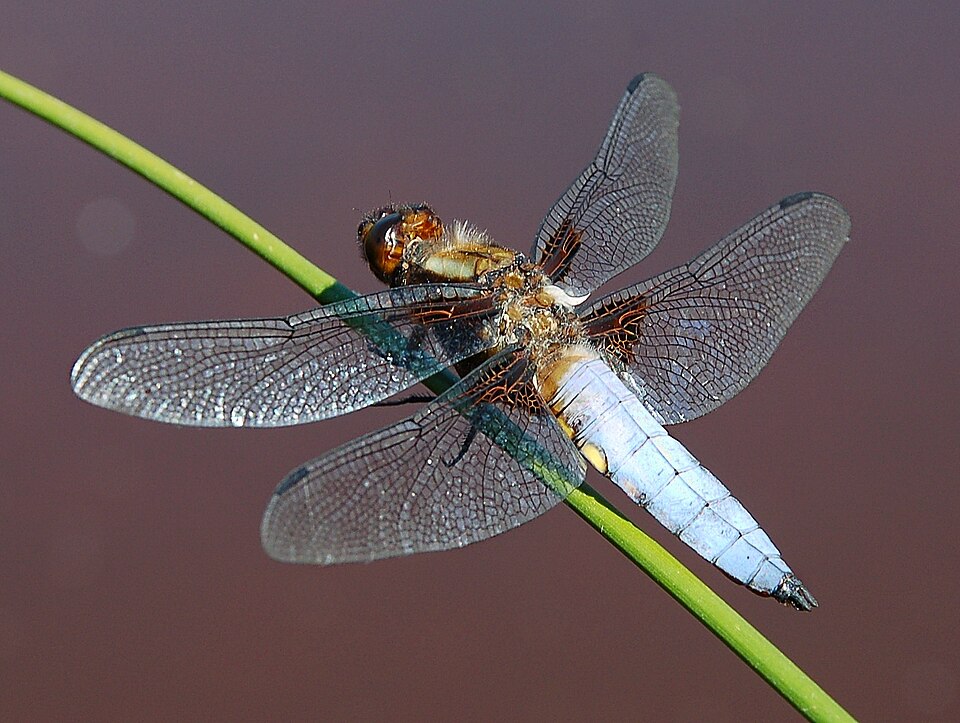
Common skimmers or “darters” usually have stout, colorful bodies and a broad, flat abdomen. Wings sometimes have dark, irregular markings with a dark base next to the body. The thorax has pale stripes on either side. Male abdomens are pale blue and females’ are brownish yellow. Both sexes have yellow marks at the side of the abdomen. Nymphs are often short and slightly flat.
Brown Darners are found from Nova Scotia to Florida, west to Texas, and north to Illinois. They live at the edges of free-flowing streams. They are good fliers but do not fly very far from their home stream. Brown Darner naiads are found under stones and debris near woodland streams. Green Darners live near ponds and slow streams throughout North America. They are less common in the west. Walsingham’s Darners live in the Southwest and Heroic Darners are found from Mexico to Quebec.
Gomphids live near streams. They can be found resting on logs, stones, and leaves or darting one resting place to another. Sometimes they fly along roads or through woods far from the streams. They return for mating and laying eggs.
Small Western Gomphids are found near small rippling streams from Nevada to Baja California and north to British Columbia.
Biddie naiads live in forest streams and cover themselves with silt. Adults can be seen flying slowly up and down streams, hovering about a foot above the water.
Dragonflies eat a wide variety of insects. Their prey includes flies butterflies, and mosquitoes. They have been known to eat hummingbirds. They are specialized hunters with large freely moving heads, large compound eyes, and sharp biting mouthparts.
Green and Brown Darners and Small Western Gomphids eat small flying insects like caddisflies and mosquitoes. Club-tailed dragonflies eat small flies, midges and mosquitoes. They use their specially shaped legs to scoop up prey while in flight. Catching insects while in flight is called “hawking.” Hovering over plant life to catch insects is called “gleaning.”
Dragonfly nymphs eat water fleas, worms, and insect eggs. As they grow they feed on bigger prey like water beetles and snails.
With a large head and large compound eyes they can see predators more easily. The multiple lenses in a dragonfly’s eyes allow them to easily see motion and color.
Catching dragonflies is not easy. They seem to fly in 2 different directions at once. Their ability to move swiftly through the air, darting and weaving lets them avoid predators. When the four powerful wings move independently, they are able to fly both forward and backward.
Many species are mottled with different colors that act as camouflage in wooded areas near ponds and streams.
Dragonfly nymphs bury themselves in silt, mud, or gravel. Just the head and front legs are left out to grab prey. They are hidden from predators.
Dragonflies undergo simple metamorphosis with three stages—egg, nymph, and adult. Naiads crawl out of water when fully grown. Males mate right away because they only live between one day to several weeks. Females live longer so they can lay eggs. Typically 500 to 1500 eggs are deposited. They hatch in 5 to 60 days depending on location and temperature. Very few eggs survive to adulthood.
Mated pairs of Brown Darners can be seen resting on lily pads while the female deposits her eggs into the water. Naiads turn into adults in May in the north and October in the south.
Female Gomphids lack ovipositors. To lay eggs, females break the water surface with the tip of the abdomen and deposits eggs while in flight. Biddies lay eggs on the bottom of rivers and in fast-flowing streams.
Green-eyed skimmer females can lay more than 2000 eggs at a time. Nymphs usually live at the bottom of stagnant water in marshes or peat bogs.
Club-tailed Dragonflies mate in vegetation. Females hit the tail on the surface of shallow water to release eggs. The larval stage lasts from 3 to 5 years. Discarded larvae cases are short and squat instead of long and slender like other dragonfly larvae cases.
Most males are highly territorial. They choose an area that has a good egg laying site. They protect the area by dive bombing any other males and forcing them away.
Green Darners form a “mating wheel” shape while attached upside-down to each other. After mating, the male tows the female around over water to deposit eggs in water plant stems. This tandem flight behavior is called “contact guarding.” It allows the male to protect the female from efforts of other males to mate with her.
Most dragonfly species have a resident population, but some have a migrating population. Migrating populations travel by day following the same migration paths as song birds and hawks. They can make corrections if they go off course. They stop to rest every 3 days. Some can cover as much as 100 miles per day. Nymphs of migrating species hatch and develop faster than those of resident species.
Dragonflies sometimes swarm together on the top of a hill far from water. This behavior, called “hilltopping,” may be for finding mates.
Dragonfly naiads and adults are beneficial because they destroy huge numbers of mosquitoes. In Thailand, they are used as pest control to keep mosquitoes and other insects away from rice paddies.
Dragonflies have a place in folklore of many countries. They are said to sew together fingers of sleeping people and lips of gossips. In the Middle Ages they were called “devil’s needles.”
In the United States they have different names—mosquito hawks, darning needles, snake doctors, and snake feeders. In Japan, they are a sign of good luck, courage, and strength. Inside the home, they are thought to be a visiting spirit. They are a part of Native American art and creation myths.
Dragonflies are used as an “indicator” species to determine if a pond or other body of water is healthy. They play an important role in preserving the balance of nature. In Italy they are called “keepers of the fish.”
Where this page comes from
The article above is adapted from “Dragonfly” on Simple English Wikipedia, by its contributors. We removed reference markers, navigation boxes and tables, expanded measurement templates into readable numbers, and kept the prose otherwise intact. The simpler version is adapted from Wikijunior on Wikibooks.
Both sources are published under CC BY-SA 4.0, so this page is published under the same licence. You may share and adapt it, including commercially, as long as you credit the original and keep the same licence.
Worksheets, answer keys and printable layouts elsewhere on K5Print are our own work and are not covered by this licence.