Firefly

Fast facts
- Phylum
- Arthropoda
Scientific name
- Scientific name
- Lampyridae
- Kingdom
- Animalia
- Phylum
- Arthropoda
- Class
- Insecta
- Order
- Coleoptera
- Family
- Lampyridae
How to say it in other languages
- Chinese
- 螢科
- Dutch
- Glimwormen
- French
- Lampyre
- German
- Leuchtkäfer
- Hindi
- जुगनू
- Italian
- Lampyris noctiluca
- Japanese
- ホタル科
- Korean
- 반딧불이과
- Portuguese
- Vaga-lume
- Russian
- Светляки
- Spanish
- Luciérnaga
Facts from Wikipedia’s “Firefly” page and Wikispecies (CC BY-SA 4.0).
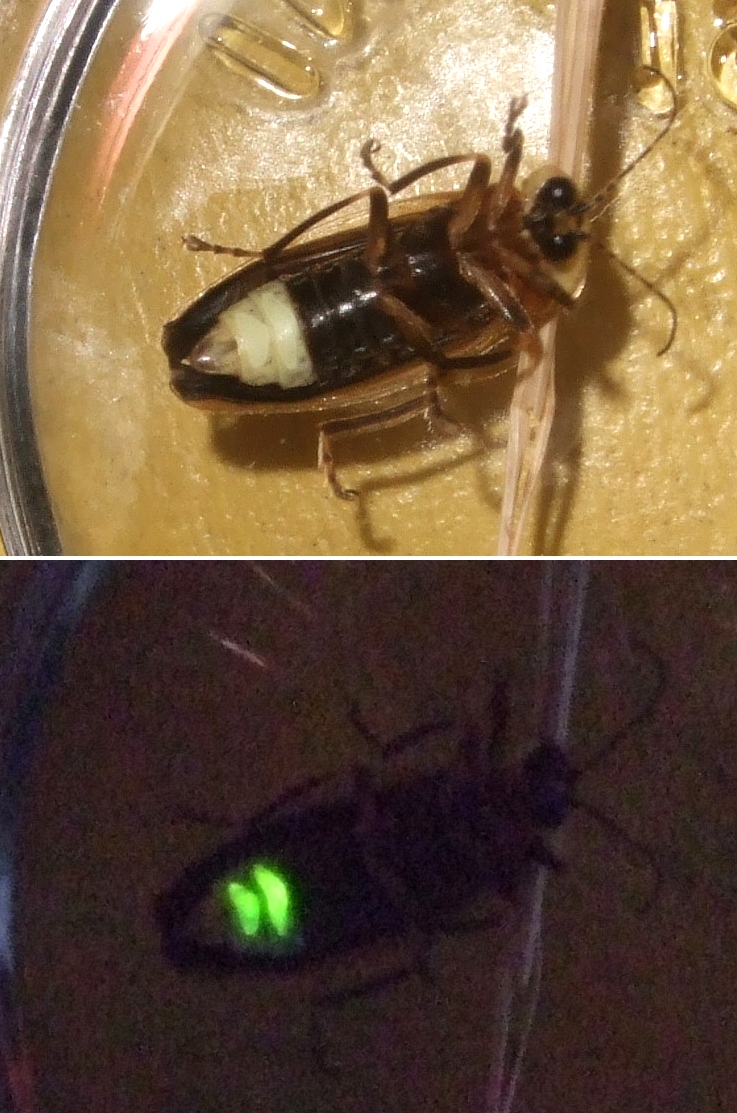
Fireflies are a family of beetles called the Lampyridae. These beetles are special in that most of them have bioluminescence, the ability to produce light. They are sometimes called fireworms, firebugs, firebeetles, glowflies, glow-worms, glowbugs, glowbeetles, lightning flies, lightning worms, lightning bugs, lightning beetles or forest stars or simply lightflies, lightworms, lightbugs or lightbeetles. There are about 2000 different species, most of which are nocturnal.
Adults use flashes of light to attract mates. Also, firefly larvae flash their lights to warn predators that they are not a tasty meal. Many predators do not like the taste of firefly larvae.
Body
A firefly is an insect, so it has an exoskeleton and three body parts. Much like an annual cicada, they are usually soft-bodied, often with the elytra (front wings) more leathery than in other beetles.
A firefly may be brown or black with yellow and red marks.
Function
All fireflies glow as larvae. Bioluminescence serves a different function in lampyrid larvae than it does in adults. It appears to be a warning signal to predators, since many firefly larvae contain chemicals that are distasteful or toxic.
Light in adult beetles was originally thought to be used for similar warning purposes, but its main purpose is now thought to be mate selection. Fireflies are a classic example of an organism that uses bioluminescence for sexual selection. They have evolved a variety of ways to communicate with mates in courtships: steady glows, flashing, and the use of chemical signals unrelated to photic systems.
Habitat
Fireflies live in tropical climates in the United States, Latin America, Caribbean Island, and South East Asia. They also live east of Rocky Mountains. Fireflies like to live in damp areas and dry areas. Examples of damp areas are rain forests, streams, marshes, ponds and leaf piles. Examples of dry areas are backyards and meadows.
Most species live in marshes or near water, because there their larvae have more than enough food.
Written for younger readers
Firefly, in simpler words
This version comes from Wikijunior, a set of books written for children aged 8 to 11. It is shorter and uses plainer language than the article above.
From Wikijunior: Bugs
Have you ever been in a field at night and sometimes seen little flying specks of light around? Well, if you were to look at one up close you’d realize that these lights are really bugs! These bugs are called fireflies. When you look close-up, you can see that fireflies have soft bodies, compound eyes and a bright, glowing rear end. The firefly’s larvae look almost exactly like fully grown fireflies, except that they don’t have the compound eyes the adults have.
Fireflies are among the most familiar insects. They belong to the Family Lampyridae. Lampyrids are able to flash their lights on and off, unlike other luminescent insects which glow continuously. The flashing rhythm is different in various species.
Like many other beetles, fireflies are brownish or blackish in color. Fireflies are medium sized insects, from 1/4 to 3/4 inches long. The sheath or covering that protects the wings is fairly soft. The protective shield (pronotum) extends forward beyond the body to hide the head from above. Females may be short-winged or wingless. The last 2 or 3 segments of the abdomen have a green, yellow, or orange luminous organ. The light comes from many tiny air tubes (tracheoles). They contain unstable molecules that break down to create light. The light on the firefly’s tail does not feel warm to the touch.
The Pyralis Firefly is 3/8 to 1/2 inches long. The protective shield is rosy pink with dull yellow edges. There is a black spot in the center. The protective wing coverings (elytra) are mostly blackish brown with dull yellow sides and middle. Both males and females have flashing lights. Females have a smaller light and do not fly. The smaller Scintilating Firefly is yellow and pink with a large black spot on its pronotum.
The Pennsylvania Firefly is 3/8 to 5/8 inches long. The body is long and flattened. The head is dull yellowish in color with threadlike antennae. Eyes are large and widely separated. The pronotum is a dull yellowish color with a black spot inside a reddish ring. Elytra are brown or gray and with a narrow pale stripe down the middle and yellow bands down the sides. Both sexes have a green luminous organ at the end of the abdomen. The larva is spindle-shaped.
Fireflies (or Lightning Bugs, as they are called in some parts in the United States) are found everywhere in the world, usually in marshes and forests; places that have enough food for the firefly’s young. The firefly is so widespread, that in some parts of the United States, the firefly is known by both the name firefly and the term “lightning bug”. They are also known as “glowing bug”.
Fireflies spend a lot of time clinging to foliage, tree trunks, and branches. Some live in moist places under debris and decaying vegetation on the ground. Others are found beneath bark and decaying vegetation.
Pyralis Fireflies are found east of the Rocky Mountains. They are usually seen in meadows. The Skintilating Firefly is found from New England to Kansas and Texas. Fireflies in the Pennsylvania Family are found from the Atlantic Coast to Texas and north to Manitoba. They live in meadows and open woods.
Fireflies are predatory when young, but as adults they usually eat plant pollen and nectar. This mixed diet depends on the type of species of firefly as there are around 2,000 different firefly species. The larvae of the firefly mainly eat the larvae of snails and slugs. They catch their prey usually by spitting digestive fluids (like spit and stomach acid) at their prey using organs near their mouth known as mandibles.
Adults are not known to feed, but they are sometimes attracted to moth baits. Firefly larvae prey on small animals, insect larvae, snails, and slugs.
Pennsylvania Fireflies eat soft bodied insects, snails, slugs, and mites. They also eat members of their own species.
It is not well known how fireflies actually protect themselves.
Both fireflies and their larva are luminescent. The light may serve as a warning to predators that they do not taste good.
Fireflies flash their lights to help them find a mate of their own species. There may be several different species courting in the same field, so each species has its own flashing code.
The firefly goes through the four-stage type of metamorphosis known as holometabolism. The firefly starts life as an egg and in three to four weeks hatch into larvae. The larvae hatch mainly in the spring and already glow like the adult firefly. For this reason, the larvae of some firefly species are known as glowworms. Most of the time, the firefly larvae will stay in this stage until the next spring. Then they go into the pupal stage for approximately two weeks. Finally, they emerge as adult fireflies; however, some firefly larvae won’t reach the pupal and adult stage for a few years, depending on the species.
Pennsylvania Fireflies and Pyralis Fireflies lay eggs in rotting wood and humid debris on the ground. Larvae hatch in spring. The fully grown larvae spend the winter in pupal chambers hidden in the soil. They pupate the following spring. Adults emerge from early summer to late August. Eggs, larvae, and pupae are all luminous.
The firefly’s well known behavior is its bright rear end, which is used usually around mating. The process that makes the firefly’s rear end glow is known as lighting, which is caused by the firefly’s special organs inside itself. Most species of firefly are also nocturnal. Some species of firefly surprisingly do not have the glowing rear end, and are diurnal, which means that they are active at daytime like humans are. Some of these non-bright species glow when they are under shade, though.
Fireflies have trouble surviving in captivity. In just a few minutes after capture, the regular rhythm of their flashes is lost and the light slowly fades.
Most of the fireflies that we see are males. Each species emits a specific signal. Upon recognizing the specific code, the female will respond with her own signal. The male quickly finds her and they mate.
Sometimes females of one species flash another species’ mating code. When the male nears it is captured and eaten. Glowworms and fireflies belong to the same beetle sub-family. Only the females produce light to attract males.
The firefly is known for being part of different people’s cultures. In ancient Mayan folklore, the firefly used to be associated with the stars. In ancient China, fireflies were caught and used to light lanterns. The Pyralis Firefly is named after a fabled fly that rose from the fire. Pyralis is Greek for “of fire.” In modern times, the firefly is known for being the state insect of Pennsylvania.
Where this page comes from
The article above is adapted from “Firefly” on Simple English Wikipedia, by its contributors. We removed reference markers, navigation boxes and tables, expanded measurement templates into readable numbers, and kept the prose otherwise intact. The simpler version is adapted from Wikijunior on Wikibooks.
Both sources are published under CC BY-SA 4.0, so this page is published under the same licence. You may share and adapt it, including commercially, as long as you credit the original and keep the same licence.
Worksheets, answer keys and printable layouts elsewhere on K5Print are our own work and are not covered by this licence.