Fly

Scientific name
- Scientific name
- Diptera
- Kingdom
- Animalia
- Phylum
- Arthropoda
- Class
- Insecta
- Order
- Diptera
How to say it in other languages
- Chinese
- 雙翅目
- Dutch
- Tweevleugeligen
- French
- Diptère
- German
- Zweiflügler
- Japanese
- ハエ目 (双翅目)
- Korean
- 파리목
- Portuguese
- Dípteros
- Russian
- Двукрылые
- Spanish
- Dípteros
Facts from Wikipedia’s “Fly” page and Wikispecies (CC BY-SA 4.0).
A fly (plural: flies) is an insect of the order Diptera. The Diptera is a large order of advanced flying insects.
Their most obvious difference from other insects is in their flight. A normal fly has two flight wings on its thorax and a pair of halteres. The halteres, which evolved from the hind wings, act as flight sensors: they are balance organs. Also flies have large eyes with excellent wide-angle vision.
With the help of their eyes and halteres, flies are exceptional fliers. They can avoid most predators, and are among the hardest insects to capture by hand. Their jinks, dives and turns to avoid their predators is their main adaptation. “These flies do a precise and fast calculation to avoid a specific threat and they are doing it using a brain that is as small as a grain of salt”…. “And they can fly like an ace at birth. It’s like putting a newborn baby in the cockpit of a fighter aircraft and it knowing what to do”.
The only other order of insects bearing two true, working wings plus any form of halteres are the Strepsiptera, a small order of insects. In contrast to the flies, the Strepsiptera evolved their halteres from their front wings and their flight wings are their rear wings.
The presence of a single pair of wings distinguishes true flies from other insects with “fly” in their name, such as mayflies, dragonflies, damselflies, stoneflies, whiteflies, fireflies, sawflies, caddisflies, butterflies or scorpionflies.
Some true flies have become secondarily wingless, including some that live in social insect colonies.
Life cycle
Flies are also holometabolous, with complete metamorphosis. This means their eggs turn into grubs, which eat voratious. Then they turn into pupae. Their bodies change while they are in the pupa.
Kinds of flies
There are an estimated 1,000,000 species, although only about 150,000 species have been described.
There are many different kinds of flies. Scientists have named 125,000 kinds (species).
- Houseflies are grey or black and can be found wherever people are.
- Horse flies and deer flies can bite people and animals.
- Fruit flies can be found near fruit that is too ripe.
- Hoverflies look like small wasps, but they have no sting.
Some flies do not have the word fly in their name, so people may not know they are flies.
- Mosquitoes are flies that bite people and can carry diseases, such as malaria.
- Midges are small flies, a bit like mosquitoes, but not all midges bite.
- Gnats are small flies that sometimes are in big groups called swarms.
Some insects have the word fly in their names, but they are not flies at all.
- Fireflies are a kind of beetle that can make light.
- Dragonflies and damselflies are from the order Odonata and are not flies.
Written for younger readers
Fly, in simpler words
This version comes from Wikijunior, a set of books written for children aged 8 to 11. It is shorter and uses plainer language than the article above.
From Wikijunior: Bugs
The word “fly” is often used to describe the house fly. There are more than 110,000 species of flies. That makes the Fly group the fourth largest insect group.
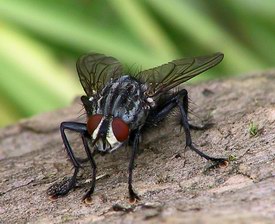
House flies are the best known fly species. Like all insects, they have 6 legs, 2 antenna, and 3 body regions (head, thorax, and abdomen). Antenna bristles are slightly feathery.
Most house flies are 1/16-inch to 1/2-inch long. They are dark with 4 black, lengthwise stripes on the thorax (middle section). Instead of chewing mouthparts, they have sponging mouthparts. They have reddish eyes.
Their long, hairy legs have adhesive pads and sharp claws on the tarsus (last segment). They have wings only on the thorax. Wings are made of thin sheets of chitin sandwiched together. A network of veins runs between the sheets to give support. The wings are held level and straight over the back.
House flies occur worldwide except in Antarctica and a few remote islands.
They are commonly found on poultry and hog farms, horse stables and ranches. They are found where there is waste for food and manure for breeding.
Adult house flies feed where they find decaying matter, sugar, or flower nectar. They feed on honeydew left by aphids or other bugs. Adult houseflies never have chewing mouthparts. They use saliva to change solids to liquids. Sponge-like mouthparts pick up semi-liquid foods, such as feces and decaying matter.
Fly larvae feed on moist organic matter. They need to store away a great deal of protein so as adults they have energy to search for food, find a mate, and produce eggs. They have sharp, curved “mouth hooks” used to scrape and cut solid food before flooding it with digestive enzymes.
The fly’s main defenses are its speed and agility. It has eyes that can see a very wide view of the world and help them notice fast movement and escape predators. Flies are often preyed upon by birds, spiders, and other flying insects.
House flies and their larvae (maggots) breed most commonly in manure. They undergo complete metamorphosis with egg, larval, pupal, and adult stages.
Female house flies lay 5 to 6 batches of 75-120 white oval eggs. Larvae hatch from eggs in about 12 hours. They are segmented, tapered at the head and blunt at the end. After growing for about 5 days they change into rounded, oblong pupae. Mature adult flies emerge after about 5 more days.
They begin breeding almost immediately. Thus, each new generation takes 10 to 12 days to develop. If temperatures are low, development may take a month or longer. Males live about fifteen days. Females live up to twenty-six days if they have access to food and water.
If a single female house fly laid 120 eggs in spring, and if all offspring survived, over five-trillion new flies could hatch by fall!
House flies are “disease vectors,” carrying as many as a half billion bacteria and other organisms on their body at one time.
Adult house flies can taste with their feet! They use a “vomit drop” of saliva to turn solid morsels into liquid nourishment.
If there are clear plastic bags, half-full of water, outside doors and windows, house flies have trouble. The constant motion of the water interferes with their vision.
House flies carry germs that cause dysentery, anthrax, typhoid fever and other diseases. They breed in unclean places. Their soft, sticky feet and hairy legs pick up “filth” from contaminated matter. When they land on people or objects, they drop bacteria and germs with every step.
House flies can be beneficial to people as pollinators of flowering plants and decomposers of waste matter.
Where this page comes from
The article above is adapted from “Fly” on Simple English Wikipedia, by its contributors. We removed reference markers, navigation boxes and tables, expanded measurement templates into readable numbers, and kept the prose otherwise intact. The simpler version is adapted from Wikijunior on Wikibooks.
Both sources are published under CC BY-SA 4.0, so this page is published under the same licence. You may share and adapt it, including commercially, as long as you credit the original and keep the same licence.
Worksheets, answer keys and printable layouts elsewhere on K5Print are our own work and are not covered by this licence.