Insects

Scientific name
- Scientific name
- Insecta
How to say it in other languages
- Arabic
- حشرة
- Chinese
- 昆蟲綱
- Dutch
- Insecten
- French
- Insectes
- German
- Insekten
- Italian
- Insetti
- Japanese
- 昆虫綱 (こんちゅうこう)
- Korean
- 곤충강
- Portuguese
- Inseto
- Russian
- Насекомые
- Spanish
- Insecto
Facts from Wikipedia’s “Insect” page and Wikispecies (CC BY-SA 4.0).
Insects are a class in the phylum Arthropoda. They are small terrestrial invertebrates which have a hard exoskeleton.
Insects are the largest group of animals on Earth by far: about 926,400 different species have been described. They are more than half of all known living species. They may be over 90% of animal species on Earth.
New species of insects are continually being found. Estimates of the total number of species range from 2 million to 30 million.
All adult insects have six legs; and most have wings. Insects were the first animals capable of flight. As they develop from eggs, insects undergo metamorphosis. Insects live all over the planet: almost all are terrestrial (live on land). Few insects live in the oceans or in very cold places, such as Antarctica. The most species live in tropical areas.
Some people call all insects “bugs”, but this is not correct. Only some insects are true bugs, which is a particular order of insects. People who study insects are called entomologists.
Insect bodies
Insects have exoskeletons (skeletons on the outside). Their skeletons are made out of thin, hard pieces or plates, like armour, made of chitin. All together, these pieces make a hard layer around the insect’s body. The exoskeleton protects the insect.
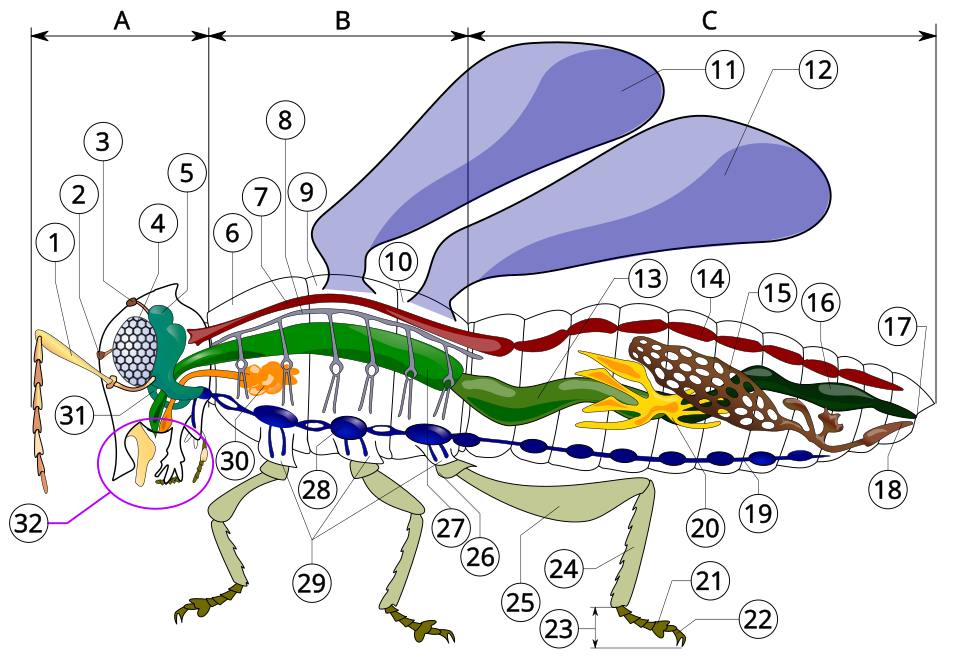
The body of an insect has three main parts: a head, a thorax, and an abdomen. On the head are an insect’s compound eyes, its two antennae (they feel and smell things), and its mouth.
On the thorax, insects have wings and legs. All insects have six legs (three pairs of jointed legs) and usually four wings (two pairs).
The abdomen is the back part of the insect. Inside the abdomen is the stomach, the heart, and the excretory system where body wastes pass out of the insect. Bees also have a stinger at the back of the abdomen.
Physiology
Just like our muscles connect to our bones to make us walk and stand up, the muscles of an insect connect to the exoskeleton to make it walk and move. Their muscles are on the inside of their skeleton.
Insects are cold-blooded, which means that they cannot control their body temperature. This means that insects are not good at surviving the cold, at any rate out in the open. In the winter, many insects go into something called diapause, which is the insect version of hibernation. Some insects, like cockroaches, cannot go into diapause and they will die if it gets too cold outside. This is why cockroaches love living in people’s warm houses.
Respiratory and circulatory systems
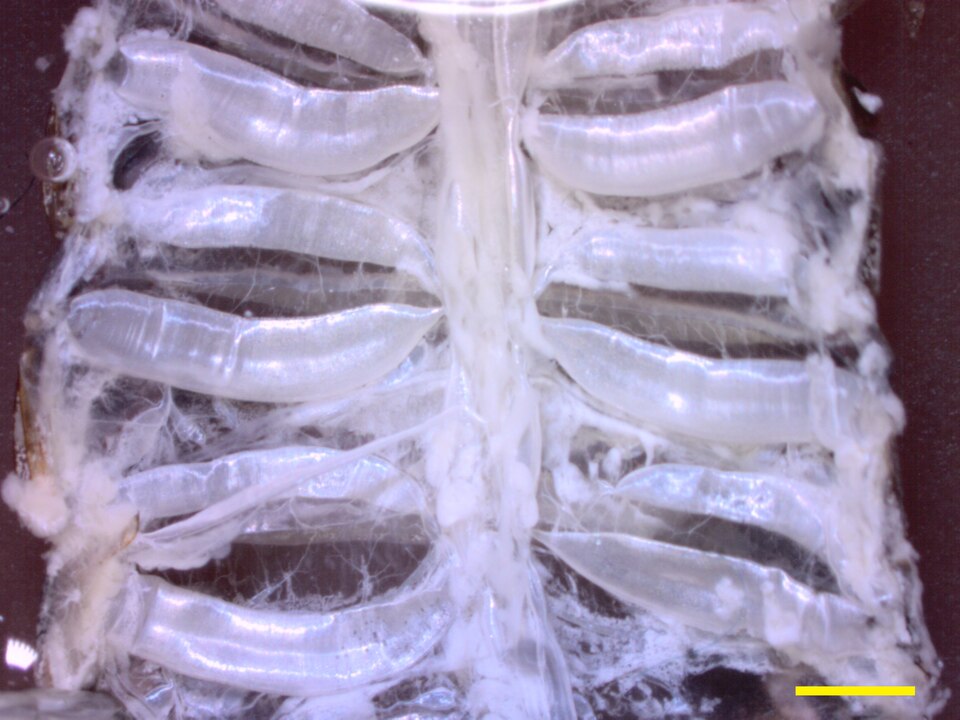
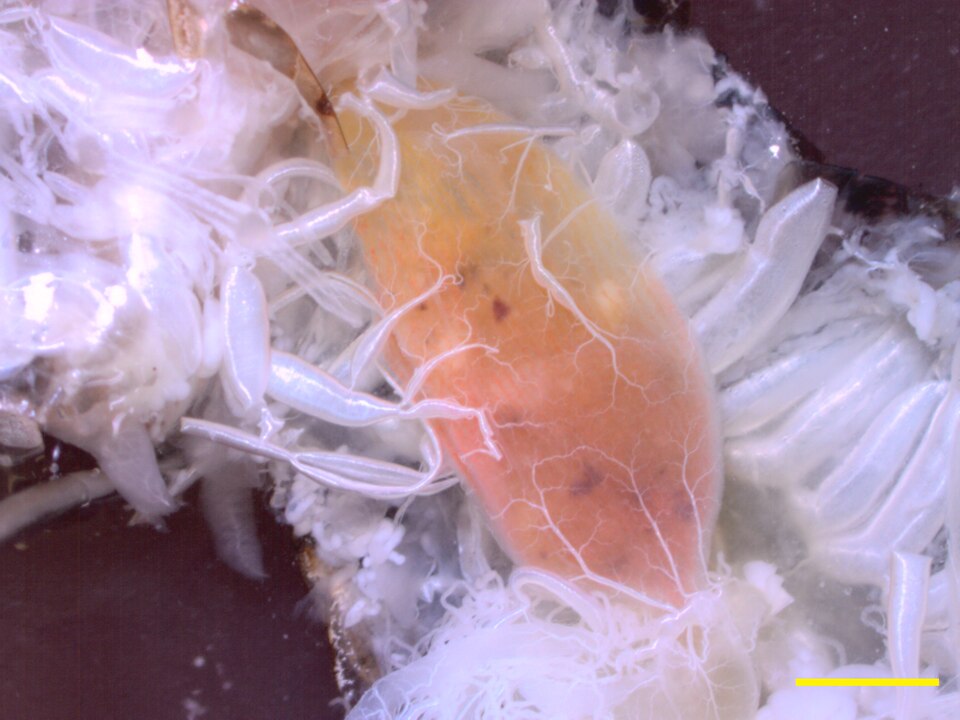
Insect respiration happens without lungs. There is a system of internal tubes and sacs through which gases diffuse or are actively pumped. Air is taken in through openings on the sides of the abdomen called spiracles. Oxygen gets to tissues that need it through their trachea (element 8 in diagram).
Many insect larva e live in water. Many of those have gills that can extract oxygen dissolved in water. Others must rise to the water surface to get air which may be held or trapped in special parts of their body.
Adult insects use oxygen at a high rate when they fly. They need it for the flight muscles, the most active tissue known in biology. The flight muscles use oxygen at a huge rate: 100 ccs of oxygen for every single cc of tissue per hour. With this system, the greatest diameter a muscle could have (and still consume oxygen at this rate) is about 0.5 cm. Even with special extra arrangements, insects cannot get larger than about 11 cm long. The largest insect bodies are about as big as a mouse.
Some insects also use a molecule called haemocyanin, which does the same job as haemoglobin does in vertebrates (but less efficiently). The insect circulatory system has no veins or arteries. The ‘blood’ is called haemolymph, and moves around in the space called the haemocoel. The organs sit in the haemocoel and are bathed in the haemolymph. The ‘heart’ is little more than a single tube which pulses (squeezes).
How insects grow
Insects start life as an egg. Usually a female (mother) insect lays eggs, but a few species have live birth (the eggs develop inside the mother). The eggs are small; but they can usually be seen with the naked eye.
Although the adults are larger, they do need a magnifying glass or a binocular microscope to see the details. A professional entomologist uses a binocular microscope to identify insects, plus a printed reference work. There are far too many insects for anyone to remember them all, and most entomologists specialise in just one or two orders.
After the eggs hatch, two kinds of development may occur. Some insects have what is called ‘incomplete metamorphosis’. This means that a small insect, called a nymph comes out of the egg, and the nymph looks almost the same as the adult insect. As the nymph grows, it does not change the way it looks, but only how big it is. It goes through a number of stages, called ‘instars’. Grasshoppers grow in this way.
Other insects have complete metamorphosis, which means that the small larva which comes out of the egg looks very different from the adult insect. Insects that have complete metamorphosis usually come out of the egg as a larva, which usually looks like a worm. The larva eats food and gets bigger until it turns into a pupa. Butterfly pupae (plural for pupa) are often inside cocoons. Inside the cocoon the insect changes the way it looks and often grows wings. When the cocoon opens, the adult insect comes out. Many insects have complete metamorphosis, for example beetles, butterflies and moths, and flies. The adult stage of development is called the imago.
Origin of insects
The oldest known insect fossil is the Devonian Rhyniognatha, from the 411 million year old Rhynie chert. It may have superficially resembled a modern-day silverfish insect. This species already possessed mandibles of a type associated with winged insects, suggesting that wings may already have evolved at this time. Thus, anatomical records suggest the first insects may have appeared earlier, in the Silurian period. Genomic analysis puts their origin even further back in the Ordovician period.
If Rhyniognatha is not an insect, then Rhyniella from the same place is the first known insect. Also 411 mya.
Origin of wings
In 2008, researchers uncovered what they believe is the world’s oldest known full-body impression of a primitive flying insect, a 300 million-year-old specimen from the Carboniferous period.
The origin of insect flight is unclear, since the earliest known winged insects appear to have been capable fliers. Some extinct insects had an additional pair of winglets attaching to the first segment of the thorax, for a total of three pairs. It seems the insects were not a particularly successful group of animals before they evolved wings.
Upper Carboniferous and Lower Permian insect orders include both living groups and a number of Palaeozoic groups, now extinct. During this era, some giant dragonfly-like forms reached wingspans of 55 to 70 cm (22 to 28 in) making them far larger than any living insect.
This gigantism may have been due to higher atmospheric oxygen levels, which allowed increased respiratory efficiency. The lack of flying vertebrates could have been another factor. Many of the early groups became extinct during the PermianTriassic extinction event, the largest mass extinction in the history of the Earth, around 252 million years ago.
Kinds of insects
Different kinds of insects are put into groups called orders. There are about 29 insect orders. The biggest insect orders are listed below:
- Beetles (order Coleoptera) have the front pair of wings changed into a hard shell to protect the back wings.
- Butterflies and moths (order Lepidoptera) have large, often colourful wings.
- Flies (order Diptera) have only two wings.
- Ants, bees, and wasps (order Hymenoptera) sometimes have stingers and sometimes live in large colonies (like ant hills).
- True bugs (order Hemiptera) have a mouth that is long and narrow, like a drinking straw. This kind of mouth is called a beak.
- Grasshoppers (order Orthoptera) can usually jump with their legs. Eat grass and grain plants.
- Odonata, dragonflies and damselflies are top predators of other insects. Both aquatic nymphs and flying adults are carnivorous.
- Phasmatodea, the stick and leaf insects, is an order which is entirely based on camouflage. It includes the world’s longest insect, Chan’s megastick.
All these groups except one (Odonata) are strongly connected with plants as a source of food.
Spiders, scorpions, and similar animals are not insects; they are arachnids. Arachnids are arthropods that have four pairs of legs. Centipedes are also arthropods, but not insects: they are in a subphylum called the Myriapoda.
Taxonomy
This taxonomy lists some of the better known groups of insects.
- Archaeognatha (jumping bristletails)
- Thysanura (silverfish or bristletails)
- Palaeoptera (insects that cannot flex their wings over their abdomen)
- Ephemeroptera (Mayflies)
- Odonata
- Anisoptera (dragonflies)
- Zygoptera (damselflies)
- Neoptera (insects that can flex their wings over their abdomen)
- Exopterygota sensu stricto
- Caloneurodea (extinct)
- Titanoptera (extinct)
- Protorthoptera (extinct)
- Plecoptera (stone flies, about 1700 species)
- Embioptera (webspinners, about 300 species)
- Orthoptera (grasshoppers, crickets and locusts)
- Zoraptera (one genus, about 30 species, resemble termites)
- Dermaptera (earwigs)
- Dictyoptera
- Notoptera
tentative - Grylloblattidae (ice crawlers)
- Mantophasmatidae (discovered in 2001, (gladiators)
- Phasmatodea (stick insects, about 2500 species)
tentative - Blattaria (cockroaches)
- Isoptera (termites)
- Mantodea (mantids)
- Paraneoptera
- Psocoptera (booklice)
- Thysanoptera (thrips)
- Phthiraptera (lice)
- Hemiptera (true bugs, 80.000 species)
- Endopterygota or Holometabola (850,000 living species in eleven orders)
- Hymenoptera (ants, bees, wasps, sawflies)
- Coleoptera (beetles)
- Strepsiptera (parasites that mostly live inside other insects)
- Raphidioptera (snakeflies)
- Megaloptera
- Neuroptera (net-winged insects, contains antlions for example)
- Mecoptera (scorpionflies, may include fleas)
- Siphonaptera (fleas)
- Diptera (true flies)
- Trichoptera (moth-like)
- Lepidoptera (moths and butterflies)
Insects and people
Some insects can be pests to people in different ways. Some are parasites, such as lice and bed bugs. Some of these parasite insects spread diseases, for example mosquitoes spread malaria.
Many insects eat agricultural products (plants meant for people to eat). Locustss are an example of pest insects that eat plants in agriculture.
Some insects are used by us. Bees make honey. The larvae of some moths make silk, which people use to make clothing. In some parts of the world, people actually eat insects. Eating insects for food is called entomophagy.
Many bees and flies pollinate plants. This means the insects help the plants make seeds by moving pollen from one flower to another. Some good insects eat pest insects, such as lady beetles (or ladybirds or ladybugs) eating aphids. Many insects eat dead plants and animals.
Pesticides
People often use poisons called insecticides to kill pest insects. Insecticides do not always work. Sometimes the pest insects become resistant to the insecticides, which means the insecticides do not hurt them anymore. Both the Colorado potato beetle and the diamondback moth are insects that are resistant to many insecticides.
Insecticides do not only kill pest insects; sometimes many helpful insects are killed too. When helpful insects are killed, such as those that eat pest insects, the pest insects may come back in larger numbers than before because they are not being eaten by helpful insects anymore.
Written for younger readers
Insects, in simpler words
This version comes from Wikijunior, a set of books written for children aged 8 to 11. It is shorter and uses plainer language than the article above.
From Wikijunior: Animal Kingdom
There are more insects than any other creature in the world. For every person on this earth, there are hundreds or possibly thousands of insects. Insects are usually very small and easy to kill, but because there are so many of them, it would be difficult to kill them all.
Insects have probably been around longer than any other animal. They are called insects because they are divided into a head, a thorax and an abdomen. Insects always have six legs, which is why spiders are not insects. Insects have an exoskeleton instead of a regular skeleton, which means they are easy to destroy, but the exoskeleton keeps them relatively intact.
Insects usually live in giant colonies of themselves, although some of them, such as flies, do not. They start as maggots and later begin to fly. Insects usually eat leaves or other insects.
Throughout human history, people have been bothered by insects. Some insects are parasites who cause diseases and might even feed on human blood, like mosquitoes. This is why humans have developed various techniques for trying to destroy insects.
Some insects have been good for people. Bees help farmers by spreading flower pollen which makes more flowers.
- Cockroach
- Fly
- Ant
- Ladybug
- Butterfly
Where this page comes from
The article above is adapted from “Insects” on Simple English Wikipedia, by its contributors. We removed reference markers, navigation boxes and tables, expanded measurement templates into readable numbers, and kept the prose otherwise intact. The simpler version is adapted from Wikijunior on Wikibooks.
Both sources are published under CC BY-SA 4.0, so this page is published under the same licence. You may share and adapt it, including commercially, as long as you credit the original and keep the same licence.
Worksheets, answer keys and printable layouts elsewhere on K5Print are our own work and are not covered by this licence.