Jaguarundi

Fast facts
- Conservation status
- Least concern
Scientific name
- Scientific name
- Herpailurus yagouaroundi
How to say it in other languages
- French
- Jaguarondi
- German
- Jaguarundi
- Japanese
- ジャガランディ
- Portuguese
- Jaguarundi
- Spanish
- Jaguarundí
Facts from Wikipedia’s “Jaguarundi” page and Wikispecies (CC BY-SA 4.0).
The jaguarundi (Puma yagouaroundi) is a small wild cat native to Central and South America. It is a smaller relative of the better-known cougar, and has many local names.
The cat is still widespread throughout the Amazon Basin, and is listed as least concern on the IUCN Red List since 2002. It is sometimes found in Mexico and southern Texas, and as far south as northern Argentina and these cats have been introduced to the state of Florida and state of Alabama in 1980’s.
Jaguarundis are mostly daytime animals. They are comfortable in trees, but hunt on the ground.
According to a 2006 genomic study of Felidae, an ancestor of today’s Leopardus, Lynx, Puma, Prionailurus, and Felis lines migrated across the Bering land bridge into the Americas about 8.0 to 8.5 million years ago.
Written for younger readers
Jaguarundi, in simpler words
This version comes from Wikijunior, a set of books written for children aged 8 to 11. It is shorter and uses plainer language than the article above.
From Wikijunior: Big Cats
NOTOC
Jaguarundis are one of the oddest members of the cat family, rarely seen, and often thought to be otters when they were spotted. Their scientific name, Herpailurus, means “snake-like cat”.
Jaguarundis live in Central and South America, and in the southern tip of Texas. They live in areas of lowland brush close to a running water source and will occasionally inhabit dense tropical areas.
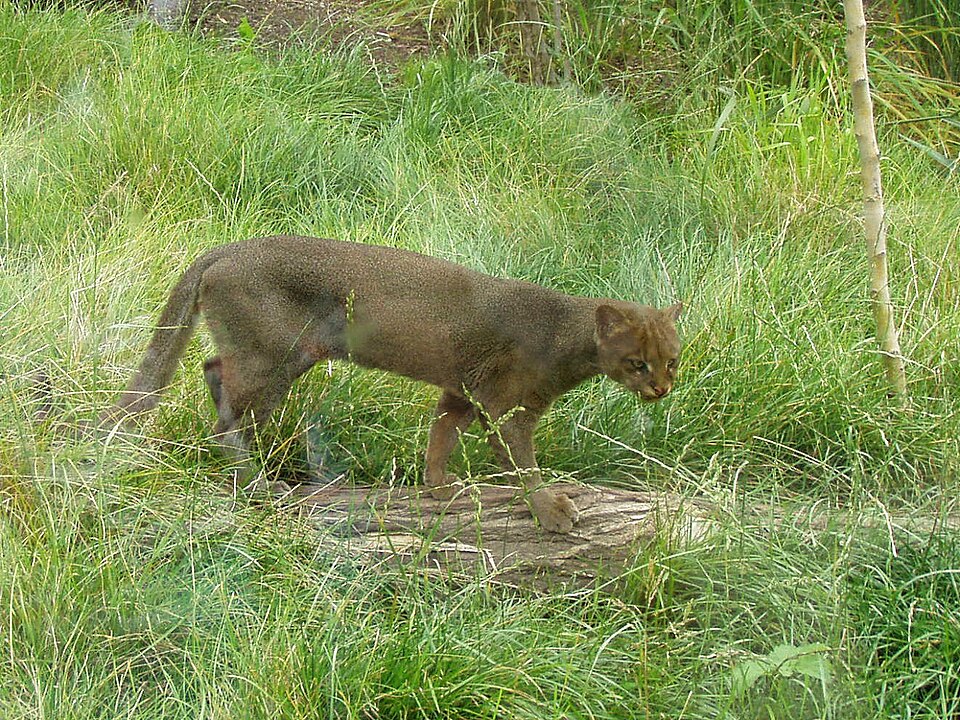
This medium-sized cat has an average length of 65 cm (30 inches) with 45 cm (20 inches) of tail. It has short legs and an appearance somewhat like an otter; the ears are short and rounded. The fur is a uniform chestnut brown, but can range from grey to dark brown. Their coats have no markings except for spots at birth.
Jaguarundis eat fish, small mammals, reptiles and birds. They feel comfortable in trees but prefer to hunt on the ground. They can also eat rabbits, armadillos, small rodents, lizards, and bird eggs. They can enter the water or scale a tree to reach their prey.
See how much you know about the jaguarundi:
They have a name like the jaguars, but are the closest living relative of the puma.
The Jaguarundi can reach speeds of over 60 mph
They are diurnal, unlike most cats, they are active during the day.
They have retractable claws
They have rough bumps on their tongue; Papillae, that help them scrape meat from the bone.
They sleep in enclosed spaces, such as hollow logs or caves.
Wikipedia: Jaguarundi
Next Topic: Rusty-spotted cats
de:Wikijunior Großkatzen/ Jaguarundi
Where this page comes from
The article above is adapted from “Jaguarundi” on Simple English Wikipedia, by its contributors. We removed reference markers, navigation boxes and tables, expanded measurement templates into readable numbers, and kept the prose otherwise intact. The simpler version is adapted from Wikijunior on Wikibooks.
Both sources are published under CC BY-SA 4.0, so this page is published under the same licence. You may share and adapt it, including commercially, as long as you credit the original and keep the same licence.
Worksheets, answer keys and printable layouts elsewhere on K5Print are our own work and are not covered by this licence.