Jumping Spider

Fast facts
- Phylum
- Arthropoda
Scientific name
- Scientific name
- Salticidae
- Kingdom
- Animalia
- Phylum
- Arthropoda
- Class
- Arachnida
- Order
- Araneae
- Family
- Salticidae
How to say it in other languages
- Chinese
- 跳蛛科/蠅虎科
- Dutch
- Springspinnen
- French
- Araignées sauteuses
- German
- Springspinnen
- Japanese
- ハエトリグモ科
- Korean
- 깡충거미과
- Russian
- Пауки-скакуны
Facts from Wikipedia’s “Jumping spider” page and Wikispecies (CC BY-SA 4.0).
Jumping spiders belong to the family Salticidae. These spiders catch their prey by jumping on them.
Species live in many habitats, from leaves lying on the ground, to the tops of trees in the forest, and even way up on Mt. Everest. They are found on every continent in the world except for Antarctica.
At present, 5026 species in 530 genera have been found. They are actually the largest family of spiders, with about 13% of all species.
Appearance
They are easy to identify because their eye pattern is distinctive. They have eight eyes, two of which are very large, and because their faces form a flat surface, facing where they are going.
Behaviour
They often hunt high up in bushes, or on vertical walls. To save themselves from falling they do something very much like what climbers do to protect themselves in the mountains. Humans tie a rope to the mountain and attach the other end to the harness they wear. Jumping spiders attach silk from their spinnerets to the thing on which they are standing and then they jump. While they are moving through the air they make silk so that there is always a safety rope trailing out behind them.
Jumping spiders can jump long distances for their size, as much as 16 cm. p11 When they jump, they use their hind legs. They raise their front legs to be ready to grab their prey.
Many other kinds of spider hunt at night, but jumping spiders depend on their eyes, so they like to come out in the daytime. Often they will find a sunny spot on a wall or tree trunk.
There are however many variations, and many surprising aspects. For one thing, Salticids do not necessarily follow a straight path in approaching prey. They may follow a circuitous course, sometimes even a course that takes the hunter through places where the prey is not visible. Such complex behaviour is hard to reconcile with an organism that has such a tiny brain. Some spiders in species of Portia can take long detours from one bush down to the ground, then up the stem of another bush to capture a prey item on a particular leaf. Such behaviour is the subject of research.
Because they have good vision, jumping spiders can see human beings when they approach. Some jumping spiders may run away from approaching humans, and some do not. But either way a jumping spider will watch a nearby human being. When they do not run away, but do turn to keep watch over a human being, it may seem that they are interested in us. Some of them will even jump from where they are sitting on branches, rocks, etc. onto a person’s finger or camera. These spiders only bite to get something to eat or to defend themselves, so if they jump on somebody’s hand they will not bite. People might get bitten if they pinch or squeeze a jumping spider.
Physical capabilities
Jumping spiders are able to climb glass and other very smooth surfaces because besides having two claws on each foot they also have sticky hairs (called scopulae) that hold onto the surface. Many tiny ends on each hair are held to the glass by Van der Waals forces, the force that will make two very flat sheets of glass stick tightly together without any glue.
Jumping spiders are able to see very clearly. Two of their eight eyes are very large and are complicated inside. The eyes cannot move, so the spider will often move its body to look at what it wants to see. However, it can also move the retinas of its two main eyes on the inside of the eye, so the center of the eye’s picture can be moved. So the jumping spider has binocular vision.
Use of silk
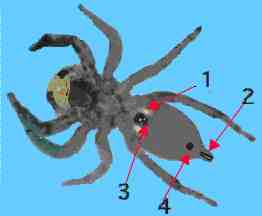
Very few kinds of jumping spider make webs; instead they use their silk for their safety rope and also to make a kind of tent where they sleep at night, shed their skins (molt), lay their eggs, and enjoy a long sleep during winter (hibernate). Their silk comes out of their spinnerets (see diagram).
Images
File:Phidippus audax3.JPG|Phidippus audax preparing to jump File:Jumping spider with prey.jpg|A camouflaged Menemerus, a jumping spider, with a winged male ant as prey. Camouflage is a form of crypsis, the ability of an organism to avoid observation or detection by other organisms. File:Phidippus mystaceus PEM.jpg|One of the larger jumping spiders found in the eastern part of the U.S., Phidippus mystaceus. This female is 12 mm. in body length. File:Salticidae eyes diag.svg|The squared-off head and eight eyes of a jumping spider
Written for younger readers
Jumping Spider, in simpler words
This version comes from Wikijunior, a set of books written for children aged 8 to 11. It is shorter and uses plainer language than the article above.
From Wikijunior: Bugs
Many Jumping Spiders are ¼ to ½ inch long. Some are 3/8 to 1 inch long. The cephalothorax (head and midsection) is shaped like a rectangle. In hot tropical regions they have bright colors and markings. Some have shiny scales to attract females. They have furry bodies and short hairy legs. Hairs sense movement of prey or predators. There are 2 claws on the tip of each leg. Sometimes there is a tuft of hair on each foot for climbing on slippery surfaces. Jumping Spiders have 8 eyes, including 2 really large eyes in the front. Young Jumping Spiders look like small versions of adults. They have different colors and markings.
Male Dimorphic Jumping Spiders have 2 different forms. One has clusters of black hair. The other has red, white, and black markings. Metaphid Jumping Spiders have spots, bands, and stripes. They are brown to yellow in color. Thick hair makes their legs look gray. Ant-mimic Jumping Spiders have a thick plate on the back and constrictions (narrow places) like ants. They are reddish-brown with white spots on each side of the abdomen.
Daring Jumping Spider males are black with light cross-bands. They have either gray or white spots on the abdomen. Their chelicerae (jaws) are metallic green. The young often have pale, yellow or orange markings.
Dimorphic Jumping Spiders live in meadows on leaves and flowers. They are found from New England to Georgia, and in the Midwest. Metaphid Jumping Spiders are found throughout North America. They live in woods, meadows, and tall grasses. They make homes on leaves and tree bark.
Ant-mimic Jumping Spiders are found from Quebec, Canada to Florida, and west to Texas and Nebraska. They live in meadows and woods, on soil and leaves. Daring Jumping Spiders are found from the Atlantic coast to the Rocky Mountains. They live on tree trunks, fallen limbs, and ground litter in the woods. They are common in gardens and houses.
One species of Jumping Spiders lives high in Asia’s Himalayan Mountains. Its scientific name means “standing above everything.”
Jumping Spiders are daytime hunters. They eat small insects and spiders. They do not spin webs. They make a long silk dragline as they pounce on victims from above. If they miss they climb back up the dragline and try again. They have strong back legs to leap and catch flying insects.
Daring Jumping Spiders eat insects. They often hunt on window sills and curtains inside houses. Ant-mimic Jumping Spiders eat ants and small insects. The Green Jumping Spider of Australia eats small frogs.
Jumping Spiders spin shelter webs for protection in winter. They make shelters under stones or leaves. Some hide in plain sight. They look like debris or bird droppings on a leaf, so predators ignore them. Some look like ants or scorpions to avoid being eaten.
They have sharp eyesight to spot predators. They can run forward, backward, or sideways to avoid capture. They can jump to get far away from danger. They can leap forty times their body length. When they sense danger, they use their silk drag line to climb up and escape.
Their small eyes cannot see clearly, but they can detect motion in all directions. Their 2 large eyes work together to make clear images.
Spiders undergo simple or incomplete metamorphosis (change). They become adults in only three stages—egg, nymph (spiderling), adult. There is no “resting” stage before they become adults.
Jumping Spider males hop, dance, and show off their bright colors to attract a mate. Females spin a silk sac for the eggs. They hide the egg sac in leaves, bark, or crevices. Females guard their eggs for a few weeks. Inside the egg sac, spiderlings are blind, and unable to eat until they get bigger. When they are big enough, they chew a hole in the egg sac and float away on a silk string. They eat and molt until they mature. It takes 3 months to grow into an adult.
Metaphid Jumping Spiders make a cocoon for their eggs. They attach it to twigs and stay close while the spiderlings grow. Ant-mimic Jumping Spiders leave their egg sacs under stones and in crevices.
Jumping Spiders are excellent hunters with very sharp eyesight. Two large eyes face forward. They work together to make one image (binocular vision). Unlike most spiders, Jumping Spiders can see colors.
Males wave their feelers to attract females. If a female approaches too quickly, the male backs away.
An Ant-mimic Jumping Spider will touch its front legs to an ant’s antennae. The ant does not recognize it as a predator and is captured.
They are curious. Instead of running away from people, they may sit and stare at them. Sometimes they jump into a person’s hand to get food. They can be trained to jump from finger to finger on a person’s hand.
Jumping Spiders will sometimes stick a dead insect on a leaf to lure prey.
The Australian Fringed Jumping Spider uses tricks to catch prey. It taps its legs or plucks web strands to make small vibrations. When the other spider comes out to investigate, it becomes the meal.
Jumping Spiders are mostly beneficial as they eat insect pests. They are especially helpful to rice farmers because they eat insects that destroy rice crops.
Jumping Spiders are not dangerous. They only bite in self-defense. Some people may have an allergic reaction to the venom. Though the venom usually does not harm us, and only leaves a small red dot
Where this page comes from
The article above is adapted from “Jumping Spider” on Simple English Wikipedia, by its contributors. We removed reference markers, navigation boxes and tables, expanded measurement templates into readable numbers, and kept the prose otherwise intact. The simpler version is adapted from Wikijunior on Wikibooks.
Both sources are published under CC BY-SA 4.0, so this page is published under the same licence. You may share and adapt it, including commercially, as long as you credit the original and keep the same licence.
Worksheets, answer keys and printable layouts elsewhere on K5Print are our own work and are not covered by this licence.