Ladybug

Fast facts
- Phylum
- Arthropoda
Scientific name
- Scientific name
- Coccinellidae
- Kingdom
- Animalia
- Phylum
- Arthropoda
- Class
- Insecta
- Order
- Coleoptera
- Family
- Coccinellidae
How to say it in other languages
- Chinese
- 瓢蟲科
- Dutch
- Lieveheersbeestjes
- French
- Coccinellidés
- German
- Marienkäfer
- Italian
- Coccinelle
- Japanese
- テントウムシ科
- Korean
- 무당벌레과
- Portuguese
- Joaninhas
- Russian
- Божьи коровки
- Spanish
- Mariquitas
Facts from Wikipedia’s “Coccinellidae” page and Wikispecies (CC BY-SA 4.0).
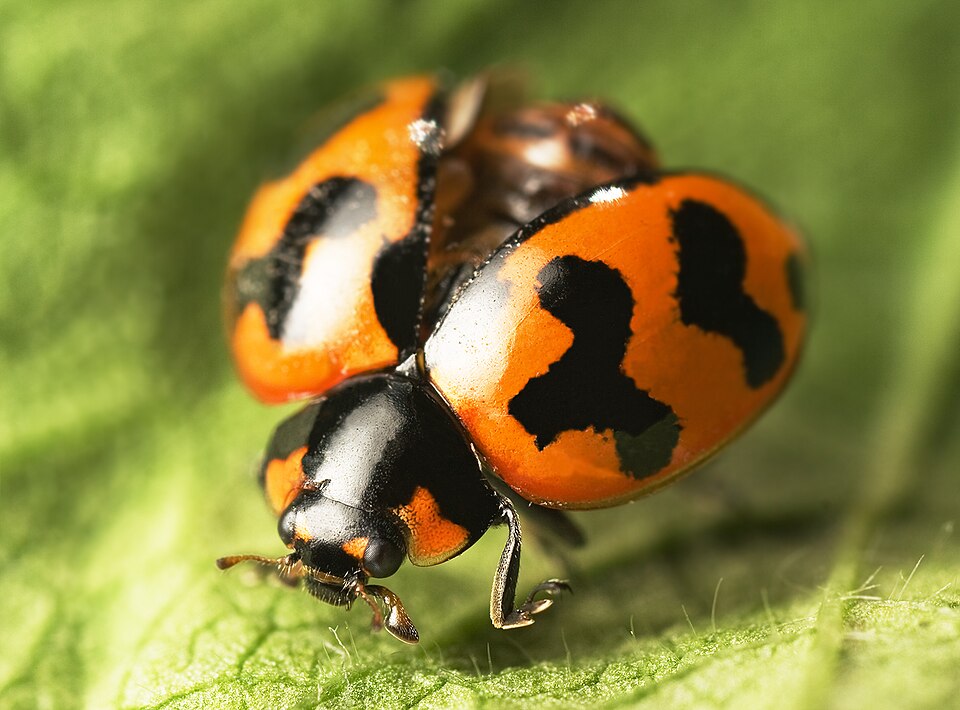
Lady beetles are the Coccinellidae, a family of beetles. All species are protected by noxious fluids based on cyanide, and most have warning colouration, such as red with black spots or black stripes.
They are often called ladybugs or ladybirds, but biologists prefer the term ‘coccinellid’ or ’lady beetle’.
Coccinellids are found worldwide, with over 5,000 species. Most species are insectivorous, feeding mainly on the true bugs, the Hemiptera. These are insects which feed on plants, such as aphids (greenfly) or scale insects. Ladybeetle larvae are also voracious (greedy) eaters of greenfly.
Harmonia axyridis (or harlequin ladybug) was introduced into North America from Asia in 1988 to control aphids. It is now the most common species there, out-competing many of the native species. It has since spread to much of western Europe, reaching the UK in 2004.
Defense
Many coccinellids are brightly coloured to warn potential predators. This phenomenon is called aposematism. It works because predators learn by experience to associate certain prey phenotypes (appearance) with a bad taste or being poisonous.
Mechanical stimulation (such as a predator attack) causes “reflex bleeding” in both larval and adult ladybird beetles. A toxin is put through the joints of the exoskeleton, deterring feeding. This method works well: birds and cats seldom try twice.
Appearance
Most people know lady beetles as small, round, red beetles with black spots on their backs. In Europe, the most common lady beetle is seven-spotted Coccinella septempunctata.
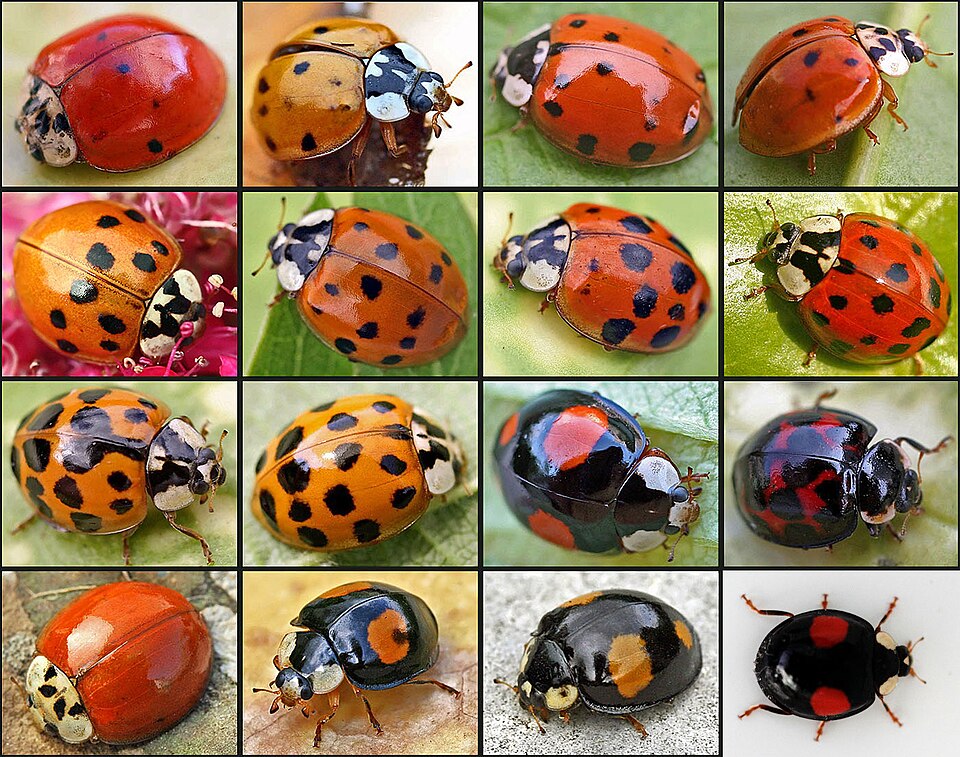
Not all lady beetles are red, and not all red lady beetles have spots. Some lady beetles are very small, black and hairy. Lady beetles vary in color as red, orange, pink, or yellow with black spots. They can also be black with red spots. Some are missing spots altogether. There are even a few kinds of ladybeetles with metallic blue iridescence, and some have checkerboard markings or stripes.
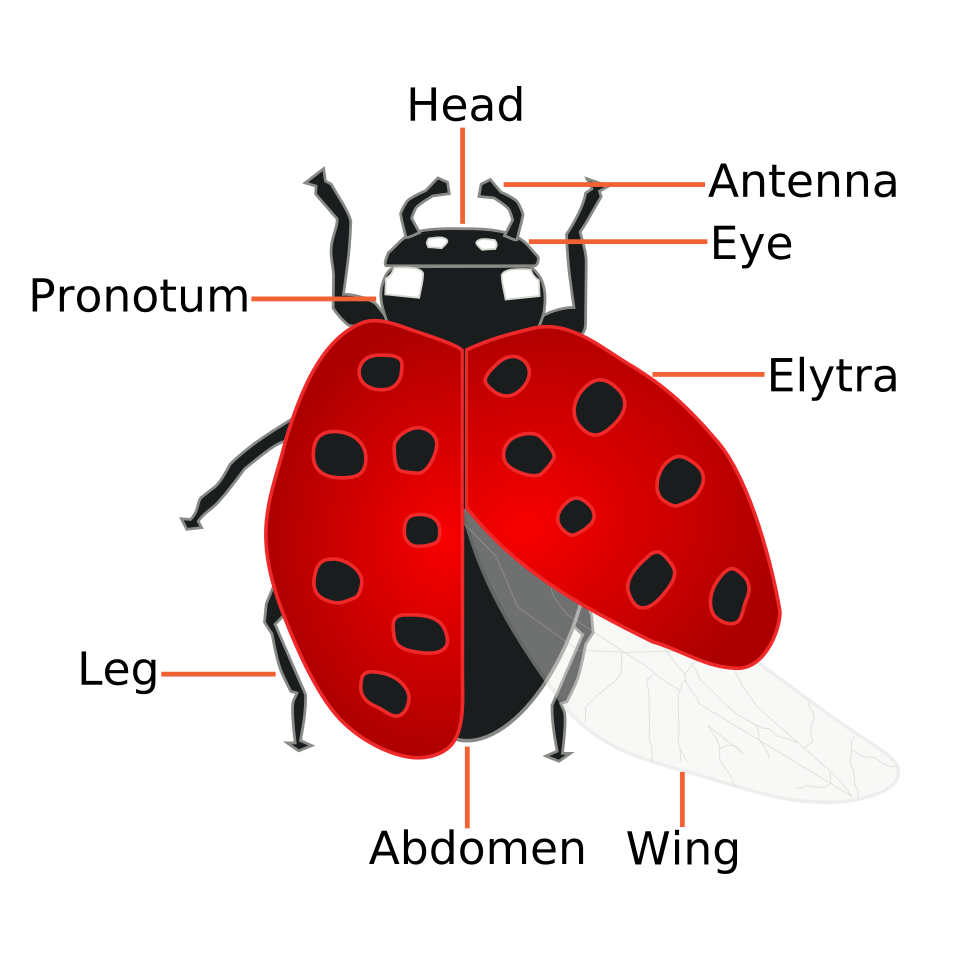
The (usually) black front part (pronotum) of the ladybeetle is the thorax and the head.
Females are usually slightly larger and rounder, while males are a bit smaller and more compact.
Life and food supply
Most coccinellids overwinter as adults. In Harmonia axyridis, eggs hatch in 3–4 days from clutches numbering from a few to several dozen. Depending on the supply of aphids, the larvae pass through four instars over 10–14 days, after which pupation occurs. After several days, the adults become reproductively active and are able to reproduce again, though not late in the season. On average, the lifespan on the lady beetle is 1-2 years.
It only takes about four weeks for the ladybeetle to transform from a tiny egg to an adult. Some females can lay up to 1,000 eggs in one summer. The ladybeetle may lay her eggs near an aphid colony, or on plants where the larvae will have a ready supply of food when they hatch.
Almost all lady beetles are insectivores: they eat other insects. Many of these insects have soft bodies, such as aphids. Even the larvae eat other insects. Aphids are a huge problem for farmers and gardeners, and therefore a ladybug is a great help to the farmer. Some species of ant herd aphids like sheep, and will attack a ladybeetle that tries to eat one of their aphids.
Lady beetles can typically be found on plant foliage located in areas the get direct sunlight. They play important roles in keeping the diversity around gardens and forest under control through pest control.
Jessica Sickler created a research program called “The Lost Ladybug Project” to get families and children outside and looking at wildlife. The team are able to keep track of what species of lady beetles are located in what regions. Families are invited to join.
Written for younger readers
Ladybug, in simpler words
This version comes from Wikijunior, a set of books written for children aged 8 to 11. It is shorter and uses plainer language than the article above.
From Wikijunior: Bugs
Lady beetles belong to the family Coccinellidae and the order Coleoptera. There are about 450 species native to North America. There are over 5000 species worldwide. Lady beetles are small insects between 1/32-inch and 5/8-inch long. They can be either shiny and smooth or hairy. Their elytra (wing covers) are usually brightly colored orange, yellow, or reddish, with small black spots.
Lady beetles are almost hemispherical in shape, like half of a pea. They have chewing mouthparts. The small head is turned downward and the legs are short. Head, legs, and antennae are black. Larvae (grubs) are warty or spiny and dark colored. Pupae may look like bird droppings.
Convergent Lady Beetles are 1/4-inch to 3/8-inch long. The pronotum (area just behind the head) is black with a white border and 2 converging white stripes. The elytra are red or orange with 13 black spots. Sometimes the spots are large forming 3 transverse bands.
Ashy Gray Lady Beetles are 1/8-inch to 1/4-inch long. They can be pale yellow to ashy gray with irregular black or brown spots.
Leaf-eating Lady Beetles are less rounded and tend to be dirty yellow in color. The most common leaf-eating lady beetle in North America is the Mexican Bean Beetle.
Multicolored Asian Lady Beetles are approximately 3/10-inch long. They are sometimes called Halloween lady beetles because they are seen in late October and have a yellow-orange color like a pumpkin. The larvae are long and somewhat flat with tiny flexible spines.
Nine-spotted Lady Beetles are about 1/4-inch long. They are black with yellowish or white markings on the head. The legs and underside are black. The elytra are yellow-red or orange with 9 black spots.
Spotless nine-spotted Lady Beetles are about 1/4-inch long. The head and thorax are black with yellow or white markings. The legs and underside are black. The elytra are yellow-red with or without a black spot.
Two-spotted Lady Beetles are about 1/8-inch to 1/4-inch long. The head and thorax are black with yellow marks. Elytra are orange with 2 large black spots. The underside is black to reddish brown. Larvae are velvety black with yellow and white spots.
Most of the lady beetles east of the Rocky Mountains were introduced from other places. Lady beetles are found on foliage throughout the world. In the fall they sometimes fly into houses looking for places to spend the winter. Huge swarms fly into mountain canyons in the West where they spend the winter under leaves. They return to the valleys in the spring. Lady beetles are the official state insect of Delaware, Massachusetts, New Hampshire, New York, Ohio, and Tennessee.
Ashy Gray Lady Beetles occur across most of the United States but are rare in Oregon and Washington. They are common in the American Southwest. Their habitat is deciduous forest and areas with scattered trees.
Convergent Lady Beetles are native to North America. They live in woods, meadows, and gardens. They occur in great numbers in the mountains and fly to valleys in February or March.
Fourteen-spotted Lady Beetles were accidentally introduced to the United States from other countries in the late 1960s. They probably came via shipping on the St. Lawrence Seaway. They are now seen in several areas of the North Eastern United States.
Mealybug Destroyers were brought from Australia in 1892 to destroy mealybug infestations in California citrus groves. They are still sold for this purpose.
Mexican Bean Beatles are widespread in the mountains of the United States. They were first discovered in Colorado in 1853. They may have been hidden in hay sent for cavalry horses during the Mexican-American War.
Multicolored Asian Lady Beetles live in trees. They were first introduced into pecan and apple orchards to eat aphids. They are now believed to threaten native biodiversity in North America. They spread rapidly in Louisiana and Mississippi and currently thrive in many parts of the United States.
Spotted Lady Beetles range throughout the eastern United States and are common in the Southwest. They are often seen on flowers in open areas. Two-spotted Lady Beetles live in meadows, fields, gardens, and houses in North America. Nine-spotted Lady Beetles live in meadows, gardens, crop fields, and marshes throughout North America, except the South West. Spotless nine-spotted Lady Beetles are found along edges of California forests.
Lady beetle species vary in their feeding habits. Relatively few are hunters. Adults and their larvae are best known as aphid eaters, but they also feed on mealy bugs, scales, spider mites, and other soft-bodied insects. They eat eggs of the Colorado Potato Beetle and European Corn Borer.
A few species feed on plant and pollen mildews, fungus and leaves. Leaf-eaters eat melons, potatoes, and beans in much of the world except South America and Australia. Larvae of most species feed on aphids, scales and mites. Larvae feed continuously while molting. When the final larval stage is reached feeding stops and the search for a place to pupate begins.
Ashy Gray Lady Beetles feed on aphids, especially on walnut trees. The larvae easily move about leaves and branches feeding on aphids and other soft-bodied insects.
Convergent Lady Beetles eat almost 60 aphids a day. Their eggs hatch into voracious aphid-eating larvae.
Larvae of the common Red Lady Beetle are sometimes found in ant nests where they eat scale insects.
Vidalia Beetles were the first of 179 species to be purposely imported to North America. They are often credited with saving the California citrus industry in the 1880s. They eat Cottony Cushion Scale Bugs introduced to California from Australia in the 1860s.
Lady beetles have several insect enemies, such as assassin bugs and stink bugs. Spiders and toads sometimes eat them. Their best defense is flight, but they sometimes fall to the ground and “play dead.”
They have bright colors and spots to warn of distasteful repellents. They secrete a bad tasting, irritating amber fluid from the leg joints. This defense is called “reflex bleeding.”
Larvae release repellents from abdominal glands, so birds and other vertebrates usually avoid them.
Ladybird beetles have a safety system based on social groups. When hibernating, they cluster together in great numbers, each one releasing a very small amount of repellent. As a group they make a strong vapor to warn off predators that might not detect the scent from a single beetle.
Lady beetles undergo complete metamorphosis. In the spring, small clusters of tiny, oval eggs are deposited on leaves. After about one week the very small first larvae emerge. The empty shells are left stuck to the leaf surface. The larvae are usually long and alligator-shaped. They are covered with tiny bristles. They have six strong legs, but no wings. Pale spots tell predators that they taste bad.
The larvae molt three times before entering the pupal stage about 4 weeks later. Pupae are slightly rounded and dark in color. They attach to leaves, stems or rocks.
The adult emerges from the pupa 5 to 6 days later. The full color gradually appears as the outermost layer hardens. Within the next few hours, the elytra are raised to let the hindwings expand and harden. Afterward, the hindwings are folded away ready for flight. The complete life cycle from egg to adult takes about a month, depending on the weather. The adult stage is the longest with some lady beetles living 2 or 3 years.
In winter Ladybird Beetles group together to seek shelter in crevices or under bark, where they survive until springtime. In California, millions of ladybirds can be found in crevices or under bark. By December, they can be brushed into boxes where they are kept chilled until spring. They are shipped to buyers who release them in gardens or orchards to eat pests.
Large clusters of Multicolored Asian Lady Beetles usually hibernate in manmade structures. They leave a bad odor and sometimes bite. They are considered a nuisance pest.
In the Middle Ages, European ladybirds were called “Beetles of Our Lady” because they protected the vineyards from harmful insect pests. At the end of the grape harvest, growers set fire to the dying vines. A children’s nursery rhyme warns the beetles to fly away home to safety.
Lady beetles are generally considered useful insects, feeding on garden and agricultural pests. Commercial operators harvest millions of Convergent Lady Beetles to sell to gardeners for “natural” pest control. There is no evidence that this method is effective in many types of gardens.
Multicolored Asian Lady Beetles were introduced to North America and now threaten native lady beetle populations. They bite people and damage grapes and other fruit. If crushed with grapes, their defensive chemicals spoil wine production.
Lady beetles are often helpful to people. During the spring and summer, larvae and adults eat large numbers of plant damaging pests, reducing the need for pesticides. They have nearly eliminated the harmful pecan aphid and helped control pests that infest fruit trees and damage ornamental plants.
Seven-spotted Lady Beetles were introduced from Europe to the United States as a method of biological control. By the early 1980s, they were the dominant species in the northeast and have now replaced the Nine-spotted native species.
Where this page comes from
The article above is adapted from “Ladybug” on Simple English Wikipedia, by its contributors. We removed reference markers, navigation boxes and tables, expanded measurement templates into readable numbers, and kept the prose otherwise intact. The simpler version is adapted from Wikijunior on Wikibooks.
Both sources are published under CC BY-SA 4.0, so this page is published under the same licence. You may share and adapt it, including commercially, as long as you credit the original and keep the same licence.
Worksheets, answer keys and printable layouts elsewhere on K5Print are our own work and are not covered by this licence.