Leopard

Fast facts
- Conservation status
- Vulnerable
Scientific name
- Scientific name
- Panthera pardus
How to say it in other languages
- Arabic
- نمر
- Chinese
- 豹
- Dutch
- Luipaard
- French
- Léopard
- German
- Leopard
- Hindi
- तेंदुआ
- Italian
- Leopardo
- Japanese
- ヒョウ
- Korean
- 표범
- Portuguese
- Leopardo
- Russian
- Леопард
- Spanish
- Leopardo
Facts from Wikipedia’s “Leopard” page and Wikispecies (CC BY-SA 4.0).
A leopard (Panthera pardus) is a big cat of the genus Panthera. It lives in Africa and Asia.
Appearance
Leopards are known for their unique appearance. They have well-camouflaged fur, which is usually tan, and spots (called rosettes). They usually have a lighter-coloured underside.
However, there can be a lot of differences within the different leopard subspecies. There are also leopards who are completely black; these are also called black panthers.
Male leopards are about 30% larger than female leopards.
Habitat
Originally the leopard lived in all of Africa (except for the Sahara Desert) and in southern Asia. However, today many leopard subspecies, especially in Asia, are endangered.
Leopards adapt to many habitats, including rainforests, steppes, mountains, savannas, and montane areas. Usually, they live in habitats where there are some trees.
Lifestyle
The leopard is a secretive big cat. Unlike lions, leopards are usually solitary and do not live in groups, though it is not uncommon for young leopards to seek out the company of other leopards. Some territorial males even establish relatively tolerant relationships with the females in their immediate vicinity.
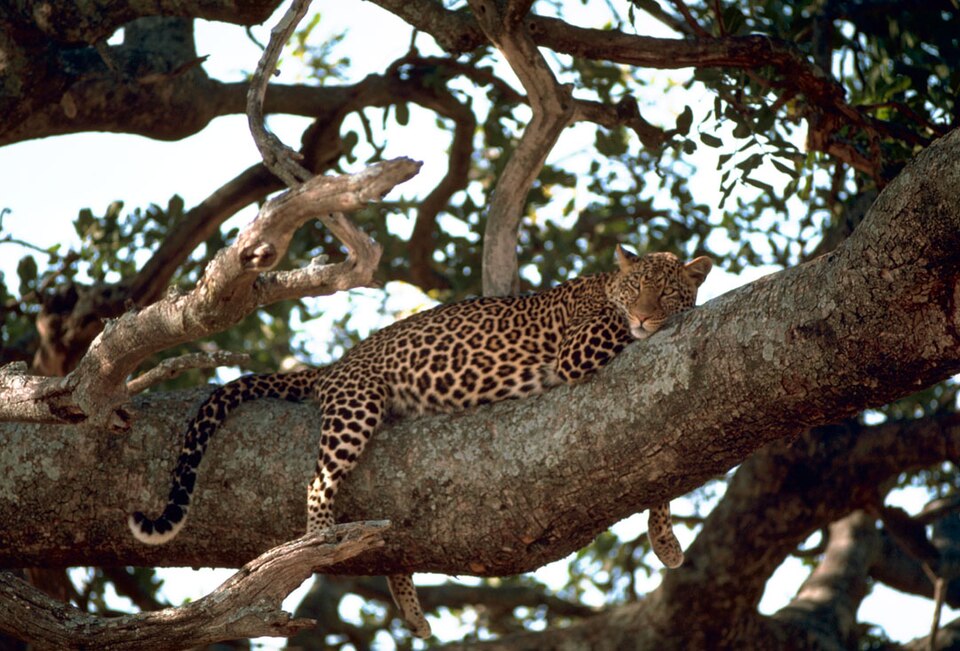
They climb trees very well, and they spend a lot of time in trees. They can carry prey up a tree and keep it safe from hyenas and lions. Trees are its main escape from attacks by lions or packs of dogs.
Young leopards leave their mothers after 13 – 18 months.
The most similar cat in its lifestyle is the jaguar, which lives in Central and South America.
Hunting behavior
Leopards are versatile, opportunistic hunters. They hunt at different times, usually in the afternoon or late at night, and use different methods for hunting.
Most references to leopards describe them as nocturnal. They are often active at night. Still, it is not uncommon to encounter a leopard moving or even hunting during the day, even in extreme temperatures.
Leopards are ambush predators. They operate best when they have some cover to hide behind. Usually, they secretly move towards their prey and attack it when they are close, or hide and wait for it to come close.
Leopards are unpredictable animals. The leopard’s ability to surprise its prey is one of the factors that makes it such a lethal predator.
Diet
Leopards are carnivores with a very wide diet. They prey on Thomson’s gazelle, impala, duikers, reedbucks, steenboks, and topi calves, zebras, young warthogs, blue wildebeest, and guineafowl. They also prey on rodents, hyraxs, rats, hares, storks, and monitor lizards.
Leopards can take down baboons and even jackals. They are the only natural predators of adult chimpanzees and mountain gorillas, though probably not the large male silverback gorillas.
Leopards do not usually eat humans, but sometimes leopards that are hurt or sick attack and eat people when they do not have enough to eat. A leopard in India is believed to have eaten more than 125 people.
Subspecies
There are nine subspecies of leopards recognized today, one in Africa and eight in Asia. They are:
- African leopard P.p pardus, which includes the Barbary leopard
- Amur leopard P.p orientalis
- Arabian leopard P.p nimr
- Indian leopard P.p fusca
- Indo Chinese leopard P.p delacouri
- Javan leopard P.p melas
- North Chinese leopard P.p japonensis
- Persian leopard P.p saxicolor
- Sri Lankan leopard P.p kotiya
Written for younger readers
Leopard, in simpler words
This version comes from Wikijunior, a set of books written for children aged 8 to 11. It is shorter and uses plainer language than the article above.
From Wikijunior: Big Cats
NOTOC
The leopard is the champion athlete of the cat world. Most big cats can pull with five times as much force as the same weight of human athletes. The leopard can pull seven times as hard. It would take three Olympic class weightlifters merely to achieve a draw at tug of war with one 100 pound leopard. This amazing strength is demonstrated when a successful hunter scrambles up the side of a tree with a full grown antelope in its jaws to eat in peace.
The leopard gets its name from the ancient Greek words for “lion” (leon) and “panther” (pard).
Leopards live in the Middle East, parts of Asia, and Africa. This means they live in more places than any other big cat. Leopards spend a lot of time in trees, often sleeping draped over a branch. They will even pull entire prey animals up into the branches where they can eat without having to fight off other predators trying to steal their food.
Leopards are usually 6.5-10 feet (2-3 m) long, including 23-43 inches (58-110cm) of tail, and weigh about the same as a human or a large dog, 65-155 pounds (30-70 kg). They stand 17.5–30.5 inches (43-78 cm) tall. Female leopards are usually only two-thirds the size of male leopards.
A leopard’s coat is short and sleek. Depending on where it lives, a leopard’s coat can be a pale straw color, grey, gold-ish, or black. All leopards have black spots. Because the fur in a leopard’s spots is thicker and more coarse, they can be felt as well as seen.
Black leopards are sometimes called panthers, and they were once thought to be a separate species. Though they are all black, they still have the black spots that leopards are famous for. On black leopards, these spots are only slightly darker than the surrounding fur, but under very bright light, they stand out from the lighter, somewhat purplish, background fur.
Leopards tend to eat antelopes and similarly sized herd animals. They avoid the larger herbivores, such as water buffalo, because the larger beasts can only be safely captured by groups of animals that hunt in teams, such as lions. Leopards also eat smaller animals including rodents, rabbits, and even large insects. Some have been known to eat Nile crocodiles, which are powerful reptiles!
They are known to kill and eat dogs, so those persons who bring a dog into leopard country are advised to cage the dog so that it does not become food for leopards.
In captivity, leopards are the most temperamental of the large cats and can be difficult to handle. While they can be affectionate, they cause an unusually large number of animal-related injuries among caretakers in zoos, circuses, and animal care centers.
It is built like and acts much like a house cat, so anyone fascinated by the big cats might as well have a house cat that behaves much the same as a leopard – except that a house cat can’t hurt you a lot when it scratches or bites.
One of the funniest movies ever made was one called Bringing Up Baby. It is old – it was made in 1939 and it is in black-and-white – and it stars a leopard named “Baby” that creates problems for the great human movie stars Cary Grant and Katherine Hepburn. (If you don’t know who Cary Grant and Katherine Hepburn are, then ask an adult over 50. Those were two of the greatest movie stars ever). But don’t ask for a pet leopard. A little house cat or a dog of any size is far safer.
Wikipedia: Leopard
The Cyber Zoomobile http://home.globalcrossing.net/~brendel/leopard.htm
Big Cats Online http://dspace.dial.pipex.com/agarman/bco/fact2.htm
Leopards at the San Diego Zoo http://www.sandiegozoo.org/animalbytes/t-leopard.html Next Topic: Jaguars
ca:Viquijúnior:Grans felins/Lleopard de:Wikijunior Großkatzen/ Leopard zh:Wikijunior:大猫/豹
Where this page comes from
The article above is adapted from “Leopard” on Simple English Wikipedia, by its contributors. We removed reference markers, navigation boxes and tables, expanded measurement templates into readable numbers, and kept the prose otherwise intact. The simpler version is adapted from Wikijunior on Wikibooks.
Both sources are published under CC BY-SA 4.0, so this page is published under the same licence. You may share and adapt it, including commercially, as long as you credit the original and keep the same licence.
Worksheets, answer keys and printable layouts elsewhere on K5Print are our own work and are not covered by this licence.