Linnaeus
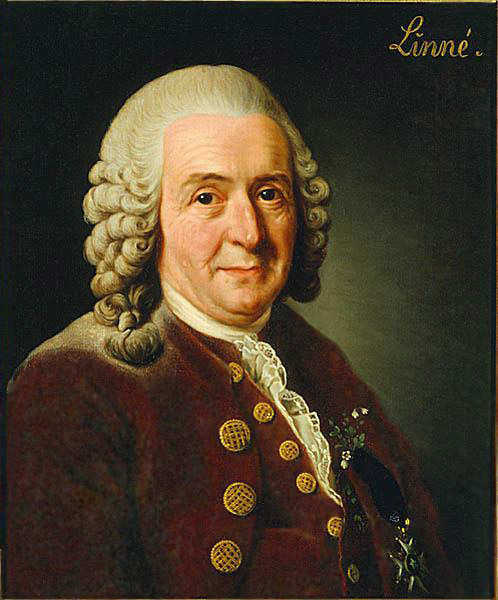

Quick facts
- Born
- May 23, 1707, Råshult, Sweden
- Died
- January 10, 1778, Hammarby, Sweden
Facts from Wikipedia’s “Carl Linnaeus” page (CC BY-SA 4.0).
Carl Linnaeus (23 May 1707 – 10 January 1778), also known as Carolus Linnaeus, was a Swedish botanist, physician and zoologist who created the binomial nomenclature. In this system, every kind of animal and plant is given a name consisting of two Latin words, for its genus and species. This became used by biologists all over the world, so he is known as the “father of modern taxonomy”. He was a good linguist, and famous in his time. He was made a noble by the Swedish king.
Early life
Carl was born in Småland in southern Sweden. He was going to be a priest like his father, but did not do well enough in school. Instead, Carl studied at a college for botany because he liked it. He studied in Lund and tried to improve the garden there. He later went to another college.
Travels and research
In 1735, Linnaeus moved to the Netherlands for three years. There, he earned his degree in medicine. He also published his book on plant classification. His book was called Systema Naturæ. His book explained how to classify living things by putting them into groups. Some of these groups are bigger than others.
Later he moved to Stockholm and practiced as a doctor. In 1739, Linnaeus married Sara Morea in Stockholm. Throughout the 1740s he conducted many field trips to places in Sweden to name plants and animals. When not on travels, Linnaeus worked on his classification, so it would work for plants, animals, and minerals.
The Swedish king Adolf Fredrik made Linnaeus a noble in 1757, and Linnaeus took the last name von Linné, later often signing just Carl Linné.
Last years
After he was made a noble, he continued teaching and writing. His reputation had spread over the world, and he talked with many different people. Linnaeus was upset by weak health, and he had gout and tooth aches. A stroke in 1774 weakened him, and two years later he had another, losing the use of his right side. He died on January 1778 and was buried in Uppsala cathedral.
Mankind
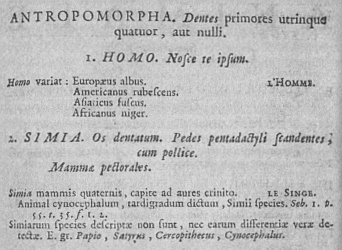
Linnaeus classified man as among the primates, which was already well understood by anthropologists like Blumenbach and natural historians like Buffon. It attracted the criticism of the Swedish church. The Lutheran Archbishop of Uppsala accused him of “impiety”.
Linnaeus recognised four races in the human species. These were European whites, American reds (Native Americans), Asian browns, and African blacks. Blumenbach’s classification was similar, with the addition of a Mongolian (= Chinese) or yellow race. Thus recognition of man’s position as a primate and the existence of races was quite widespread before the theory of evolution was formulated.
Written for younger readers
Linnaeus, in simpler words
This version comes from Wikijunior, a set of books written for children aged 8 to 11. It is shorter and uses plainer language than the article above.
From Wikijunior: Life
Carolus Linnaeus lived from 1707 to 1778. He became famous for his way grouping and naming living things.
In Europe in the 1700s, people were discovering more and more of the world.
They were finding out about lots of new plants and animals.
Just naming them all was a big problem. People just made up names by themselves.
There were lots of problems when they wanted to write about them and talk about them.
Linnaeus thought of a way of naming living things that everybody started to use.
Where this page comes from
The article above is adapted from “Linnaeus” on Simple English Wikipedia, by its contributors. We removed reference markers, navigation boxes and tables, expanded measurement templates into readable numbers, and kept the prose otherwise intact. The simpler version is adapted from Wikijunior on Wikibooks.
Both sources are published under CC BY-SA 4.0, so this page is published under the same licence. You may share and adapt it, including commercially, as long as you credit the original and keep the same licence.
Worksheets, answer keys and printable layouts elsewhere on K5Print are our own work and are not covered by this licence.