Lion

Fast facts
- Conservation status
- Vulnerable
Scientific name
- Scientific name
- Panthera leo
- Kingdom
- Animalia
- Phylum
- Chordata
- Class
- Mammalia
- Order
- Carnivora
- Family
- Felidae
- Genus
- Panthera
- Species
- Panthera leo
How to say it in other languages
- Arabic
- أسد (ʾĀsad)
- Dutch
- Leeuw
- French
- Lion
- German
- Löwe
- Hindi
- सिंह (singh
- Italian
- Leone
- Japanese
- ライオン (Raion)
- Korean
- 사자 (saja)
- Portuguese
- Leão
- Russian
- Лев (Lev)
- Spanish
- León
Facts from Wikipedia’s “Lion” page and Wikispecies (CC BY-SA 4.0).
The lion (Panthera leo) is a large mammal of the Felidae (cat) family. Some large males weigh over 250 kg. Today, wild lions live in sub-Saharan Africa and western India. Lions are adapted for life in grasslands and mixed areas with trees and grass. The relatively small females are fast runners over short distances, and coordinate their hunting of herd animals.
Lions have disappeared from North Africa and southwest Asia in historic times. Until the late Pleistocene,which is about 10,000 years ago, the lion was the most widespread large land mammal after humans. They were found in most of Africa, across Eurasia from western Europe to India, and in the Americas from the Yukon to Peru. The lion is now a vulnerable species. There was a decline in its African range of 30–50% over two decades in the second half of the 20th century. Habitat loss and conflicts with humans are the greatest causes of concern.
Lions are often called the “king of the beasts”. They are used as symbols representing courage. They appear in heraldry more often than any other animal. They are an icon of courage and royalty.
Lions live for 10 to 14 years in the wild. When they are captured, they can live longer than 20 years. In the wild, males do not usually live longer than 10 years. This is because wounds from fighting other males make their lives shorter. They usually live in savanna and grassland. These areas do have bushes and trees, but lions are mainly adapted to catch prey in grasslands. Compared to other cats, lions are social. A group of lions is called a pride. In a pride of lions, there are related females, their young, and one or two adult males. Groups of female lions often hunt together.
Lions are carnivores and scavengers. They are also apex predators. Lions feed ungulates on small feed Thomson’s gazelle, warthogs, blue wildebeests, plains zebra, African buffalos, common elands. Lions scavenge animals either dead from natural causes (disease) or killed by other predators. They keep a constant lookout for circling vultures, because this means there is a dead or injured animal close by.
Etymology
The word “lion” comes from the Latin word “leo” which means lion. The Latin word itself is derived from the Greek word “leon”. Both words originally came from even older languages such as Sanskrit and Ancient Egyptian. Basically, the word “lion” has been passed down through different civilizations over time also in a language called Punjabi the word called Singh means lion in Pajabi.
Adaptations
They have an archetypal roar which is used to communicate with other group members and warn different intruders of territorial boundaries.
They have long, retractable claws which help the lion to grab and hold prey. They also have a rough tongue that helps them peel the skin of prey animals away from flesh and flesh away from bone. Across their belly, they have loose skin which allows the species to be kicked by prey with little chance of an injury.
Description
There are around 30,000 lions left in the wild in Africa. Only 350 lions (of the Asiatic lion subspecies) are left in Asia. They live in the Gir Forest in the state of Gujarat, India.
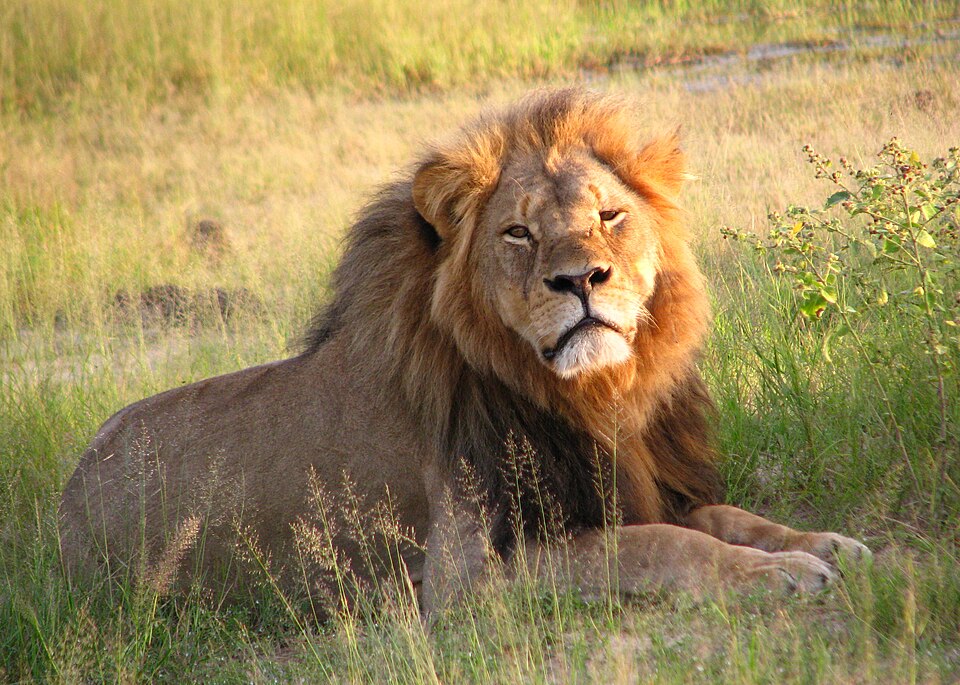
Lions hunt many animals, such as gnus and antelopes. Male lions usually weigh between 150 and 250 kg (331 and 551 lb). Large lions have reached 250 to 270 kg. Females (lionesses) are usually 120 to 182 kg. Mature male lions are the only cats with a mane. The lion has a long body, short legs, large claws, big head, and a yellowish-brown coat.They also have a long tail.
Behaviour
Lions live in groups that are called prides. About 10 to 40 lions may live in a pride. Each pride has a home area that is called a territory. Lions do not allow other carnivores (meat-eating animals) to hunt in their territory. A territory can be as large as 260 square kilometres (100 sq mi).
The lions’ roar is unique in each individual. It is used for territorial marking and warning off other lions in separate prides (or lone individuals). This however, is usually carried out by competing males. Other male lions will challenge the alpha of the pride to a fight in order to take their spot of dominance if they win. Lions actually have prides in order to strengthen their species throughout the generations (Boothalingam 2018).
Lions are not built for extreme speed as cheetahs are, but hunt in packs. This is unusual in cats. The females usually do the hunting for the pride. However the males can sometimes help if needed, to take down large animals like a buffalo or a giraffe. After lions have brought down a prey, they suffocate it by biting the front of its face to prevent it breathing. Lions also have long retractable claws which act like grappling hooks, to keep hold of prey.They are aggressive, powerful creatures.
Even though a lion is good at killing prey, they are not among the most dangerous animals to humans.
Lions also have a variety of vocalizations. These include growling, roaring, snarling, grunting, purring, moaning, and highly likely, snap-roars. Some roars are used in movies, and the most common versions are from the Hollywood Edge, Sounddogs and Sound Ideas, which are all actually liger, tigon and Bengal tiger roars.
Breeding
A lioness is ready to have young when she is 2–3 years old. Young lions are called cubs. Cubs are born after months. The cubs are born blind; their eyes do not open until they are about a week old, and cannot see well until they are about two weeks old. Lions do not have a den (home) where they would live for a long time. The lioness conceals the cubs in thick bush, gullies, or rocky outcrops. If the hiding place has been seen by other predators, then the lioness will move the cubs to a new hiding place. The cubs will be introduced to the pride at about 6 weeks old. The cubs are very vulnerable when the lioness goes out to hunt and needs to leave the cubs behind. Also, when a new male takes over a pride from another male, he usually kills all of the cubs. The cubs’ mothers will then mate with the new pride male, which means that the first batch of new cubs will be his offspring. A litter of 2-6 cubs are born. Usually, only 1-2 cubs survive until introduced to the pride, at which point they are protected by the whole pride.
In zoos, lions have been known to breed with tigers. If the parents are a male lion and a female tiger, the offspring is called a liger. If the parents are a male tiger and a female lion, the offspring is called a tigon.
Lions in heraldry
Lions appear in heraldry more often than any other animal. They traditionally symbolise courage, valour and royalty.
Written for younger readers
Lion, in simpler words
This version comes from Wikijunior, a set of books written for children aged 8 to 11. It is shorter and uses plainer language than the article above.
From Wikijunior: Big Cats
NOTOC Lions are a major symbol of wild Africa. They have been long respected in Africa for their strength and beauty. Lions are the only big cats that live in large groups. Also, they have the loudest roar of any cat, which can be heard for up to five miles!
Despite the nickname King of the jungle, lions do not live in the jungle. They live in flat grassy plains called savannas and usually have a certain place in the savannas where they like to stay. In ancient times, lions roamed nearly every continent. Today, they can commonly be found across central and southern Africa. There is also a small population in the Gir forest of India, on the continent of Asia. Also, most people today know lions as “The King of the Beasts”.
Lions have tawny, or yellowish brown, fur. They grow to a length of about 10 feet (3 meters) and stand about 4 feet (1.2 meters) tall. Male lions are larger than the lionesses (females), weighing as much as five men or about 550 pounds (250 kilograms). The more slender lioness usually weighs about as much as 400 pounds (180 kilograms).
Adult males can be recognized by the furry mane that runs around the heads and down the neck. For some lions, the mane even runs along the belly. There is no other big cat with such a dramatic difference in appearance between males and females.
Both lions and lionesses have tufts on the end of their tails, something no other cat has. If you could touch a male lion’s tail, you would feel a sharp bone tucked into the tail tuft. One old legend claims that lions would use the tail spur to whip themselves into a frenzy before fighting.
Lions are the most social cats, living in large groups called prides. Prides are made up of one to three related adult males, along with as many as thirty females and cubs. The females are usually closely related to each other, being a large family of sisters and daughters. Lion prides act much like packs of wolves or dogs, animals surprisingly similar to lions (but not other big cats) in behavior, and also very deadly to their prey.
The male lion is much stronger than the female. This makes him an able protector, especially when a group of females are hunting and the cubs are at risk of marauders, such as hyenas. Male lions use their muscles and fighting skills to guard the land and keep enemies away. Sometimes those enemies are other lions.
In prides, cubs are cared for not just by their mothers but by other adult females, as well. Often, one or two lionesses (female lions) will stay with the cubs while the other females hunt. If a cub becomes an orphan, it is common for it to be cared for by other females who are related to it, perhaps by a lioness who is an aunt or older sister.
According to a study on sciencedirect.com, “male lions were frequent and successful hunters. The main prey species of all male group types, but particularly nonterritorial males, was buffalo. By contrast, females preyed more frequently on the most abundant medium-sized ungulates, such as wildebeest.” There are photographs of both male and female lions hunting at http://www.laocomics.com/blog/category/animals/.
When young male lions reach the age of one year, they are chased from the prides they are born into by the older male lions. If the lead male is elderly, the young male, either alone or with male siblings, will sometimes fight to take over the leadership of the pride. If the young males leave the pride, they become “rogue” males. They travel alone or may partner with other rogues, perhaps brothers. Having a partner makes it easier for a rogue lion to survive and eventually win a pride of his own. These rogue lions are often found scavenging food killed by smaller predators, such as hyenas or jackals, which can be chased away. Rogue lions hunt for themselves until they are able to take over a pride of their own!
Lions eat large prey, such as gazelles, antelopes, zebras, wildebeests, giraffes, and buffalo. They have even been known to take down elephants, but only with all of the adults of the pride participating in the kill. Even elephants fear hungry lions. When food becomes scarce, lions will hunt smaller prey or sometimes eat the kills of other animals.
Most prey animals can run much faster than the average lion. Therefore, lions hunt in fairly well organized groups and stalk, or sneak up on, their prey. They may try to surround them first, then make a swift, sudden charge from the tall grass. The grass where lions live is not short and green but grows very tall and is a light brownish color most of the time. The lions’ fur is the same color as this grass, making it difficult for other animals to see them. Coloring that helps to hide an animal or thing is called “camouflage”.
Females do most of the hunting and work in groups although, if she has to, a single lioness is able to hunt on her own. Male lions are actually more capable hunters than females, but they usually focus more on protecting the pride. Lions may spend hours stalking prey but the actual kill is made in just minutes. After a kill is made, the females let out low roars. This tells the pride to join them for a meal. Adult males eat first, followed by females, and then cubs.
To avoid the dangerous heat of the mid-day sun, lions usually hunt at night when the dim light helps to keep them hidden from their prey. Lions have very good night vision so the darkness does not pose a problem for them. Animals that are active at night like lions are called nocturnal creatures. Lions can eat 69kg of meat a day!
A male lion’s roar can be heard up to 5 miles away.
The hunting grounds for a pride of lions can range from 8 to 150 square miles.
The largest lion on record was almost 11.8 feet long and weighed nearly 900 pounds.
Lions rarely eat an entire kill. Hyenas and vultures finish the rest.
A lion can run as fast as 50 mph for short distances and can leap a distance of more than 30 feet.
There are only a quarter the number of lions in Africa as there were just 40 years ago.
A lion’s eyesight is five times better than a human’s eyesight, and it can hear prey that is more than a mile away.
It may take up to 4 hours for a pride of lions to finish eating.
A male lion eats first, even though the females actually catch the prey.
After eating, a thirsty lion may drink for as long as 20 minutes.
Lions were once thought to be magical creatures and were worshiped as gods. Domestic cats replaced lions in that role, especially in Egypt, because they were much safer and easier to care for.
There can be up to 40 members in a pride with over half of them being cubs and young adults.
Females will often stay with the pride their entire life, while young males are driven out.
A lion eats 36 kg of meat a day.
When a male lion gets old, its mane may fall off.
The lion is the only social predator among the Big Cats.
Lions can’t climb as well as leopards.
Lions can steal food from other predators such as cheetahs.
Wikipedia: Lion
http://www.sandiegozoo.org/animalbytes/t-lion.html - hear the sound of a roaring lion.
http://www.tigertouch.org/barbary/index.html - learn about the rare Barbary lions of North Africa.
Next Topic: Tigers
ca:Viquijúnior:Grans felins/Lleó de:Wikijunior Großkatzen/ Löwe es:Wikichicos/Grandes felinos/León fr:Wikijunior:Les félins/Les lions it:Wikijunior Grandi felini/Leone zh:Wikijunior:大猫/狮
Where this page comes from
The article above is adapted from “Lion” on Simple English Wikipedia, by its contributors. We removed reference markers, navigation boxes and tables, expanded measurement templates into readable numbers, and kept the prose otherwise intact. The simpler version is adapted from Wikijunior on Wikibooks.
Both sources are published under CC BY-SA 4.0, so this page is published under the same licence. You may share and adapt it, including commercially, as long as you credit the original and keep the same licence.
Worksheets, answer keys and printable layouts elsewhere on K5Print are our own work and are not covered by this licence.