Lynx

Scientific name
- Scientific name
- Lynx
- Kingdom
- Animalia
- Phylum
- Chordata
- Class
- Mammalia
- Order
- Carnivora
- Family
- Felidae
- Genus
- Lynx
How to say it in other languages
- Arabic
- وشق
- Dutch
- Lynxen
- French
- Lynx
- German
- Luchse
- Hindi
- लिंक्स
- Italian
- Lince
- Japanese
- オオヤマネコ属
- Korean
- 스라소니속
- Portuguese
- Lince
Facts from Wikipedia’s “Lynx” page and Wikispecies (CC BY-SA 4.0).
The Lynx is a small cat. It is a genus with four species. The four species are in Eurasia, Spain, Canada and America, and do not overlap much.
Appearance
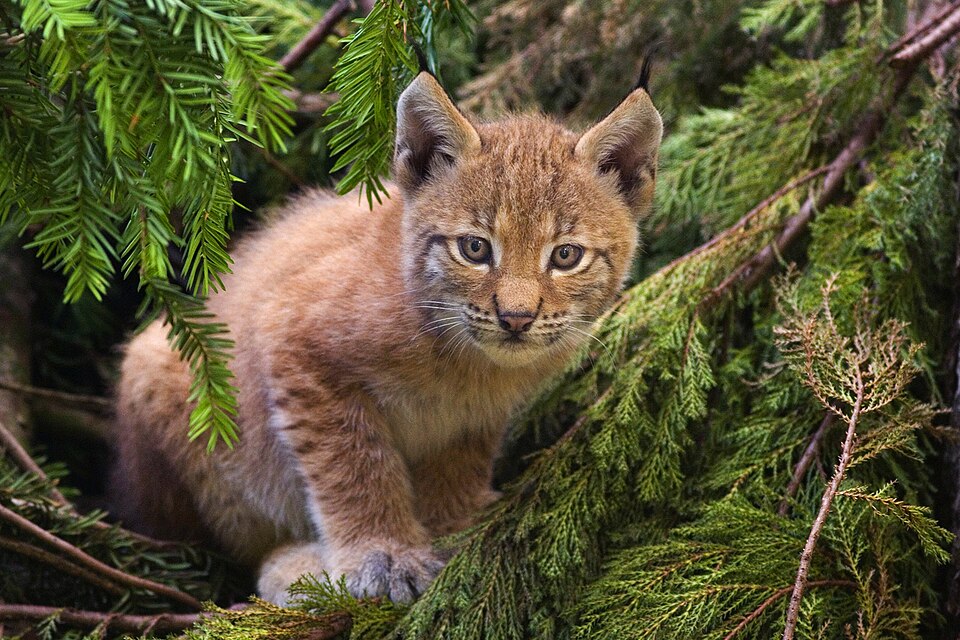
Lynx have short tails, and usually some hair on the ears. They have large paws (feet) padded for walking on snow, and long whiskers on the face. The color of the body is from light brown to grey and is sometimes marked with dark brown spots, especially on the legs. They weigh about 5 kg or about 11 pounds (approximately the size of a large domestic cat) and can weigh up to about 30 kg (66 pounds). They are between 70 and 150 cm long, with a relative short tail - 5-25 cm. They live for about 20 years.
Lynx are similar to a regular house cat, but larger. They have a powerful body on short, furry legs attached to hefty feet, and a bobbed, black-tipped tail. The fur is spotted and yellowish-brown to grey. It has a collar of fur around the face, giving a triangular shape. They also have long black ear tufts.
Habitat
Lynx live in the high altitude forests with many shrubs, reeds and grass. They hunt only on the ground, but can climb trees and swim.
They can be found in the some places in northern Scandinavia, in North America and also in the Himalayas. Since the 1990s people try to move part of the population of the Eurasian lynx to Germany. They can also be found in Białowieża Forest (northeastern Poland), and southern Spain.
The Colorado Division of Wildlife tried to move other wild Lynx populations from Canada back to the United States.
Behaviour
Lynx are usually solitary, although a small group may travel and hunt together occasionally. Mating takes place in the late winter and once a year the female gives birth to between two and four kittens. The young stay with the mother for one more winter, a total of around nine months, before moving out to live on their own as young adults.
Lynx make their dens in crevices or under ledges. They feed on a wide range of animals from white-tailed deer, reindeer, roe deer, small red deer, and chamois, to smaller, more usual prey: snowshoe hares, sheep, squirrels, mice, turkeys and other birds, and goats. They also eat ptarmigans, voles, and grouse.
The genus Lynx
- Genus Lynx
- Canada lynx, Lynx canadensis
- Eurasian lynx, Lynx lynx
- Iberian lynx or Spanish Lynx, Lynx pardinus
- Bobcat, Lynx rufus
Conservation
The Iberian lynx is the most endangered feline in the world. There are only two populations (together, 300 animals), in the southern Spain. Hunting lynxes is illegal in many countries.
Where this page comes from
The article above is adapted from “Lynx” on Simple English Wikipedia, by its contributors. We removed reference markers, navigation boxes and tables, expanded measurement templates into readable numbers, and kept the prose otherwise intact.
Both sources are published under CC BY-SA 4.0, so this page is published under the same licence. You may share and adapt it, including commercially, as long as you credit the original and keep the same licence.
Worksheets, answer keys and printable layouts elsewhere on K5Print are our own work and are not covered by this licence.