Malacology
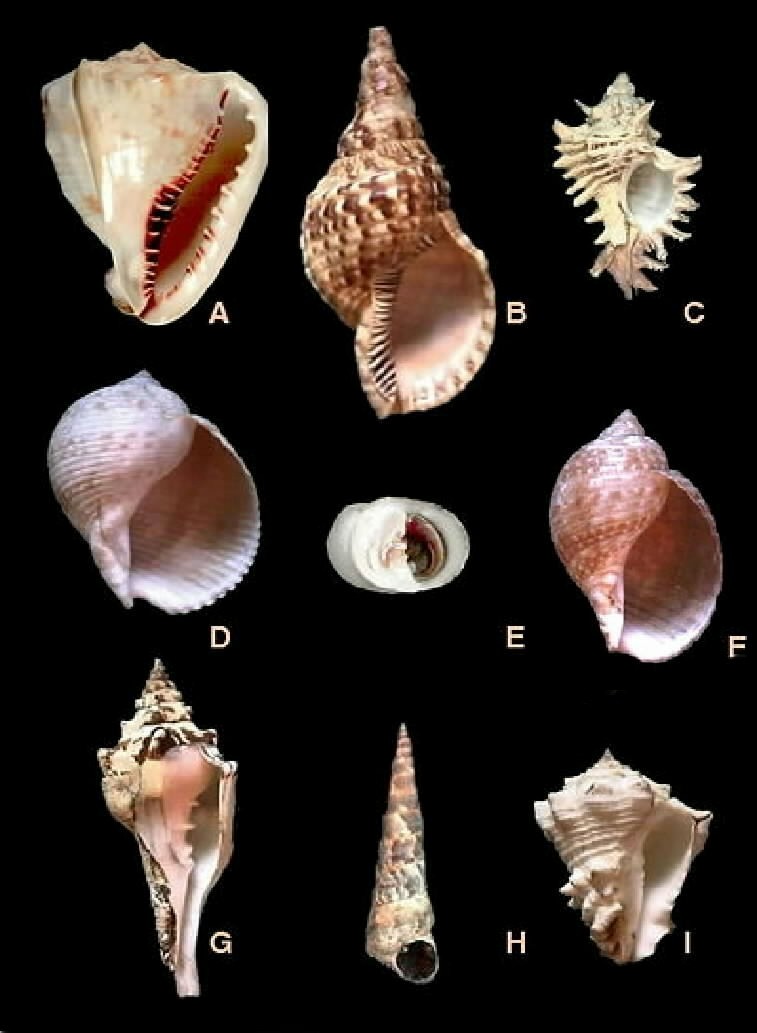

Malacology is the study of molluscs. These animals include snails, slugs, octopus, squid, and bivalves generally, such as clams and mussels. Most of them have shells. The shells are often collected for their beauty and interest. Many people eat molluscs, especially those people who live near the ocean.
Those scientists who study molluscs are called malacologists. They identify and classify them, and find out everything they can about their lives.
Types of gastropods
The gastropods are the most common type of mollusc. They have about 70,000 described species.
- marine gastropod
- sea snail
- sea slug
- non-marine gastropod
- freshwater gastropod: with very few exceptions, the only freshwater molluscs are freshwater snails
- freshwater snail
- terrestrial gastropod: gastropods are the only group of molluscs which have some species living on land
- land snail
- land slug
- semi-slug
Types of bivalves
With 20,000 described species, bivalves are the second commonest class of molluscs. There are several classifications of bivalves in use. This is a rough guide:
- Pteromorphia including the
- File shells
- Mussels
- Oysters
- Pearl oysters and pen shells
- Heterodonta
- Soft-shelled clams
- Shipworms (Turedo)
- Hard-shelled clams, cockles and razor shells
Malacologists
- Horace Burrington Baker (1889–1991)
- Henri Marie Ducrotay de Blainville (1777-1850)
- Jean Guillaume Bruguière (1749-1798)
- William J. Clench (1897-1984)
- Georges Cuvier (1769-1832)
- Gérard Paul Deshayes (1795-1875)
- John Edward Gray (1800-1875)
- Otto Friedrich Müller (1730-1784)
- Alcide d’Orbigny (1802-1857)
- Isabel Pérez Farfante (1916-2009)
- Constantine Samuel Rafinesque (1783-1840)
- Lovell Augustus Reeve (1814-1865)
- María Isabel Scott Hylton (1889-1990)
- James Sowerby (1757–1822)
- George Brettingham Sowerby I (1788-1854)
- George Brettingham Sowerby II (1812-1884)
- George Brettingham Sowerby III (1843-1921)
- William Swainson (1789-1855)
Museums
Museums that have either exceptional malacological research collections (behind the scenes) and/or exceptional public exhibits of molluscs:
- Academy of Natural Sciences of Philadelphia
- American Museum of Natural History
- Bailey-Matthews Shell Museum
- Cau del Cargol Shell Museum
- Museum of Comparative Zoology at Harvard
- Royal Belgian Institute of Natural Sciences, Brussels: with a collection of more than 9 million shells (mainly from the collection of Philippe Dautzenberg)
- Smithsonian Institution
Some mollusks
Image:Acanthopleura_granulata_with_Nerita_tessellata.jpg|two chitons with small sea snails Image:Cassidae sp.jpg|sea snail Image:Limax cinereoniger.JPG|land slug Image:Snail black on grass2.jpg|land snail Image:Mya arenaria.jpg|marine clam Image:Unknown_Unionidae_4.jpg|freshwater clam Image:Octo2.jpg|octopus Image:Sepiotenthis lessoniana.jpg|squid
Where this page comes from
The article above is adapted from “Malacology” on Simple English Wikipedia, by its contributors. We removed reference markers, navigation boxes and tables, expanded measurement templates into readable numbers, and kept the prose otherwise intact.
Both sources are published under CC BY-SA 4.0, so this page is published under the same licence. You may share and adapt it, including commercially, as long as you credit the original and keep the same licence.
Worksheets, answer keys and printable layouts elsewhere on K5Print are our own work and are not covered by this licence.