Manul

NOTOC
Manuls or Pallas’ Cats are the oldest living species of cat, traceable in the fossil record to 10 million years ago. They were once thought to be the ancestor of the domestic cat breed known as the Persian because of their highly unusual face.
Where do manuls live?
Manuls live on the rocky plateaus and riverbanks of Central Asia.
What do manuls look like?
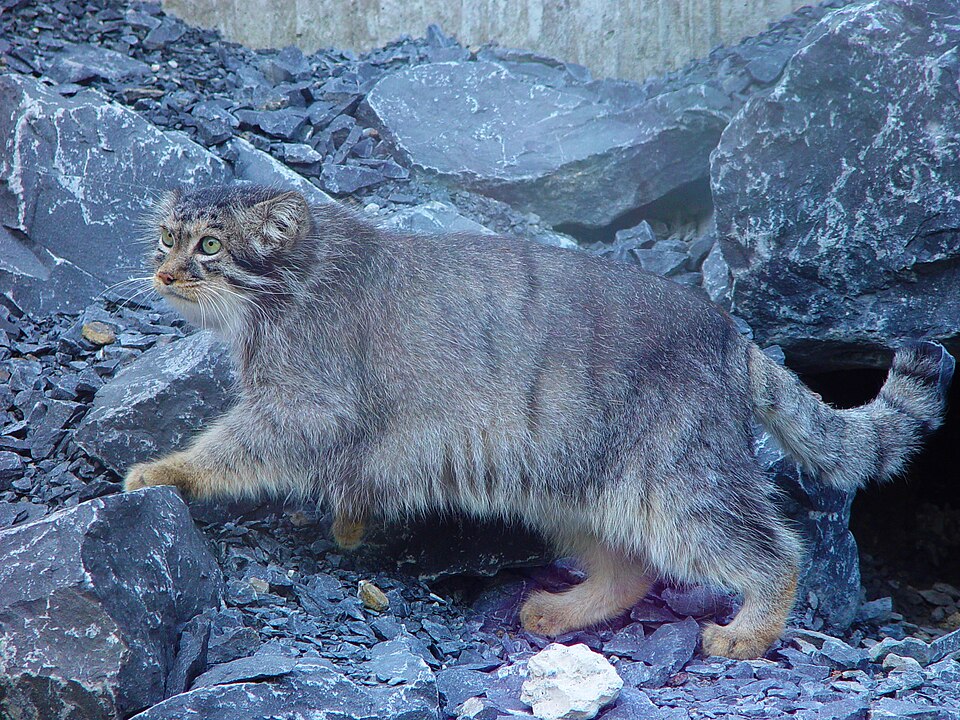
The manul is similar to the lynx in facial structure, with a large, sturdy body and short legs. Its head is short and broad, with large round eyes and blunt wide-set ears. Its long, silky coat varies in color from light gray to russet brown, with white tips to its hairs giving a sparkling, almost iridescent appearance. There are dark lines on its cheeks, rings on its tail, and its lips, chin, and throat are white. Pallas cats are the only living species of small cat whose eyes have round pupils.
What do manuls eat, and how do they catch their prey?
Manuls hunt by night, from the ground, and seek small mammals and birds. The vast majority of their diet is a small animal called a pika (pronounced PY-kah) that is closely related to rabbits but has small, round ears. Where pikas are plentiful, a manul will eat almost nothing else.
Fun facts
See how much you know about the manul:
- The name Pallas’ Cat came from the first scientist to describe one, Peter Pallas.
For more information
- Wikipedia: Pallas cat Next Topic: Wild cats de:Wikijunior Großkatzen/ Manul
Written for younger readers
Manul, in simpler words
This version comes from Wikijunior, a set of books written for children aged 8 to 11. It is shorter and uses plainer language than the article above.
From Wikijunior: Big Cats
NOTOC
Manuls or Pallas’ Cats are the oldest living species of cat, traceable in the fossil record to 10 million years ago. They were once thought to be the ancestor of the domestic cat breed known as the Persian because of their highly unusual face.
Manuls live on the rocky plateaus and riverbanks of Central Asia.
The manul is similar to the lynx in facial structure, with a large, sturdy body and short legs. Its head is short and broad, with large round eyes and blunt wide-set ears. Its long, silky coat varies in color from light gray to russet brown, with white tips to its hairs giving a sparkling, almost iridescent appearance. There are dark lines on its cheeks, rings on its tail, and its lips, chin, and throat are white. Pallas cats are the only living species of small cat whose eyes have round pupils.
Manuls hunt by night, from the ground, and seek small mammals and birds. The vast majority of their diet is a small animal called a pika (pronounced PY-kah) that is closely related to rabbits but has small, round ears. Where pikas are plentiful, a manul will eat almost nothing else.
See how much you know about the manul:
The name Pallas’ Cat came from the first scientist to describe one, Peter Pallas.
Wikipedia: Pallas cat Next Topic: Wild cats de:Wikijunior Großkatzen/ Manul
Where this page comes from
The article above is adapted from “Manul” on Simple English Wikipedia, by its contributors. We removed reference markers, navigation boxes and tables, expanded measurement templates into readable numbers, and kept the prose otherwise intact. The simpler version is adapted from Wikijunior on Wikibooks.
Both sources are published under CC BY-SA 4.0, so this page is published under the same licence. You may share and adapt it, including commercially, as long as you credit the original and keep the same licence.
Worksheets, answer keys and printable layouts elsewhere on K5Print are our own work and are not covered by this licence.