Margay

Fast facts
- Conservation status
- Near threatened
- Genus
- Leopardus
- Species
- wiedii
Scientific name
- Scientific name
- Leopardus wiedii
How to say it in other languages
- Chinese
- 長尾虎貓
- Dutch
- Margay
- French
- Margay
- German
- Langschwanzkatze
- Italian
- Margay
- Japanese
- マーゲイ
- Portuguese
- Gato-maracajá
- Spanish
- Margay
Facts from Wikipedia’s “Margay” page and Wikispecies (CC BY-SA 4.0).
The Margay (Leopardus wiedii) is a spotted cat native to the Americas. It is a solitary and nocturnal animal which prefers remote parts of the rainforest.
Life-style
The margay is mostly nocturnal. It eats small mammals (sometimes including monkeys), birds, eggs, lizards and tree frogs. The margay is able to hunt its prey entirely in trees. However, they do sometimes hunt on the ground, and have been reported to eat cane rats and guinea pigs.
There is a report of a margay using sound mimicry to lure a prey. A margay was seen to imitate the call of an infant pied tamarin while in the presence of a group of adult tamarins. This caused the adults to investigate. Although the margay was not successful in catching a monkey, this was the first observation of a Neotropical predator using this type of mimicry.
Margays are mainly nocturnal, but they do sometimes hunt during the day. They prefer to spend most of their life in the trees, but also travel across the ground, especially when moving between hunting areas. During the day, they rest in safe branches or clumps of lianas.
Like most cats, they are solitary: the adults usually meet only to mate. They have large home ranges of 11 to 16 square kilometres. They use scent to mark their territory (urine spraying) and leave scratch marks on the ground or on branches. Their vocalisations are short range: they do not call to each other over long distances.
Special adaptations
The margay is one of only two cat species with ankles flexible enough to climb head-first down trees. The other is the clouded leopard; the little-studied marbled cat may also have this ability.
The margay is very agile; its ankles can turn up to 180 degrees, it can grasp branches equally well with its fore and hind paws, and it is able to jump up to 12 feet (3.7 m) horizontally. The margay has been seen to hang from branches with only one foot, and can run upside down beneath branches.
Conservation
Although once thought to be vulnerable to extinction, the IUCN now lists it as only “near threatened”. It roams the rainforests from Mexico to Argentina. Actually, it is a successful and widespread species. It has ten subspecies over a large geographical range from Mexico to Argentina. Its past range even included the southern United States.
They are hunted mainly for their fur and this has resulted in a large population decrease - around 14,000 are killed a year. They also suffer from a loss of habitat, which is also a significant part of this decline.
Written for younger readers
Margay, in simpler words
This version comes from Wikijunior, a set of books written for children aged 8 to 11. It is shorter and uses plainer language than the article above.
From Wikijunior: Big Cats
NOTOC
Margays are the masters of vertical space, spending much of their lives in the branches of trees where they pursue their prey and even nap hanging upside down by their back feet.
Margays live from Mexico in the north all the way south to northern Argentina. Margays also live in rainforests. Margays used to be found in Texas, but have been hunted out all the way to southern Mexico. They prefer to live in damp areas.
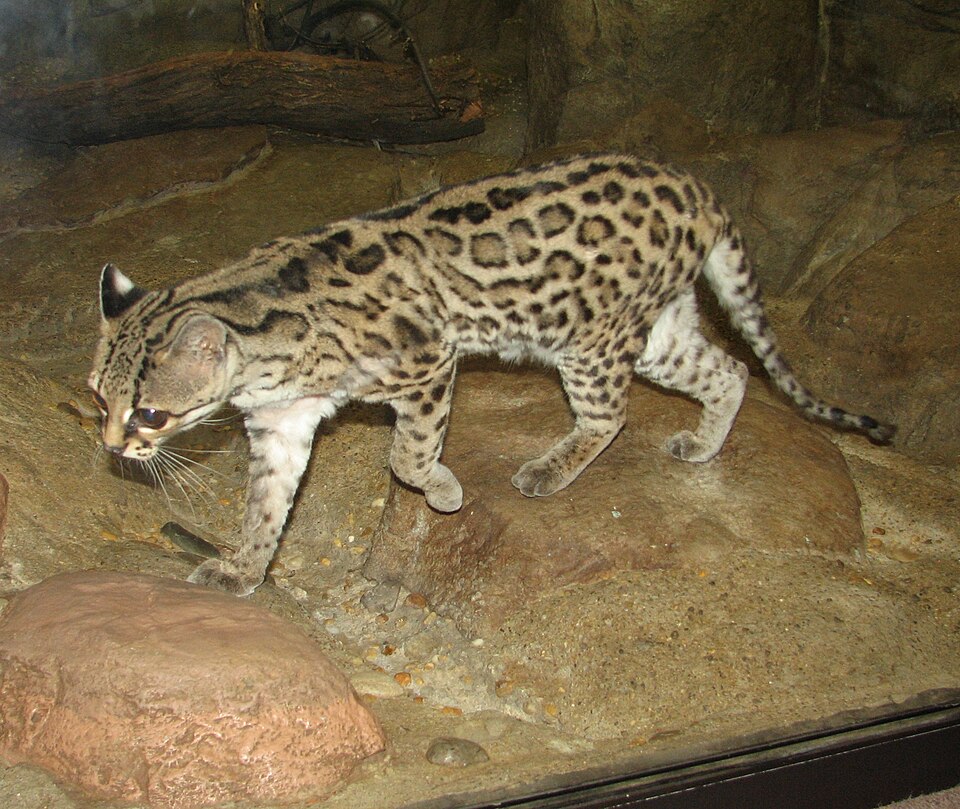
A margay has spots like a cheetah, two stripes on its forehead, and some on its cheeks. It also has thick stripes on its tail. Like a tiger’s, leopard’s, or cheetah’s, the margay’s patterns are specific to each individual. It has very large eyes and a very long tail that is 70 percent as long as its body. It can jump higher than an ocelot by 20 feet! The margay, also known as the Long Tailed Spotted Cat, is similar in appearance to the ocelot —- its body however, is smaller, growing up to 27 inches. In comparison with the ocelot, the margay displays longer legs and tail. This cat is often confused with its relatives –- the ocelot and the oncilla. Their coats are very similar. The margay’s fur is thick and its tail is really long. The tail is used as weight to help with balance. The margay is a spotted, golden brown cat with white on the belly, chest, throat, and chin. The spots may be solid black or have pale centers. The ears have white eye spots on the backs and the tail is either ringed or spotted. Margays weigh between 9-20 pounds and are between 34-52 inches long. The margay also has extremely big eyes, which helps its night time vision. Also the Margay is one of two species of cat that have flexible enough ankle joints to be able to climb down trees headfirst like a squirrel!
Margays are agile hunters, leaping after and chasing birds and monkeys through the treetops. The ankles on their back legs are so flexible that they can run down a tree head first like a squirrel. Since Margays are such great tree climbers, they often eat other mammals that live in trees such as big eared climbing rats, squirrels, opossums, small monkeys, and sloths. They also eat tree frogs, lizards and birds. They also will sometimes eat insects, grasses and sometimes even fruit. Margays can hunt in the dark due to their huge eyes, which can see exceptionally well in the dark.
See how much you know about margays:
Margays have the ankle flexibility needed to climb down trees head first.
Margays can hang from a branch by one back foot.
Captive margays have lived for 20 years.
Margay kittens weigh about 450 grams at birth (In comparison, a domestic kitten may weigh 110 grams).
Margays scientific name is Leopardus Wiedii
Wikipedia: Margay Next Topic: Jaguarundis de:Wikijunior Großkatzen/ Langschwanzkatze
Where this page comes from
The article above is adapted from “Margay” on Simple English Wikipedia, by its contributors. We removed reference markers, navigation boxes and tables, expanded measurement templates into readable numbers, and kept the prose otherwise intact. The simpler version is adapted from Wikijunior on Wikibooks.
Both sources are published under CC BY-SA 4.0, so this page is published under the same licence. You may share and adapt it, including commercially, as long as you credit the original and keep the same licence.
Worksheets, answer keys and printable layouts elsewhere on K5Print are our own work and are not covered by this licence.