Mayfly

Fast facts
- Phylum
- Arthropoda
Scientific name
- Scientific name
- Ephemeroptera
- Kingdom
- Animalia
- Phylum
- Arthropoda
- Class
- Insecta
- Order
- Ephemeroptera
How to say it in other languages
- Chinese
- 蜉蝣目
- French
- Éphémère
- German
- Eintagsfliegen
- Japanese
- カゲロウ目 (蜉蝣目)
- Korean
- 하루살이목 (부유목)
- Russian
- Подёнки
- Spanish
- Cachipollas
Facts from Wikipedia’s “Mayfly” page and Wikispecies (CC BY-SA 4.0).
Mayflies are insects which belong to the Order Ephemeroptera (from the Greek ephemeros = ephemeral, or short-lived; pteron = wing). The name refers to the most distinctive features of the adults. They are in an ancient group of insects, the Palaeoptera, (‘Ancient wings’) with dragonflies and damselflies.
There are over 3,000 living species of mayfly, in over 400 genera in 42 families.
Egg stage
At mating the female lays her eggs in the water. They settle to the bottom where they stick to rocks, vegetation or the bottom of the stream. They range in size by the particular species of Mayfly. Depending on temperature, the eggs take from a few days to a year to develop: usually it is one to three months. During this embryonic stage the mouth, legs, tail and organs all develop.
Larva (or nymph) stage
Mayfly are insects whose aquatic larvae (called naiads or nymphs) live from several months up to a year, in freshwater. The naiads go through 20 or 30 moults as they develop.
Adult stage
Mayflies are unique in that they moult one more time after getting functional wings (this is known as the alate stage). This second-to-last winged stage is usually very short, lasting from 30 minutes to one day, depending on the species. The function of the adult imago is reproduction and dispersal; they do not eat. The stage is a favorite food of many fish, and many ‘fishing flies’ are modeled on them.
The hatch
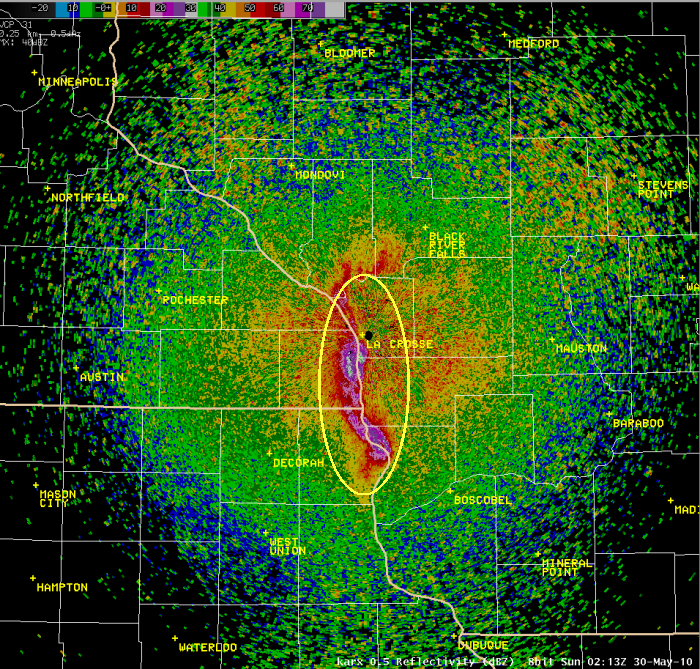
It often happens that all the mayflies in a population mature at once (called the hatch). For a day or two in the Spring or Autumn (Fall), mayflies will be everywhere, dancing around each other in large groups, or resting on every available surface. The adults have various special features. Their rear wings are small or almost vestigial; the males have two long front legs for holding females, the rest have no function. Mating is usually in mid-air. The mayfly are quite a successful group. About 2,500 species are known worldwide, including about 630 species in North America. The hatch at La Crosse, Wisconsin has been a news event for several years. The hatch is so large it appears on weather radar. The emerging mayflies land on everything and cover some areas like snow.
Written for younger readers
Mayfly, in simpler words
This version comes from Wikijunior, a set of books written for children aged 8 to 11. It is shorter and uses plainer language than the article above.
From Wikijunior: Bugs
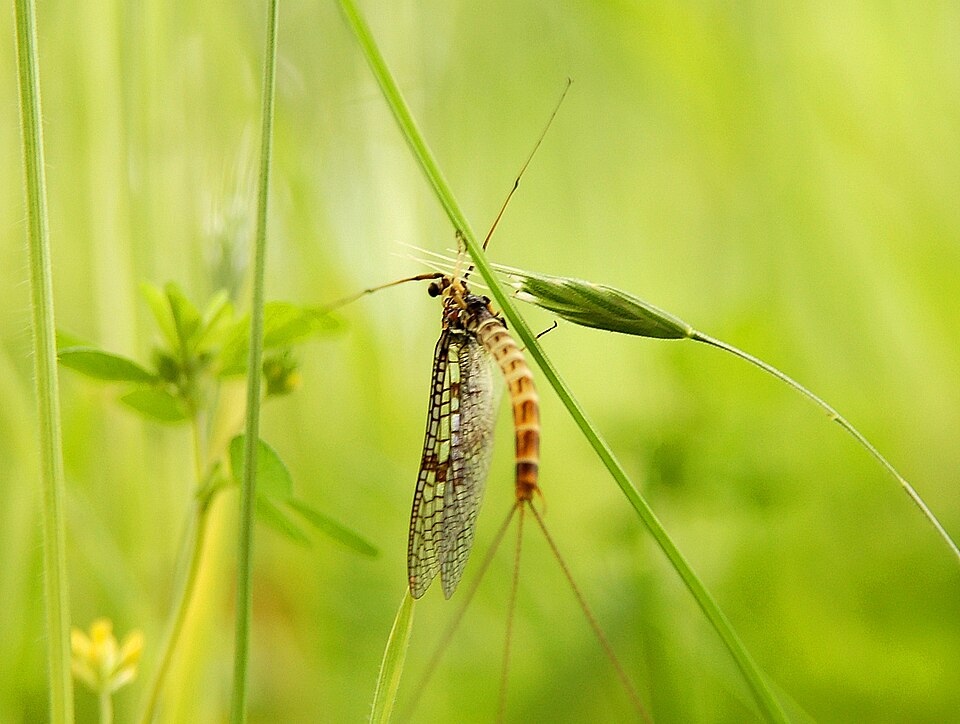
Mayflies are dainty insects with lacy wings and three long hair-like “tails” which trail behind in flight. They are often called dayflies or the scientific name, Ephemeroptera, because of their short lives. The length of adult Mayflies varies from ¼ inch to a little over 1 inch. Their soft bodies may be yellow, green, or brown. Some are black and white. The long, slender Brown Stream Mayfly is golden-brown in color. The Golden Mayfly has a yellow body as well as yellow antennae, legs, and tails. It has brown markings on its head and abdomen.
Like all insects, they have 6 legs, 3 body parts, and 2 antennae. They have two short, bristly antennae and their front legs are longer than the back ones. Mayflies are not true flies because they have four wings instead of two. The front wings are held upright when at rest. The hind wings are much smaller than the fore wings. A few of the smaller species lack hind wings altogether.
Their transparent wings and wispy tails give Mayflies an uncommonly delicate and graceful appearance. The wings have various markings depending on the species. The Brown Drake Mayfly Ephemera simulans has spotted wings. The wings of the Golden Mayfly Hexagenia are clear and lack markings. Young Mayflies have wings that are cloudy in appearance.
Immature Mayflies are called naiads. Naiads have two forms—flattened and cylindrical. They have long legs and plate-like gills on the sides of the abdomen. They usually have three long thin tail projections and short antennae. Their body color may be green or brown depending on the food they eat.
Names of Mayfly families often refer to the structure of the larvae. For example, Flat-headed Mayflies have flattened larvae. Their shape is an adaptation to living under rocks or logs in flowing streams. Minnow Mayflies have slender minnow-like larvae.
Mayflies are found in freshwater areas throughout the world. Central Hungary is home to one of the largest Mayfly populations. Experts believe there are about three thousand different Mayfly species. About 600 species are found in North America.
There are about twelve species of common burrowing Mayflies in North America. The larvae are inconspicuous because they burrow in sediment at the bottom of lakes and streams.
Mayfly naiads can be found at almost any time of the year in clear running water. The flattened forms are attached to rocks or other substrates. The cylindrical forms swim well and prefer flowing or highly oxygenated water.
Mayfly larvae are sensitive to changes in water conditions. Recently, pollution in rivers and streams has caused some species to be endangered or become extinct.
None of the Mayfly species feed during their short adult lives because they have only vestigial mouthparts.
The aquatic immature Mayflies feed by scavenging small pieces of plants or algae that live on rocks under the water.
Although Mayflies do not seem to have any defenses, they have survived mostly unchanged for 350 million years. Scientists believe they were around even before the dinosaurs.
Mayflies have incomplete metamorphosis. Eggs are placed on the surface or underwater by adult females. Immature stages molt (shed exoskeletons) and develop through several stages (instars) before leaving the water. The number of molts depends on the species and is affected by temperature and water conditions. A typical life cycle lasts one year.
When a naiad hatches from an egg, it may live underwater for several years before surfacing to molt into a subimago. This is the in-between stage after the naiad and before the adult. The subimago usually molts into a full-grown adult in a few hours. It has wings like the adult, but is unable to mate.
Upon reaching the surface of a river or lake, the male subimago pulls itself free from its larval skin which is left floating on the surface. A pair of long filaments trails from the back tip of the abdomen. In this first winged stage the subimago flutters toward the river bank landing in tree branches where it molts again. The Mayfly is the only insect that molts after reaching the winged stage. The fully adult stage is called the imago. Adults live for a day or two, just long enough to mate and lay eggs.
The males swarm in the air to find females and to mate. They have bifocal eyes to help them in their search. The upper part of each eye is enlarged for spotting females in the air above. The males use their long front legs to grab and hold a female. After mating, the female flies away and the male searches for another mate. The males continue to compete in finding females, swooping and fluttering over the water.
Within a few hours, the females deposit several hundred eggs while flying low over the water, or by dipping the abdomen on the water surface. Some submerge themselves to lay eggs underwater. Females often die on the water surface as soon as their eggs are laid.
In a few species, the males assemble in aerial columns several meters high into which the females fly to be mated. Within the hour, successful or not, they are all dead, and their bodies accumulate in piles on the water’s surface.
Some Mayfly species do not even lay their eggs. The whole abdomen with the eggs that it contains simply breaks off and falls into the water.
Mayflies belong to the order Ephemerida. Their scientific name refers to the very short (ephemeral) lives of adults.
Immature Mayflies are an important food source for fish. Many lures and artificial fishing flies are patterned after them. Anglers call the subimagos “duns” and the imagos “spinners.”
In general, Mayflies are unnoticed and not considered pests. They do not cause harm to people by transmitting disease or biting. Some problems occur when Mayflies swarm around electric lights at night. Dead Mayflies sometimes cause a foul smell in rivers or lakes.
Emergences of millions of adult Mayflies from the Great Lakes formerly left huge drifts of dead insects on sidewalks in Toledo, Chicago, and Green Bay. These huge hatches disappeared in the 1960s because the lakes had become polluted. Recently Mayfly swarms have reappeared around Lake Erie—a welcome sign that the lake has been cleaned up to healthy levels again.
Where this page comes from
The article above is adapted from “Mayfly” on Simple English Wikipedia, by its contributors. We removed reference markers, navigation boxes and tables, expanded measurement templates into readable numbers, and kept the prose otherwise intact. The simpler version is adapted from Wikijunior on Wikibooks.
Both sources are published under CC BY-SA 4.0, so this page is published under the same licence. You may share and adapt it, including commercially, as long as you credit the original and keep the same licence.
Worksheets, answer keys and printable layouts elsewhere on K5Print are our own work and are not covered by this licence.