Monarch butterfly

Fast facts
- Conservation status
- G4
Scientific name
- Scientific name
- Danaus plexippus
- Kingdom
- Animalia
- Phylum
- Arthropoda
- Class
- Insecta
- Order
- Lepidoptera
- Family
- Nymphalidae
- Genus
- Danaus
- Species
- Danaus plexippus
How to say it in other languages
- Arabic
- فراشة ملكية
- Chinese
- 黑脉金斑蝶
- Dutch
- Monarchvlinder
- French
- Monarque
- German
- Monarchfalter
- Hindi
- मोनार्च
- Italian
- Monarca
- Japanese
- オオカバマダラ
- Portuguese
- Borboleta-monarca
- Russian
- Данаида монарх
- Spanish
- Mariposa monarca
Facts from Wikipedia’s “Monarch butterfly” page and Wikispecies (CC BY-SA 4.0).
The monarch butterfly (Danaus plexippus) is an insect in the Nymphalidae family. It is the best-known butterfly in North America.
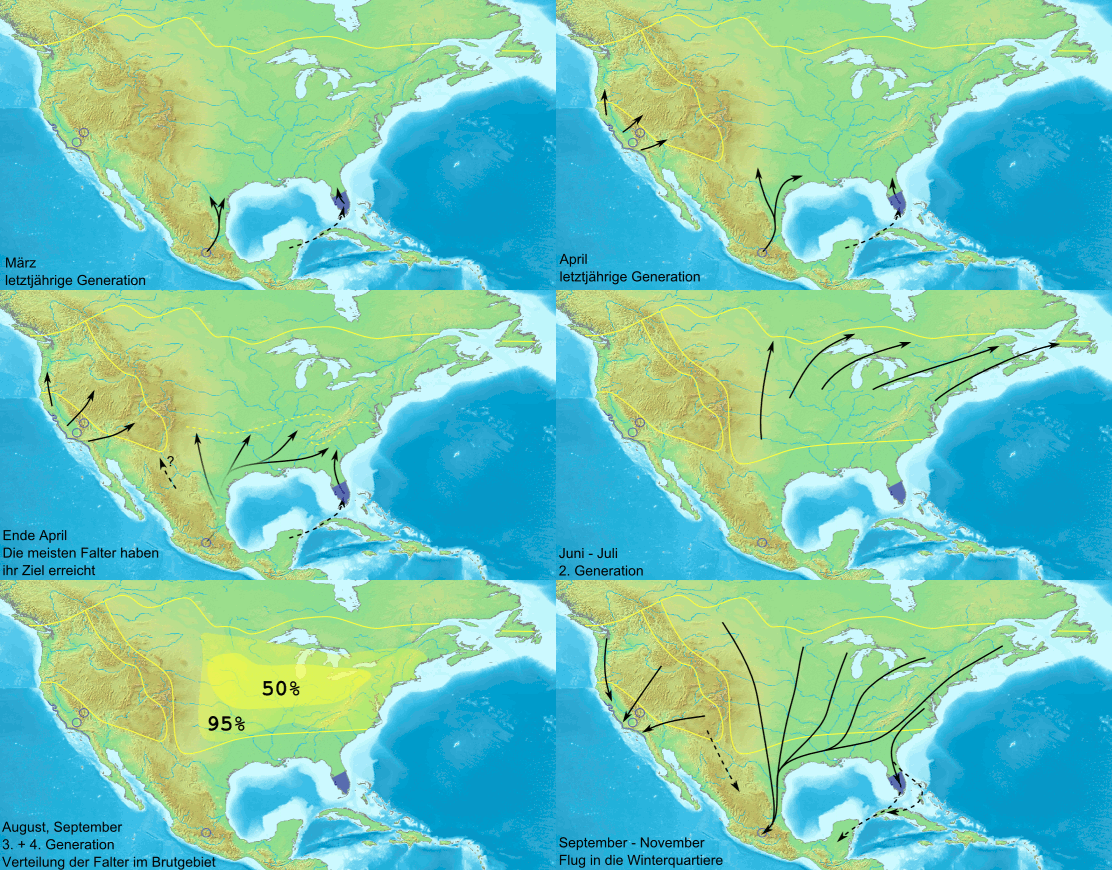
Monarchs are known for their long annual migrations. In North America, they travel long distances south in the fall, and north in the spring. They start to migrate south in about August. They must get to frost-free areas. Freezing will kill them. A migration towards the north starts in the spring.
No single individual makes the whole round trip. The migration north spans the life of three to four generations of the butterfly. A longer-lived “super generation” flies from the northern-most parts of the butterfly’s range in Canada all the way to Mexico. It overwinters in the south, and breeds in the spring to start the next generation flying north. The following reference gives a map of the migration routes.
Caterpillar
The monarch caterpillar is banded with yellow, black, and white stripes. The head is also striped with yellow and black. There are four black body extensions, two on each end of the body. They look similar to antennae. The caterpillar will be as long as 5 cm (2 inches).
Adults
The monarch butterfly has a wingspan that ranges from 8.9 to 10.2 centimeters (3½ to 4 inches).
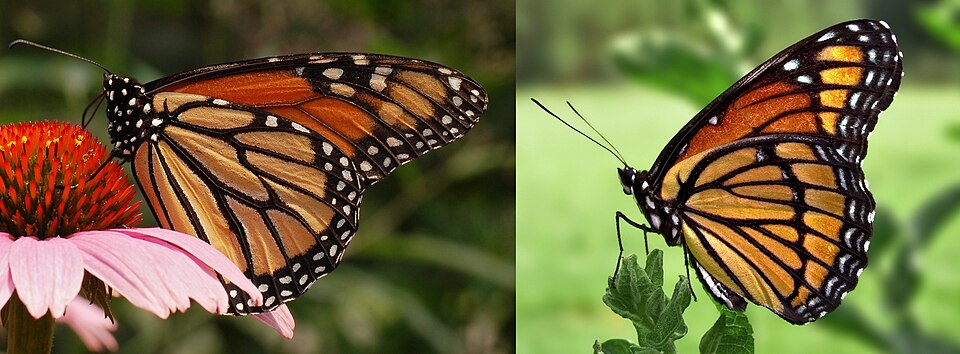
The upper side of the wings are orange with black edges and veins. There are white spots in the black wing margins. The male has a spot on his bottom wing. The spot gives out scents which attract females. The viceroy butterfly (Limenitis archippus) is similar. It has an extra black band across the bottom wing. The underside of the wings is a tan-orange color with black veins. The wing margins are black with white spots in them.
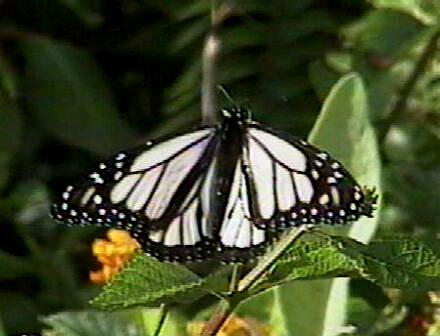
A white form of the monarch has been seen in Australia, New Zealand, Indonesia and the United States. It has been seen as early as 1896. It was named nivosus by lepidopterists (a lepidopterist is a person who studies butterflies and moths). It is grayish white in all areas of the wings that are normally orange. The white form makes up about 1% or less of all monarchs except for on Oahu, Hawaii where it has kept populations as high as 10%. The existence of two or more forms of a species in the same area is quite common, and is called polymorphism.
Range and distribution
In North America, the monarch is found from southern Canada to northern South America. It sometimes wanders to western Europe, sometimes as far as Greece. It reaches Europe from being transported by USA ships. It can also wander to Europe by flying there if weather and wind conditions are right. It has also been found in Bermuda, Hawaii, the Solomons, New Caledonia, New Zealand, Australia, New Guinea, Ceylon, India, the Azores, and the Canary Islands.
Migration
Monarch butterflies are known for their long annual migration. In North America, they make large migrations towards the south starting in August until the first frost. A migration towards the north takes place in the spring. No single individual makes the whole round trip. Female monarchs lay eggs for the next generation during these migrations.
By the end of October, the monarchs that are east of the Rocky Mountains migrate to Mexico. Many thousands from the Great Lakes region pass through Point Pelee National Park. They migrate to the sanctuaries of the Mariposa Monarca Biosphere Reserve in the Mexican states of Michoacán and Mexico. Most of the monarchs that are west of the Rocky Mountains do not travel all the way down to Mexico. Instead, they overwinter (spend the winter) in many places in central and southern California.
While in Mexico, the monarchs gather in very large numbers to rest. They perch on suitable trees and bushes by clinging (hold on to tightly) with their feet. They cling to each other making layers and layers of resting Monarchs overwintering. This was discovered by Fred Urquhart of the University of Toronto, who studied monarch butterflies for nearly forty years. He knew the Monarchs migrated because he would stop seeing them after a certain time of the year. He put a label on each Monarch he found. On this label was his name, address, and a request to send him the butterfly if it was found.
A few months later, people from all over North America and Mexico began returning his labelled butterflies to him. Mexico was the southernmost area from which he had received a butterfly, so he started traveling there to look for the Monarchs. For many years, he traveled to Mexico. There he climbed through jungles, walked through forests, and talked to the people he found. He finally heard there was a place west of Mexico City where people had seen lots of monarchs all together. After a long search, He finally found millions of monarch butterflies covering every part of the area.
During the spring migration, the population that is east of the Rocky Mountains may reach as far north as Texas and Oklahoma. The second, third and fourth generations return to their northern places in the United States and Canada in the spring.
Habitat
The Monarch can be found in many different kinds of habitats. When it is breeding, it is found in habitats with milkweed (a kind of plant). Some of these habitats include, fields, meadows, prairies, parks in or near cities, gardens, and roadsides. The monarch can be found in almost any kind of habitat during migration. It overwinters in pine, cypress, and eucalyptus groves in California. It overwinters in fir forests and pine groves in Mexico.
Much of the monarch’s breeding habitat is not good anymore. In some states and provinces, milkweed is thought to be a weed. In these places, the milkweed is killed to keep livestock from eating it and becoming sick. Moreover, herbicides use, especially with genetically modified herbicide-resistant plants, eliminate milkweed. With fewer milkweed plants, the monarch does not have as much habitat to breed in.
Habitat destruction has been a concern as the number of monarch butterflies that completed an annual migration to their winter home in a Mexican forest sank in 2013 to its lowest level in at least two decades, due mostly to extreme weather and changed farming practices in North America. The Mexican forest occupied by the butterflies, once as high at 50 acres (200,000 m²), dwindled to 2.94 acres (11,900 m²) in the annual census conducted December 2012.
Life cycle
The monarch butterfly goes through complete metamorphosis.
Egg
The female lays her eggs one by one. They are laid on the underside of the leaves of caterpillar’s food plant. The eggs are light yellow. Freshly laid eggs are creamy-white. After three to four days, they turn dark gray. The egg usually weighs about 0.54 milligrams. It is about 1.2 millimeters long. Its diameter is about 0.87 millimeters (average on 55 eggs).
Caterpillar
The caterpillar hatches out of the egg. The young caterpillar is a gray-black color with a black head. After the first molt (shedding its skin) the caterpillar is banded with yellow, black, and white stripes. The head is also striped with yellow and black. There are four black body extensions, two on each end of the body. They look similar to antennae. The caterpillar will reach a length of 5 centimeters (2 inches). The caterpillar eats the leaves and flowers of the food plant. It make no nests or shelters. It grows very quickly, and because of this, it molts four to five times.
Chrysalis
After the caterpillar molts one last time, it makes a chrysalis. A chrysalis is not the same as a cocoon. The monarch caterpillar attaches its back end (posterior) to a support, and hangs downward in the shape of the letter ‘J’. The inside of the caterpillar’s body begins to change and it splits its skin to form the blue-green chrysalis. The blue-green chrysalis has a band of black and bright gold near the top. There are other gold spots lower down. After spending many weeks in the chrysalis, the adult finally comes out as a butterfly.
File:Monarch Butterfly Danaus plexippus Mating Vertical 1800px.jpg|A mating pair of monarchs File:Monarch Butterfly Danaus plexippus Laying Egg 2600px.jpg|A female monarch laying eggs File:Monarch Butterfly Eggs on Swan Plant.JPG|Eggs on a milkweed plant File:Monarch Butterfly Danaus plexippus Vertical Caterpillar 2000px.jpg|Caterpillar File:Monarch Butterfly Cocoon 3.jpg|Chrysalis File:Eclosing Monarch, Megan McCarty118.PNG|Monarch coming out of its chrysalis File:Monarch Butterfly Danaus plexippus on Echinacea purpurea 2800px.jpg|An adult monarch
Species similar in appearance
The viceroy (Limenitis archippus) is similar to but is smaller than the monarch. It has an extra black band across the bottom wing that the monarch does not have.
The queen (Danaus gilippus) is dark reddish-brown instead of orange. It does not have black veins. There are white spots on the top wing submarginal (near the edge of the wing) area. These spots are on both the upper side and the underside.
The soldier (Danaus eresimus) is also dark reddish-brown instead of orange. It has thin, black veins. The underside of the bottom wing has a dark center. It has light brown, square-shaped spots around the dark center.
File:Limenitis archippus 2.jpg|Viceroy File:ComputerHotline - Lepidoptera sp. (by) (28).jpg|Queen File:Danaus eresimus in Secret Woods 2.JPG|Soldier
Mimicry
Monarchs are bad-tasting and poisonous because they contain a chemical known as cardenolide (cardiac glycoside). The chemical slows the heart-beat of vertebrates. Monarch caterpillars get this chemical when they feed on milkweed.
When the monarch becomes a butterfly, it no longer eats milkweed, but it still has the chemical in its body. The butterfly shows that they are not good to eat with their bright orange and black wings. This is warning coloration. A bird may try to eat a monarch, but it will become sick and vomit after eating it. After this experience, the bird learns not to eat another monarch, and also any other butterfly which is similar in appearance. The viceroy is similar looking to the monarch, but does not have the milkweed poison in its body. Birds that have had the bad experience of eating a monarch will usually not eat a viceroy. It is an example of Müllerian mimicry.
Predators
Overwintering Monarchs in Mexico are often eaten by black-headed grosbeaks. These birds are immune to the glycoside. Other birds, such as orioles and jays, have learned to eat only the thoracic muscles and the body parts inside the abdomen. These parts have less poison than the rest of the body. Some mice are also immune to large amounts of the poison. Over time, overwintering monarchs become less poisonous. This makes them more likely to be eaten by predators. In Mexico, about 14% of the overwintering Monarchs are eaten by birds and mice.
On Oahu, Hawaii, there is a white form of the Monarch. This is because two species of birds have been introduced. The two birds are known as the red-vented bulbul and the red-whiskered bulbul. They were introduced in 1965 and 1966. They are now the most common insectivorous birds. They are probably the only birds that eat insects as big as the monarch. Monarchs in Hawaii have low cardiac glycoside levels, but the birds may be immune to the chemical. The two bird species eat the caterpillars and sometimes the chrysalids. They look for them on branches and the underside of leaves in milkweed bushes. The birds also eat resting adults and egg-laying females. They eat flying monarchs less often. The white form has a higher chance of living than the orange one. The white form does not fit the birds’ search image of a normal monarch, and so it is not eaten. This kind of defense is known as apostatic selection. The white form is also camouflaged in patches of light shining through groups of leaves.
Parasites
Parasites include the tachinid flies Sturmia convergens and Lesperia archippivora. Caterpillars that have the Lesperia archippivora maggots inside them will finish their last molt. They will then hang upside down on a horizontal surface. They die before they turn into a chrysalis. At that time one white maggot comes out of the caterpillar. The maggot then forms a brown pupa on the ground.
The bacteria Micrococcus flacidifex danai also infects the caterpillar and causes “black death”. Just before turning into a chrysalis, the caterpillar will find a horizontal surface. They die a few hours later. The body turns black shortly after. The bacteria Pseudomonas aeruginosa causes infections in weakened insects. It is a common cause of death in insects that are raised in laboratories.
Relationship with humans
The monarch is the state insect of Alabama, Idaho, Illinois, Minnesota, and Texas. It is the state butterfly of Vermont and West Virginia. It was nominated in 1990 as the national insect of the United States of America. It was nominated along with the honeybee (Apis mellifera). However, the legislation did not pass.
Many people like to attract monarchs by growing a butterfly garden with the plant Asclepias physocarpa. Others like raising them for fun or for educational purposes. Sanctuaries have been made for migrating Monarchs. The sanctuaries are found at the monarch’s favorite overwintering places. These migrations can create a lot of tourism revenue.
Many schools also enjoy caring for monarchs. They start with caterpillars. When the caterpillars mature into butterflies, they are then set free into the wild.
Some organizations, such as the Cape May Bird Observatory, have monarch labeling programs. Labels are placed on the wing of the butterfly. The labels have information on them. This helps scientists track the monarchs during their migration. It also helps the scientists study the paths that the monarchs take on their migration.
Adult food sources
Adult Monarchs have been seen on a number of different nectar plants. Here is a list of some of them:
Apocynum cannabinum – Indian hemp
Asclepias incarnata – Swamp milkweed
Asclepias syriaca – Common milkweed
Asclepias tuberosa – Butterfly weed
Aster sp. – asters
Cirsium sp. – thistles
Conyza canadensis – Canadian horseweed
Daucus carota – Wild carrot
Dipsacus fullonum – Fuller’s teasel
Eupatorium perfoliatum – Common boneset
Eutrochium maculatum – Spotted joe-pye weed
Hesperis matronalis – Dame’s rocket
Medicago sativa – Alfalfa
Solidago sp. – golden rods
Syringa vulgaris – Lilac
Trifolium pratense – Red clover
Vernonia gigantea – Tall ironweed
Males will also take in water and minerals from damp soil and small, wet rocks. This is known as puddling. The Monarch has also been seen puddling at an oil stain on pavement.
Food plants
Here is a list of plants that the Monarch caterpillar eats:
Asclepias amplexicaulis – Clasping milkweed
Asclepias asperula – Antelope horns
Asclepias californica – California milkweed
Asclepias cordifolia – Heart-leaf milkweed
Asclepias curassavica – Scarlet milkweed
Asclepias curtissii – Curtiss’ milkweed
Asclepias eriocarpa – Woollypod milkweed
Asclepias erosa – Desert milkweed
Asclepias exaltata – Poke milkweed
Asclepias fascicularis – Narrow-leaf milkweed
Asclepias humistrata – Sandhill milkweed
Asclepias incarnata – Swamp milkweed
Asclepias nivea – Caribbean milkweed
Asclepias physocarpa – Swan plant
Asclepias purpurascens – Purple milkweed
Asclepias speciosa – Showy milkweed
Asclepias subverticillata – Horsetail milkweed
Asclepias syriaca – Common milkweed
Asclepias tuberosa – Butterfly weed
Asclepias verticillata – Whorled milkweed
Calotropis gigantea – Crown flower
Calotropis procera – Apple of Sodom
Cynanchum laeve – Sand vine
Sarcostemma clausum – White vine
Written for younger readers
Monarch butterfly, in simpler words
This version comes from Wikijunior, a set of books written for children aged 8 to 11. It is shorter and uses plainer language than the article above.
From Wikijunior: Bugs
The name Monarch means “king”. An adult Monarch Butterfly is about 1 ½ inches long. Its body is black with white markings. There are white spots on the head and around the wing edges. The wings are bright orange with black veins. The undersides of the wings are light orange. Male Monarchs have a black spot on the back of each hind wing.
Wings have 2 parts: a forewing and a hind wing. The wing span can be up to 4 inches across. The back edges of the wings are called “margins”. They bend to push air backward and move the butterfly forward. The stiff front edges of the wings lift the butterfly in flight. Black veins create a framework that keeps the wings stable. Female wing veins are thicker than those of males.
Monarch Butterflies come from yellow, black, and white striped caterpillars. Monarch caterpillars grow to about 2 inches in length. They have 2 tentacles that look like antennae at the front of the body, and 2 tentacles at the back.
One population of Monarch Butterflies lives on the eastern side of the Rocky Mountains. In the fall, the eastern population migrates to the cool mountains of central Mexico. They overwinter on just twelve isolated mountaintops in the Oyamel Forest.
When spring arrives, the eastern Monarchs leave Mexico. They fly north through Texas and the Midwestern plains. Finally, they reach the Great Lakes region. By late summer, they will have spread to Canada and the east coast of the United States.
Another population of Monarchs lives on the western side of the Rockies. The western Monarchs spend the winter on the warm California coast. They like the moderate temperatures. They overwinter by clustering in groves of trees. The groves are scattered along the coast from Mendocino County in northern California to Baja in southern California.
In the spring, adults begin to move inland. They feed on flower nectar. They mate and lay eggs on milkweed plants. When they die their offspring repeat the cycle. Several generations later, the last adults produced in late summer and fall migrate to the coast. The new Monarchs have never been there before, but they can find their way to the same groves used by previous generations.
Monarch caterpillars feed on plants of the milkweed family. Adult Monarchs drink the nectar of milkweed flowers. They also like joe-pye weed, New England aster, purple coneflower, and false blue indigo.
Monarch Butterflies use 2 methods of self defense: warning colors and poison. Milkweed plants that Monarch caterpillars eat are poisonous. The poison does not hurt the caterpillars. The poison stays inside as they turn into adults. The bright colors of both caterpillar and adult butterfly warn predators to stay away. Birds and other predators will not eat them. The amount of poison decreases as the butterfly gets older. Males have less of the poison than females.
Monarch Butterflies undergo complete metamorphosis. They go through 4 stages in a life cycle: egg, caterpillar (larvae), pupa (chrysalis), and adult. They make 4 generations in one year.
Females lay hundreds of tiny white eggs on the underside of milkweed leaves. In 3 to 5 days the caterpillar chews its way out of the egg shell. Then it eats the broken shell for nourishment. The caterpillar moves away from the leaves where the eggs were laid. It feeds on the leaves of the milkweed plant.
As a Monarch caterpillar grows, the skin gets too tight and splits open. This happens several times. When the skin splits for the last time, the caterpillar makes a protective covering (chrysalis). It finds a twig or branch and attaches itself with its back legs. Hanging upside down, it weaves the chrysalis, starting from head at the bottom to back end at the top. The chrysalis is finished when it reaches the legs attached to the branch. Inside the chrysalis, the Monarch enters its resting stage.
The Monarch chrysalis is light green with tiny yellow spots along the edge. Inside the chrysalis, the caterpillar changes into a winged adult butterfly. When ready, the chrysalis splits open and the adult butterfly pulls itself out. The new wings are crumpled and wet. The butterfly rests in the sun until the wings flatten and dry.
Adults do not mate right away. Instead they fly to the Oyamel forest in the mountains of Mexico. The Monarchs cluster together on trees for protection. They hibernate until spring when it is time to mate. In February and March, the final generation of Monarch butterflies comes out of hibernation to mate. They migrate north and east in order to find a place to lay their eggs. This starts a new “1st” generation.
The first 3 generations usually die about six weeks after mating. The 4th generation is called the Methuselah (long-living) generation.
The male Monarch has a black spot on each hind wing. The spots are glands that make a special scent to attract females.
To sip nectar from a flower the adult butterfly has a spiral, straw-like tongue (proboscis). The tongue rolls out to drink, then rolls up out of the way. The tongue works like a paper towel with tiny grooves that soak up drops of nectar.
Monarchs travel alone in daylight. They cluster on tree trunks at night. A cluster of butterflies is called a “roost” or a “bivouac”. Some roosts are small with just a few butterflies. Others roosts can harbor thousands of butterflies.
Monarch Butterflies are not considered pests. They benefit people by pollinating plants. They prefer native plants, especially milkweed. People like native plants because they are hardy and need less water and fertilizer. Native plants attract butterflies to gardens.
Monarch Butterflies are adapted to the delicate environment of the Oyamel Forest in Mexico. To protect the habitat, the Mexican government has created the Oyamel Forest Monarch Butterfly Preserve. They have made laws against cutting down the trees in the Oyamel Forest.
Monarch Butterflies are important pollinators. Pollinators help plants reproduce and create food for people.
Monarch populations have declined over the last 20 years because of lost habitat in many areas. Pesticide exposure and climate change have also caused harm. There are many Monarch conservation projects throughout the United States.
Where this page comes from
The article above is adapted from “Monarch butterfly” on Simple English Wikipedia, by its contributors. We removed reference markers, navigation boxes and tables, expanded measurement templates into readable numbers, and kept the prose otherwise intact. The simpler version is adapted from Wikijunior on Wikibooks.
Both sources are published under CC BY-SA 4.0, so this page is published under the same licence. You may share and adapt it, including commercially, as long as you credit the original and keep the same licence.
Worksheets, answer keys and printable layouts elsewhere on K5Print are our own work and are not covered by this licence.