Opossum
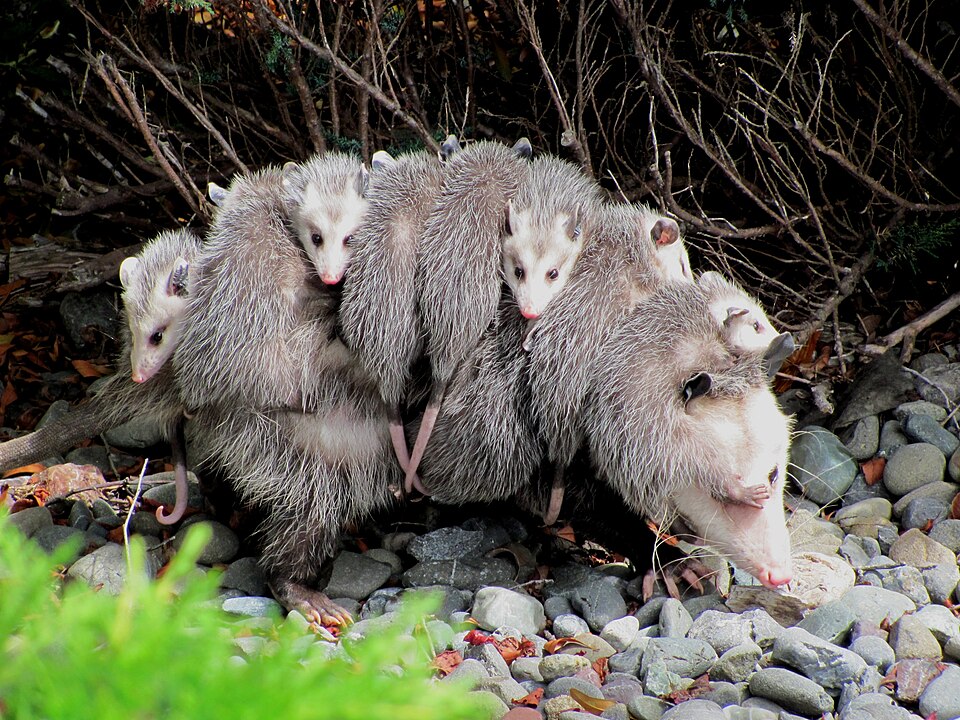

Fast facts
- Phylum
- Chordata
Scientific name
- Scientific name
- Didelphidae
- Kingdom
- Animalia
- Phylum
- Chordata
- Class
- Mammalia
- Order
- Didelphimorphia
- Family
- Didelphidae
How to say it in other languages
- Italian
- Didelfidi
- Japanese
- オポッサム科
- Korean
- 주머니쥐과
Facts from Wikipedia’s “Opossum” page and Wikispecies (CC BY-SA 4.0).
Opossums are the largest order of marsupials in the Western Hemisphere, the Didelphimorphia.
They are often called possums, though that term is more properly applied to Australian fauna of the suborder Phalangeriformes.
The Virginia opossum was the first animal to be called an opossum: the word comes from the Algonquian language, and means “white beast.” It was one of the few South American marsupials to establish itself permanently in North America after the Great American Interchange, and the only one to survive there today.
Scientists used to believe that opossums hosted large numbers of ticks, but now they think they do not. Wildlife scientist Cecilia Hennessy thinks this belief came from a paper called “Hosts as ecological traps for the vector of Lyme disease.” Hennessy did her own study and found that opossums do not eat many ticks. She and her team looked at opossums’ stomachs and found animals without bones like beetles and worms, animals with bones like amphibians and small mammals, plants including grass, leaves and seeds, and garbage.
Marsupials like opossums are born before their jaw bones have grown enough for them to drink their mothers’ milk the way other baby mammals do. Scientists from King’s College London found that opossums and other marsupials use tissue from their inner ear to make a temporary jaw so they can feed and grow.
Where this page comes from
The article above is adapted from “Opossum” on Simple English Wikipedia, by its contributors. We removed reference markers, navigation boxes and tables, expanded measurement templates into readable numbers, and kept the prose otherwise intact.
Both sources are published under CC BY-SA 4.0, so this page is published under the same licence. You may share and adapt it, including commercially, as long as you credit the original and keep the same licence.
Worksheets, answer keys and printable layouts elsewhere on K5Print are our own work and are not covered by this licence.