Orangutan


Scientific name
- Scientific name
- Pongo
- Kingdom
- Animalia
- Phylum
- Chordata
- Class
- Mammalia
- Order
- Primates
- Family
- Hominidae
- Genus
- Pongo
How to say it in other languages
- Chinese
- 猩猩
- Dutch
- Orang oetan
- French
- Orang-outan
- German
- Orang-Utan
- Japanese
- オランウータン属
- Korean
- 오랑우탄속
- Portuguese
- Orangotango
- Russian
- Орангутан
- Spanish
- Orangután
Facts from Wikipedia’s “Orangutan” page and Wikispecies (CC BY-SA 4.0).
Orangutans (Pongo) are great apes belonging to the dense, tropical rainforests of Indonesia and Malaysia. There are two species of orangutan. They are from Southeast Asia. There are very few of them left, because loss of the jungle has reduced their habitat. There are orangutans on view at the Singapore zoo.
The name orangutan comes from two Malay words, orang which means person, and hutan which means forest; so orangutan means person of the forest.
Taxonomy
- Genus Pongo
- Bornean orangutan, Pongo pygmaeus
- Sumatran orangutan, Pongo abelii
- Tapanuli orangutan, Pongo tapanuliensis OrangutanP1.jpg|Bornean orangutan Orangutan 01.jpg|Sumatran Orangutan Pongo tapanuliensis.jpg|Tapanuli Orangutan
Appearance
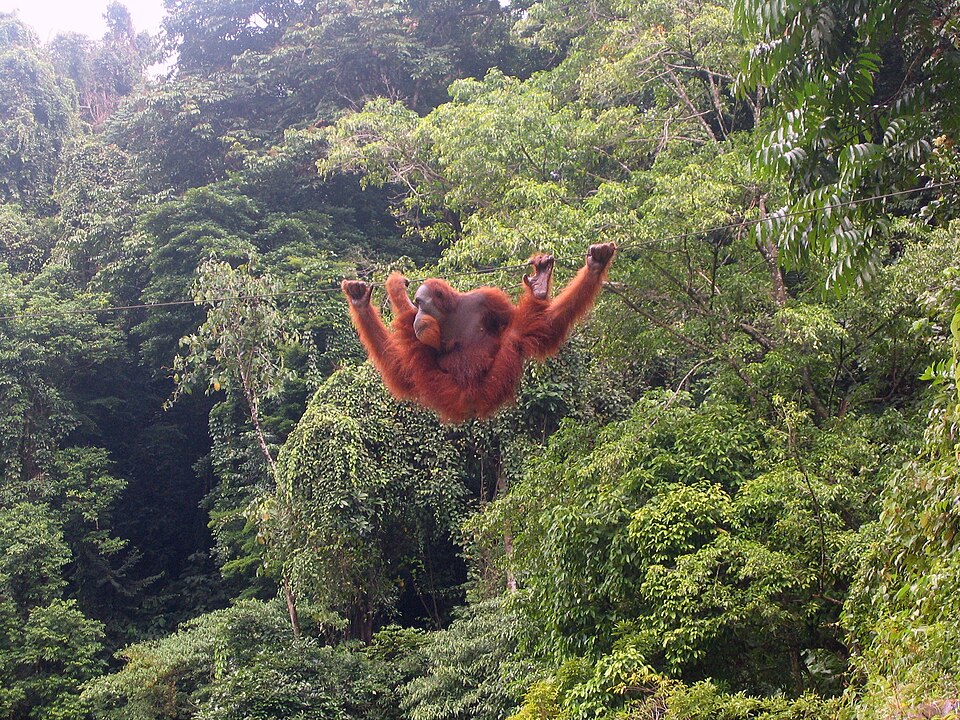
Orangutans have red-brown hair. They have long arms, and short legs. They can be very strong. They also have hands that are good for climbing. The Sumatran Orangutan is smaller and has longer hair than the Bornean orangutan. Orangutans have suffered from forest loss and are on the very edge of extinction.
Life
Orangutans are from the rainforests on the islands Borneo and Sumatra in Southeast Asia. They mostly live up in the trees. They eat fruit, leaves and bark and also insects and bird eggs. They drink water from rain that has been collected in leaves. Orangutans are not comfortable on the ground since they have to push themselves along with fists. Heavy adults move carefully through the trees, using their flexible feet to grasp the tree branches. Smaller orangutans swing with more ease.
Diet
An orangutan’s diet consists mainly of fruit, they like ripe fruit. If they cannot find fruit they will eat bark, leaves and termites, rather than move to somewhere else to get food. About 60% of an orangutan’s diet is fruit, 25% is leaves, 10% is bark and flowers, and 5% is termites and other insects.
Pregnancy
After a pregnancy of 230–260 days the female gives birth to usually one baby, but sometimes two, every eight to nine years. The little ones stay with their mother for years, riding on the mother backend and learning to move through the forest. The young orangutans are playful and affectionate. When they are five or six years old, they become more independent and eventually go off on their own.
Where this page comes from
The article above is adapted from “Orangutan” on Simple English Wikipedia, by its contributors. We removed reference markers, navigation boxes and tables, expanded measurement templates into readable numbers, and kept the prose otherwise intact.
Both sources are published under CC BY-SA 4.0, so this page is published under the same licence. You may share and adapt it, including commercially, as long as you credit the original and keep the same licence.
Worksheets, answer keys and printable layouts elsewhere on K5Print are our own work and are not covered by this licence.