Passenger Pigeon

Fast facts
- Conservation status
- Extinct
- Genus
- Ectopistes
Scientific name
- Scientific name
- Ectopistes migratorius
How to say it in other languages
- Chinese
- 旅鴿
- Dutch
- Trekduif
- French
- Pigeon migrateur
- German
- Wandertaube
- Japanese
- リョコウバト
- Portuguese
- Pombo passageiro
- Spanish
- Paloma migratoria
Facts from Wikipedia’s “Passenger pigeon” page and Wikispecies (CC BY-SA 4.0).
The passenger pigeon (Ectopistes migratorius) or wild pigeon was a species of pigeon that was once the most common bird in North America.
Description
The passenger pigeon, or, wild pigeon was a species of bird, Ectopistes migratorius, that was once common in North America. It lived in enormous migratory flocks — sometimes containing more than two billion birds — that could stretch one mile (1.6 km) wide and 300 miles (500 km) long across the sky, sometimes taking several hours to pass.
Some estimate that there were three billion to five billion passenger pigeons in the United States when Europeans arrived in North America. Others argue that the species had not been common in the Pre-Columbian period, but their numbers grew when devastation of the American Indian population by European diseases led to reduced competition for food.
The species went from being one of the most usual birds in the world during the 19th century to extinction early in the 20th century. At the time, passenger pigeons had one of the largest groups or flocks of any animal, second only to the Rocky Mountain locust.
Some reduction in numbers happened because of habitat loss when the Europeans started settling further inland. The primary factor emerged when pigeon meat was commercialized as a cheap food for slaves and the poor in the 19th century, resulting in hunting on a massive scale. There was a slow decline in their numbers between about 1800 and 1870, followed by a catastrophic decline between 1870 and 1890. Martha, thought to be the world’s last passenger pigeon, died on September 1, 1914, in Cincinnati, Ohio.
In the 18th century, the passenger pigeon in Europe was known to the French as tourtre; but, in New France, the North American bird was called tourte. In modern French, the bird is known as the pigeon migrateur.
In Algonquian languages, it was called amimi by the Lenape and omiimii by the Ojibwe. The term passenger pigeon in English derives from the French word passager, meaning to pass by.
Written for younger readers
Passenger Pigeon, in simpler words
This version comes from Wikijunior, a set of books written for children aged 8 to 11. It is shorter and uses plainer language than the article above.
From Wikijunior: Extinct Birds
The passenger pigeon, also wild pigeon, (Ectopistes migratorius) is an extinct species of pigeon.
They were very fast and could fly at 100 km/h (62 mph).
In Autumn, Winter and Spring, they ate beechnuts, acorns and chestnuts. However, in the Summer, they ate berries and fruit, like grapes and cherries.
Passenger pigeons lived in large flocks.
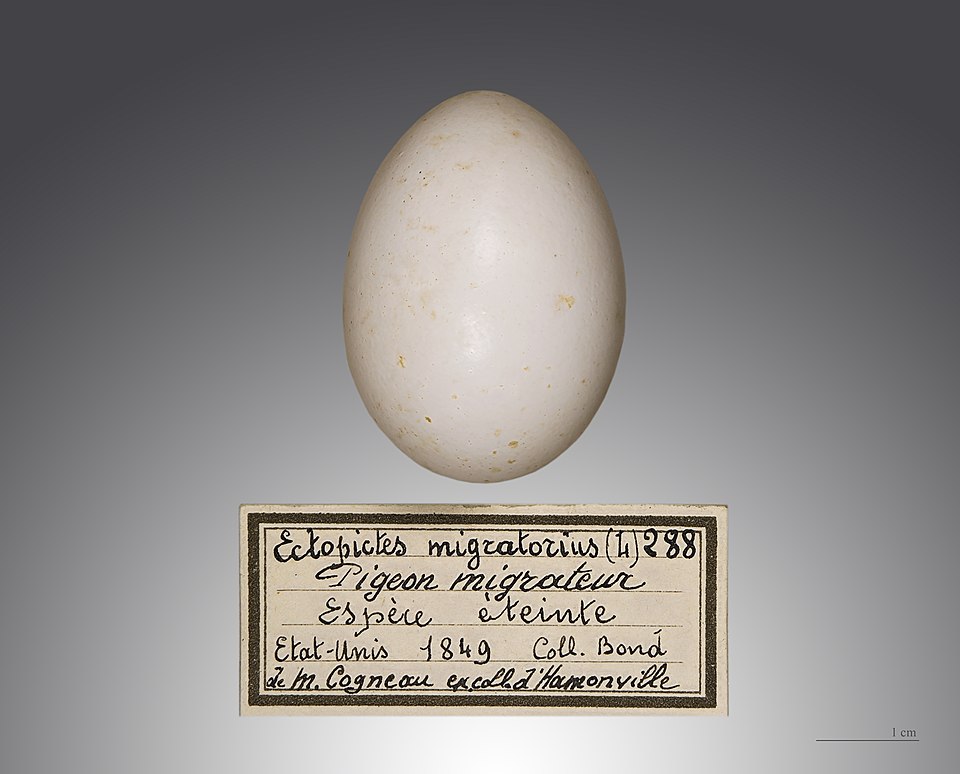
It is thought that only one egg was laid at a time. Eggs were white and oval-shaped.
Adults weighed between 260 and 340 grammes. Adult males and females look different.
Males were 390 to 410 mm long and had were bluish grey with grey wings. They had some iridescent feathers on their necks that looked, depending on how the light shone on it,bright bronze, violet or golden-green.
Females were smaller, between 380 to 400 mm long. They had quite dark brown-grey feathers and had less of the iridescent neck. The wings were quite spotted.
Juvenile birds looked quite like the females, but had no iridescent neck or spots on the wings.
They were found in Eastern North America. When breeding, the range was smaller and at the east of the normal range.
Martha was the last passenger pigeon and died on September 1, 1914, over 100 years ago.
They were always hunted by the Native Americans, but the arrival of the Europeans significantly increased this. Pigeon meat was considered a cheap food, so they were hunted intensely. Also, deforestation destroyed their habitat.
Where this page comes from
The article above is adapted from “Passenger Pigeon” on Simple English Wikipedia, by its contributors. We removed reference markers, navigation boxes and tables, expanded measurement templates into readable numbers, and kept the prose otherwise intact. The simpler version is adapted from Wikijunior on Wikibooks.
Both sources are published under CC BY-SA 4.0, so this page is published under the same licence. You may share and adapt it, including commercially, as long as you credit the original and keep the same licence.
Worksheets, answer keys and printable layouts elsewhere on K5Print are our own work and are not covered by this licence.