Praying Mantis

Fast facts
- Phylum
- Arthropoda
Scientific name
- Scientific name
- Mantodea
- Kingdom
- Animalia
- Phylum
- Arthropoda
- Class
- Insecta
- Order
- Mantodea
How to say it in other languages
- Chinese
- 螳螂目
- Japanese
- カマキリ目 (蟷螂目)
- Korean
- 사마귀목 (당랑목)
- Russian
- Богомоловые
Facts from Wikipedia’s “Mantis” page and Wikispecies (CC BY-SA 4.0).
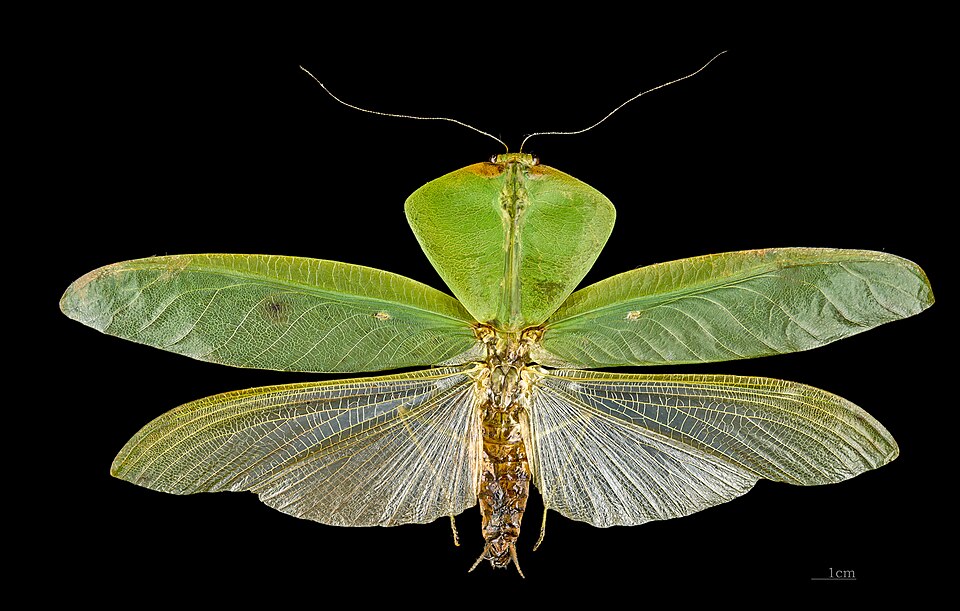
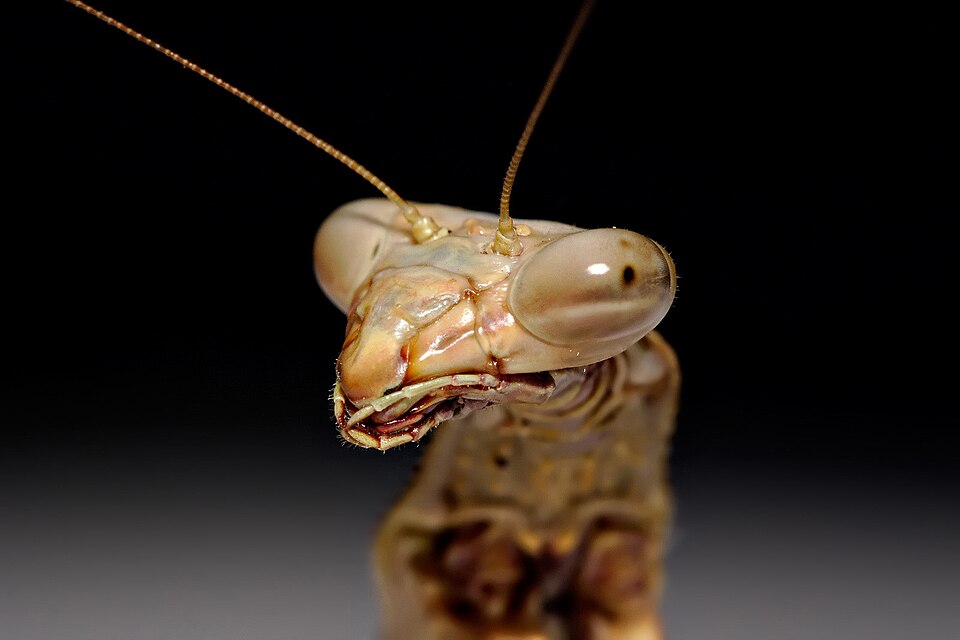
A Mantis (order Mantodea) is a predatory type of insect. They are usually known as praying mantids because of their prayer-like stance. They posses a highly elongated thorax that supports their triangular head.
The group contains about 2,300 species. They occur in temperate and tropical habitats. Most are in are in the family Mantidae, and are called Mantids.
In Europe, the name “praying mantis” refers to only a single species, Mantis religiosa. They are sometimes confused with phasmids (stick insects).
The closest relatives of mantids are the order Blattodea (cockroaches and termites), and these two groups together are ranked as the Superorder Dictyoptera.
Life habit
Mantids are notable for their hunting abilities. They are predators, and their diet usually consists of living insects, including flies,aphids,moths and crickets. Larger species have been known to prey on small lizards, frogs, birds, snakes, and even rodents.
Most mantids are ambush predators, waiting for prey to stray too near. The mantis then lashes out at remarkable speed. Some ground and bark species, however, pursue their prey rather quickly.
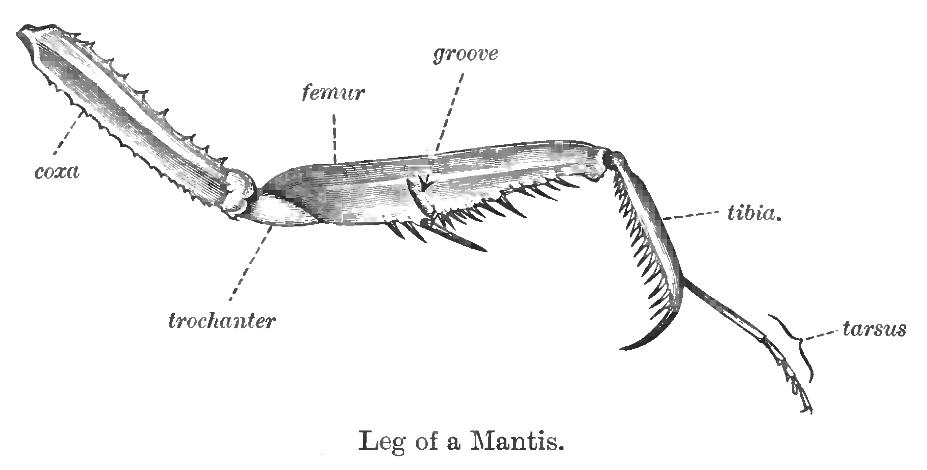
Prey are caught and held securely with grasping, spiked forelegs (‘raptorial’ legs); the first thoracic segment, the prothorax, is commonly elongated and flexibly articulated, allowing for greater range of movement of the front limbs while the remainder of the body remains more or less still. They adapt to survive in winter by leaving hardy egg cases before dying in autumn.
The movement of the head is also remarkably flexible. It gives nearly 300 degrees of movement in some species. This allows for a great range of vision (their compound eyes have a large binocular field of vision) without having to move the rest of the body. As their hunting relies heavily on vision, they are mainly diurnal, but many species fly at night, when there is less chance of being taken by birds.
Mantids are masters of camouflage and most species make use of protective colouration to blend in with the foliage or substrate. This helps to avoid predators themselves, and to better snare their victims. They not only blend with the foliage, but mimic it, appearing as either living or withered leaves, sticks, tree bark, blades of grass, flowers, or even stones. Some species in Africa and Australia are able to turn black after a molt following a fire in the region to blend in with the fire ravaged landscape (fire melanism).
Mantids bite, but have no venom, and are not dangerous to humans. They are not chemically protected; nearly any large predatory animal will eat a mantis if it is able to detect it. Mantids are generally quite aggressive towards one another, in fact, and most species are readily cannibalistic when given the opportunity.
Written for younger readers
Praying Mantis, in simpler words
This version comes from Wikijunior, a set of books written for children aged 8 to 11. It is shorter and uses plainer language than the article above.
From Wikijunior: Bugs
A cartoon version of this very helpful bug is a praying grasshopper. Here we wrote all we can figure out about them. They are very shy creatures.
The praying mantis is a skinny insect with long, curved legs in the front. The position of these legs make the mantis look like it is praying. Most, but not all, mantes (the plural of mantis) are green or brown but some are black or even pink! The mantis uses the colors to blend in with its surroundings to catch prey. Some are so well disguised that other bugs think they are flowers.
Mantes are found all around the world including North America and Europe. Many different types are found in Asia. Some common species of mantes were introduced to North America from Asia and Europe. Nearly 2,000 species live throughout the world. Most are found in places with warm temperatures. A mantis will often roost in something close to its own body color. Most mantes are green or brown and they perch in grasses, bushes and trees. However, some other species are brightly colored and depend on flowers for camouflage.
The mantis is a carnivorous ambush predator. Mantes eat other insects which they catch with their spiny front legs. The rows of spines act like hooks, so they can grab and hold their prey. There is almost no way to escape. The mantis’ strong arms and hooked claws are a deadly trap. Their camouflage helps them stay hidden and they are so fast they can snag prey in the blink of an eye. Some species of mantes also eat lizards, spiders, other mantes, and even small birds and mice.
Did You Know? When the Chinese saw the praying mantis defending itself, they created Praying Mantis Kung Fu. It is a style of martial arts that mimics the attacks and movements of a praying mantis.
When the praying mantis needs to defend itself against predators, it will stand up tall, raise its large front legs, and open its wings to look as big as possible. It uses its front legs not only to catch prey but also to defend itself if necessary. It does this by standing up tall and making clicking noises to frighten its enemies. If that does not work the mantis either flies away quickly or it delivers a powerful punch with its hooked front leg. Although an angry mantis can be frightening, they are generally not aggressive to humans.
The female lays eggs in the autumn in an egg sack. The eggs prepare to hatch in the spring. When the nymphs hatch, they look like miniature versions of their parents. The new born mantes scamper off to find food. The nymphs may be eaten by bugs, birds or bigger mantes. The nymphs hatch and molt several times before reaching adulthood. But once a mantis becomes an adult it mates, and lays eggs of its own, restarting the mantis life cycle, an endless circle of life.
The praying mantis depends a lot on camouflage and blending into its surroundings. It will dance to make it look like it is blowing in the wind like a leaf or a twig. A praying mantis can also hold very still to surprise its prey. Some people haven’t seen it before, but all mantes can fly. These remarkable talents show that big surprises can come in small packages.
Some people think mantes are pests. That is only partly true, as mantes often eat helpful bugs like ladybugs. They can be beneficial too! Praying mantes are excellent exterminators. They keep down the population of bugs that are a threat to farming. They can also eliminate bugs with harmful diseases. A master of disguise, the praying mantis can be an able assistant to a farmer or gardener. Look at a bush in your yard, very very carefully. You might find a mantis poised on a leaf if you are very lucky!
Where this page comes from
The article above is adapted from “Praying Mantis” on Simple English Wikipedia, by its contributors. We removed reference markers, navigation boxes and tables, expanded measurement templates into readable numbers, and kept the prose otherwise intact. The simpler version is adapted from Wikijunior on Wikibooks.
Both sources are published under CC BY-SA 4.0, so this page is published under the same licence. You may share and adapt it, including commercially, as long as you credit the original and keep the same licence.
Worksheets, answer keys and printable layouts elsewhere on K5Print are our own work and are not covered by this licence.