Predaceous Diving Beetle
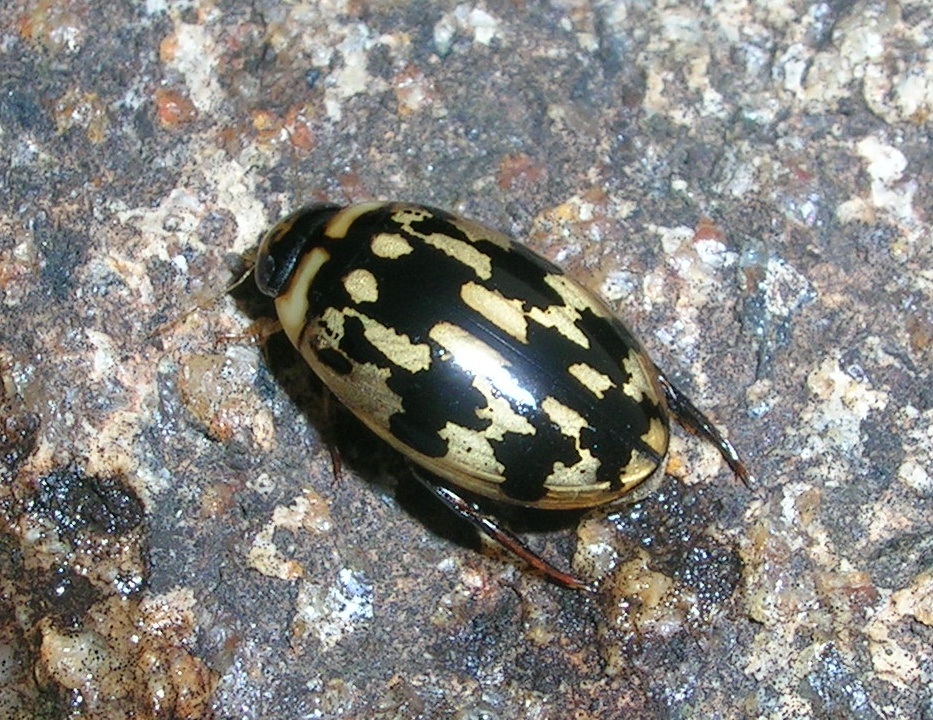

The Dytiscidae (Greek dytikos (“able to dive”) is a family of water beetles. They are called predaceous diving beetles. They are about 25 mm (one inch). The largest beetle, Dytiscus latissimus, can reach 45 mm long.
Most Dytiscidaes are dark brown, black-ish or dark olive in color with golden highlights in some subfamilies. The larvae are called “water tigers”. The water tigers will eat tadpoles and glassworms. They will also eat anything small living in the water. There are about 4,000 species in over 160 genera of Dytiscidae.
Food
The Cybister can be eaten by humans. In Mexico, C. explanatus are roasted and salted onto tacos. In Japan, C. japonicus is used as food. In Guangdong Province, China, several species are eaten. The great diving beetle (Dytiscus marginalis) are bred for human food. Dytiscidae have been eaten in Taiwan, Thailand, and New Guinea. Birds and other small mammals eat Dytiscidaes.
Books
- Commonwealth Scientific and Industrial Research Organisation (CSIRO) (2004): Water for a Healthy Country - Family Dytiscidae. Version of 2004-JUL-02. Retrieved 2008-AUG-04
- De Foliart, Gene R. (2002): Chapter 26 - Eastern Asia: China, Japan, and other countries . In: The Human Use of Insects as a Food Resource: A Bibliographic Account in Progress.
- Jäch, Manfred A. (2003): Fried water beetles Cantonese style. American Entomologist 49(1): 34-37. PDF fulltext
Written for younger readers
Predaceous Diving Beetle, in simpler words
This version comes from Wikijunior, a set of books written for children aged 8 to 11. It is shorter and uses plainer language than the article above.
From Wikijunior: Bugs
Predacious diving beetles belong to the Order Coleoptera and the Family Dytiscidae. Thermonectus is their species name.
They are aquatic beetles having a streamlined convex body. They are smooth and shiny—usually 1/8 to 1 inch long. Most species are dark brown or black in color. Some have distinctive patterns of spots, lines or mottling on the elytra (wing covers). They have filiform (thin and hairlike) antennae. Their flat hind legs are fringed with hairs to help them swim in water. The tarsi (hind legs) have claws at the end. Larvae are long with well-developed legs and large curved mandibles (jaws).
Acilius semisulcatus is a medium-sized predacious diving beetle with a black-margined square on the yellow prothorax. There are curved bands crossing the back of the elytra. Predacious diving beetle larvae are called “water tigers.” They are shaped like a rounded rod tapering toward each end. They have long curved mandibles. There are openings on the back end for getting air at the water surface. They can also breathe through their skin or long gills in the abdomen.
There are about 3500 Predacious diving beetle species worldwide and about 500 in North America. Different species live in a variety of aquatic habitats. Shallow, weedy ponds are good places to find them. They are also found in streams, lakes, ponds, and puddles. Sometimes they are found in salt water ponds. They do not live in fast-moving water.
Adults and larvae can be seen in spring, summer and fall. Adults of some species move to deeper lakes in the winter, where they remain active under the ice.
Adults and larvae are predators of other insects. They eat frogs, toads, salamanders and small fish. The larvae, called “water tigers,” have fierce appetites. They use their large, needle-like mandibles to inject digestive enzymes into prey to dissolve body tissue. The liquid is then sucked up through channels in the larvae’s jaws.
Giant Diving Beetles are members of the Predacious diving beetle family. They belong to the genus Dytiscus. They are voracious aquatic predators that often take prey as large as or larger than themselves.
Predaceous diving beetles are prey to birds and mammals. They are slow moving when on land, but in water they are fast swimmers. They are able to move through the water and quickly dive to avoid predators.
Larvae are smaller and hard to catch because of their fast movement. In a small pond, they may be at the top of the food chain without predators.
Predaceous diving beetles undergo complete metamorphosis. They grow from an egg to a larva, then to a pupa, and finally to an adult.
Females cut slits in water plants to lay their eggs inside stems. Development time for many species is unknown. Larvae pupate in cells dug into wet soil under logs or rocks near the water. The soft-bodied, pale (teneral) adults stay inside their pupal cells to harden before emerging after the final molt.
To swim, predaceous diving beetles move their hind legs simultaneously (at the same time) rather than alternately (one at a time). They hold the tip of the abdomen up to the water surface to obtain air. When they are under water, they breathe using stored air under the elytra.
Adults leave the water at night to fly around. They use the moon to navigate. In populated areas, they are attracted to porch lights, street lights and gas station lights.
Predaceous diving beetles are beneficial because they eat harmful insects. They are capable of biting, but are generally harmless to people.
They become a nuisance when too many fly around bright lights where people live and work.
They are sometimes harmful in fish hatcheries because they eat young fry (newly hatched fish).
Where this page comes from
The article above is adapted from “Predaceous Diving Beetle” on Simple English Wikipedia, by its contributors. We removed reference markers, navigation boxes and tables, expanded measurement templates into readable numbers, and kept the prose otherwise intact. The simpler version is adapted from Wikijunior on Wikibooks.
Both sources are published under CC BY-SA 4.0, so this page is published under the same licence. You may share and adapt it, including commercially, as long as you credit the original and keep the same licence.
Worksheets, answer keys and printable layouts elsewhere on K5Print are our own work and are not covered by this licence.