Ranidae

Scientific name
- Scientific name
- Ranidae
- Kingdom
- Animalia
- Phylum
- Chordata
- Class
- Amphibia
- Order
- Anura
- Family
- Ranidae
How to say it in other languages
- Chinese
- 蛙科
- German
- Echte Frösche
- Japanese
- アカガエル科
- Korean
- 개구리과
Facts from Wikipedia’s “Ranidae” page and Wikispecies (CC BY-SA 4.0).
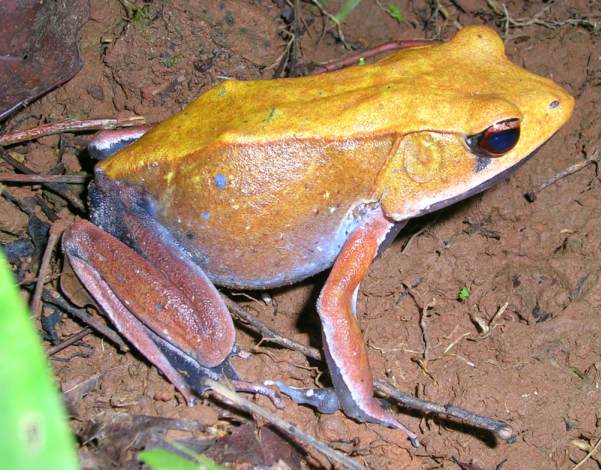
The Ranidae or true frogs can be found in most countries except Antarctica. The true frogs can be found in North America, northern South America, Europe, Asia, Madagascar, Africa, East Indies, New Guinea, and Australia. The bullfrog is the largest true frog in North America. Usually, true frogs are smooth, moist-skinned frogs, with large, powerful legs and have webbed feet. The smallest true frogs are the Wood frog (Rana sylvatica). The largest is the Goliath frog (Conraua goliath). True frogs are semi-aquatic frogs. They live near water.
Systematics
The Ranidae are not fully organized. There are some arguments about organization. Most organizations are agreed with.Some subfamilies are now seen as families (Petropedetidae, Cacosterninae, Mantellidae, and Dicroglossidae). The genus Rana is now split up.
This phylogeny was made by Che et al., 2007 using mitochondrial genes.
Genera
Most of the subfamilies in Ranidae are separate families. Raninae is the only subfamily. These genera are part of the family Ranidae:
- Abavorana Oliver, Prendini, Kraus, and Raxworthy, 2015 (three species)
- Amnirana Dubois, 1992 (11 species)
- Amolops Cope, 1865 (80 species)
- Babina Thompson, 1912 (two species)
- Chalcorana Dubois, 1992 (nine species)
- Clinotarsus Mivart 1869 (three species)
- Glandirana Fei, Ye, and Huang, 1990 (six species)
- Huia Yang, 1991 (monotypic)
- Humerana Dubois, 1992 (four species)
- Hydrophylax Fitzinger, 1843 (four species)
- Hylarana Tschudi 1838 (four species)
- Indosylvirana Oliver, Prendini, Kraus, and Raxworthy, 2015 (13 species)
- Lithobates Fitzinger, 1843 (55 species)
- Meristogenys Yang, 1991 (13 species)
- Nidirana Dubois, 1992 (19 species)
- Odorrana Fei, Ye, and Huang, 1990 (64 species)
- Papurana Dubois, 1992 (19 species)
- Pelophylax Fitzinger 1843 (19 species)
- Pseudorana Fei, Ye, and Huang, 1990 (monotypic)
- Pterorana Kiyasetuo and Khare, 1986 (monotypic)
- Pulchrana Dubois, 1992 (18 species)
- Rana Linnaeus, 1758 (58 species)
- Sanguirana Dubois, 1992 (six species)
- Staurois Cope, 1865 (six species)
- Sumaterana Arifin, Smart, Hertwig, Smith, Iskandar, and Haas, 2018 (three species)
- Sylvirana Dubois, 1992 (12 species)
- Wijayarana Arifin, Chan, Smart, Hertwig, Smith, Iskandar, and Haas, 2021 (five species)
Incertae sedis
Some taxa are part of Ranidae incertae sedis. This means that their taxonomic status is too uncertain to allow more specific placement.
- “Hylarana” chitwanensis (Das, 1998)
- “Hylarana” garoensis (Boulenger, 1920)
- “Hylarana” latouchii (Boulenger, 1899)
- “Hylarana” margariana Anderson, 1879
- “Hylarana” montivaga (Smith, 1921)
- “Hylarana” persimilis (Van Kampen, 1923)
Where this page comes from
The article above is adapted from “Ranidae” on Simple English Wikipedia, by its contributors. We removed reference markers, navigation boxes and tables, expanded measurement templates into readable numbers, and kept the prose otherwise intact.
Both sources are published under CC BY-SA 4.0, so this page is published under the same licence. You may share and adapt it, including commercially, as long as you credit the original and keep the same licence.
Worksheets, answer keys and printable layouts elsewhere on K5Print are our own work and are not covered by this licence.