Sand cat

Fast facts
- Conservation status
- Least concern
Scientific name
- Scientific name
- Felis margarita
How to say it in other languages
- Arabic
- قط الرمال
- Dutch
- Woestijnkat
- French
- Chat des sables
- German
- Sandkatze
- Italian
- Gatto delle sabbie
- Japanese
- スナネコ
- Portuguese
- Gato-do-deserto
- Russian
- Барханная кошка
- Spanish
- Gato del desierto
Facts from Wikipedia’s “Sand cat” page and Wikispecies (CC BY-SA 4.0).
The sand cat (Felis margarita) is a small wild cat in the Felinae subfamily. It is distributed over African and Asian deserts. Sometimes people call it “desert cat,” but that is really the name of a different animal. The sand cat does live in deserts, even the Sahara and Arabian Desert. It is also found in Iran and Pakistan. In zoos, this cat can live for up to 13 years.
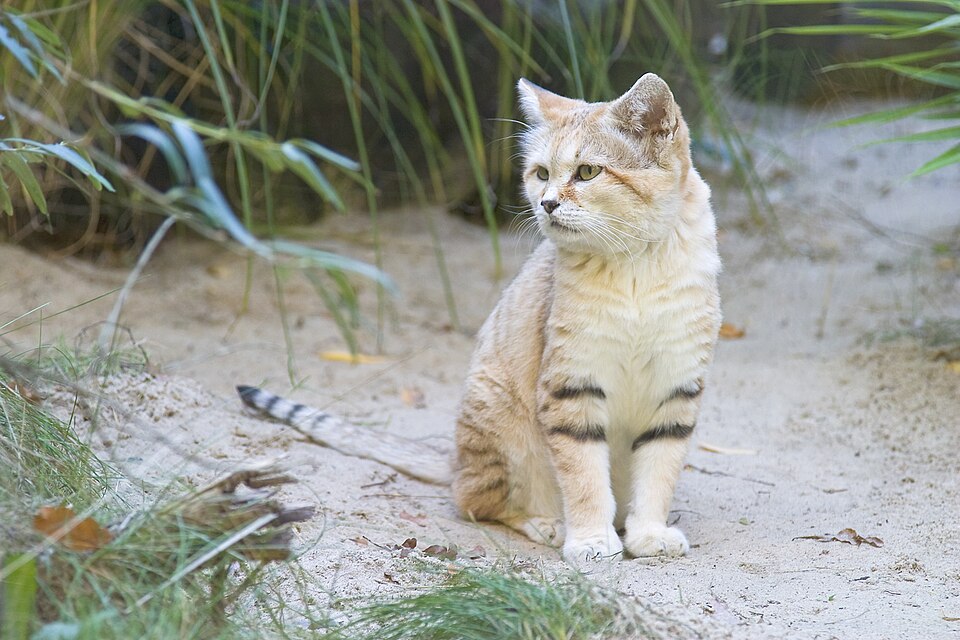
The sand cat is about 50 cm long, not including the tail. The tail is 30 cm long and has rings on it. It weighs about 2.7 kg (6 lbs). It has sand-colored fur and a wide head with ears that can point up, out or down. There is fur on its paws so that the hot sand does not hurt it.
This cat finds shade or digs a burrow during the day and hides from the sunlight underground. It only lives in places where the sand or dirt is loose enough for it to dig. The sand cat looks for food at night. It eats rodents, lizards and insects. It can even hunt and kill snakes. It does not drink water, taking all its water from eating prey. It does not need to go near watering holes, so it can avoid bigger predators that might hurt it. Wolves, snakes, large birds and humans can hurt this cat.
The sand cat does not fight with other sand cats over territory. Sometimes sand cats will take turns in the same burrow, but they will not share it at the same time. The sand cat lives alone except when looking for mates and when mothers are raising cubs.
Distribution
The sand cat lives in both sandy and stony deserts. It prefers flat terrain with little grass or small bush. It avoids bare and moving sand dunes, where there is little prey. Sand cats live in the Moroccan Sahara, Algeria, Mali, Ténéré Desert, Egypt, Sinai peninsula, Saudi Arabia, Israel, Jordan, Syria, Iraq, Iran, Pakistan.
Diet
In the Ténéré Desert, sand cats were seen hunting small rodents, young cape hare. They were also seen hunting greater hoopoe lark, desert monitor, sandfish, and venomous vipers. If they caught more than they could eat, they buried some to eat later.
In Israel, pieces of the Egyptian spiny-tailed lizards were found near burrows used by sand cats. They were seen hunting jirds, Cairo spiny mouse, desert lark, and small reptiles. In central Iran, pieces of the Blanford’s jerboa and Balochistan gerbil were found around the dens of sand cats.
Written for younger readers
Sand cat, in simpler words
This version comes from Wikijunior, a set of books written for children aged 8 to 11. It is shorter and uses plainer language than the article above.
From Wikijunior: Big Cats
NOTOC
Sand cats are the other extreme cat, taking the desert heat the way the snow leopard takes the icy cold.
As its name implies, the sand cat is commonly found in sandy desert areas in the arid countries of Northern Africa, Arabia, and parts of Central Asia and Pakistan.
The sand cat’s body is well adapted to desert life - its thick, medium length fur insulates it against the extreme cold of the desert nights and its feet and pads are covered with long hair which protects them from the heat of the desert during the day and gives it extra support needed in moving across the soft, shifting sands. The large triangular ears are very sensitive to sound.
The sand cat hunts at night, spending the hottest part of the day sleeping under rough scrubby vegetation or a shallow burrow dug into the sand. At sunset the cat will become active, moving away from its den in search of prey. Its diet is known to include small rodents such as gerbil and jerboas, insects, reptiles, including venomous desert snakes and birds but they occasionally catch larger prey. They can do this due to their great hearing and eyesight.
See how much you know about the sand cat:
Sand cats have a low-pitched meow, but can also bark to communicate at long distances.
Most sand cats never drink water due to them getting all their moisture from their prey.
This cat also tends to chase its tail when it gets bored or nervous.
They eat jerboa.
Wikipedia: Sand cat Next Topic: Tigons and Ligers
de:Wikijunior Großkatzen/ Sandkatze
Where this page comes from
The article above is adapted from “Sand cat” on Simple English Wikipedia, by its contributors. We removed reference markers, navigation boxes and tables, expanded measurement templates into readable numbers, and kept the prose otherwise intact. The simpler version is adapted from Wikijunior on Wikibooks.
Both sources are published under CC BY-SA 4.0, so this page is published under the same licence. You may share and adapt it, including commercially, as long as you credit the original and keep the same licence.
Worksheets, answer keys and printable layouts elsewhere on K5Print are our own work and are not covered by this licence.