Sarcopterygii

Scientific name
- Scientific name
- Sarcopterygii
How to say it in other languages
- Chinese
- 肉鳍鱼
- French
- Sarcoptérygiens
- German
- Fleischflosser
- Japanese
- 肉鰭綱
- Portuguese
- Actinopterígio
Facts from Wikipedia’s “Sarcopterygii” page and Wikispecies (CC BY-SA 4.0).
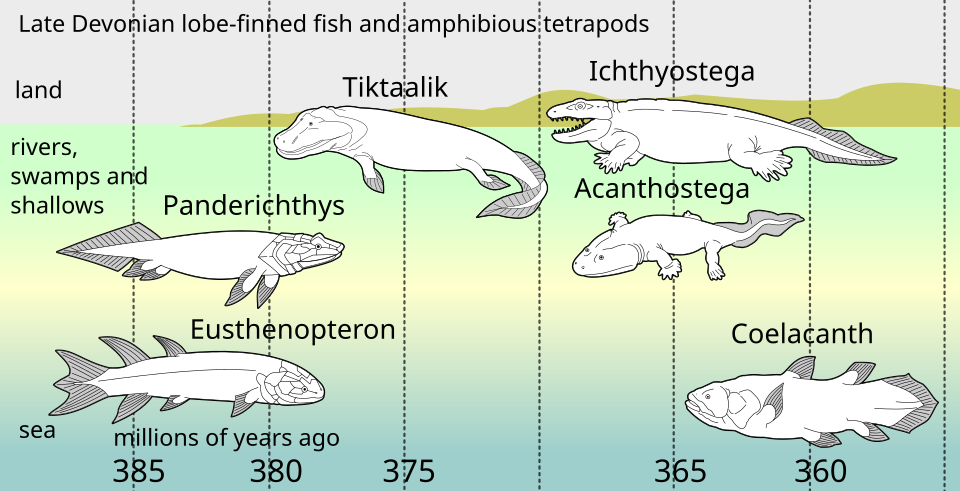
The Sarcopterygii is a class of fish. They are lobe-finned fish, like the lungfish and coelacanths. They are a clade of bony fish which first appeared in the Silurian, 418 million years ago (mya). One line in this group gave rise to the tetrapods.
Characteristics
These are bony fishes with paired rounded fins. These fins, being similar to limbs, suggest that these fish may be ancestors of land vertebrates. All sarcopterygians possess teeth covered with true enamel.
As a clade, the group includes all its descendants. This means it includes the Tetrapods, that is, all species of four-limbed vertebrates. The fin-limbs of sarcopterygiians are very similar to what people believe was the ancestral form of tetrapod limbs. The ancestors of tetrapods are to be found amongst the lobe-fins of the Devonian period. The term ‘fishapod’ is becoming used for this transitional group.
Evolution
Sarcopterygians and their relatives the Actinopterygii (‘ray-finned fish’) make up the super-class Osteichthyes, the ‘bony fish’, which have a bony skeleton rather than cartilage. Otherwise, there are vast differences in fin, respiratory, and circulatory structures between the Sarcopterygii and the Actinopterygii.
The first sarcopterygians, found in the uppermost Silurian (about 418 mya), closely resembled the Acanthodii, the ‘spiny fish’ which went extinct at the end of the Palaeozoic era. In the early–middle Devonian (416–385 mya), while the predatory placoderms dominated the seas, some sarcopterygians came into freshwater habitats.
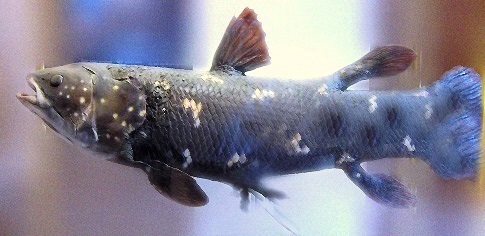
In the early Devonian (416–397 mya), the sarcopterygians split into two main lineages — the Coelacanths and the Rhipidistia. The former never left the oceans and their heyday was the late Devonian and Carboniferous, from 385 to 299 mya, as they were more common during those periods than in any other period in the Phanerozoic; coelacanths still live today in the oceans (genus Latimeria).
The Rhipidistians, whose ancestors probably lived in the oceans near the river mouths (estuaries), left the ocean world and migrated into freshwater habitats. They in turn split into two major groups : the lungfish and the tetrapods. The lungfish evolved the first proto-lungs and proto-limbs; they learned in the middle Devonian (397–385 mya) how to live outside a water environment, using their stubby fins (proto-limbs) to walk on land and find new water if their waterhole was depleted, and their lungs to breathe air and get sufficient oxygen. The lungfish’s greatest diversity was in the Triassic period; today there are fewer than a dozen genera left.
The first tetrapodomorphs, which included the gigantic rhizodonts, had the same general anatomy as the lungfish, who were their closest kin, but they appear not to have left their water habitat until the later Devonian epoch (385–359 mya), with the appearance of tetrapods (four-legged vertebrates). Tetrapods are the only tetrapodomorphs which survived after the Devonian.
Non-tetrapod sarcopterygians continued until towards the end of Paleozoic era, suffering heavy losses during the Permian-Triassic extinction event (251 mya).
Taxonomy and phylogeny
- Sarcopterygii
- Coelacanthimorpha
- Coelacanthiformes
- Latimeriidae
- Rhipidistia
- Dipnoi
- Tetrapodomorpha
- †Rhizodontiformes
- Osteolepiformes
- Panderichthyida
Where this page comes from
The article above is adapted from “Sarcopterygii” on Simple English Wikipedia, by its contributors. We removed reference markers, navigation boxes and tables, expanded measurement templates into readable numbers, and kept the prose otherwise intact.
Both sources are published under CC BY-SA 4.0, so this page is published under the same licence. You may share and adapt it, including commercially, as long as you credit the original and keep the same licence.
Worksheets, answer keys and printable layouts elsewhere on K5Print are our own work and are not covered by this licence.