Serval

Fast facts
- Conservation status
- Least concern
- Phylum
- Chordata
- Genus
- Leptailurus
- Species
- Leptailurus serval
Scientific name
- Scientific name
- Leptailurus serval
How to say it in other languages
- Arabic
- بج
- Chinese
- 藪貓
- Dutch
- Serval
- French
- Serval
- German
- Serval
- Italian
- Serval
- Japanese
- サーバル
- Portuguese
- Serval
- Russian
- Сервал
- Spanish
- Serval
Facts from Wikipedia’s “Serval” page and Wikispecies (CC BY-SA 4.0).
The serval (Leptailurus serval) is a medium-sized wild cat which lives in sub-Saharan Africa. It is the only species in its genus.
Description
The serval has the longest legs of all cats, relative to its size. Not only can it run fast, but it is an amazing jumper: two to three metres from a standing start.
Its length as an adult is about 32 inches (body) and 16 inches (tail). It weighs about forty pounds. There are a number of subspecies, and its geographical range is from the Cape of South Africa to Algeria, wherever the circumstances are right for it.
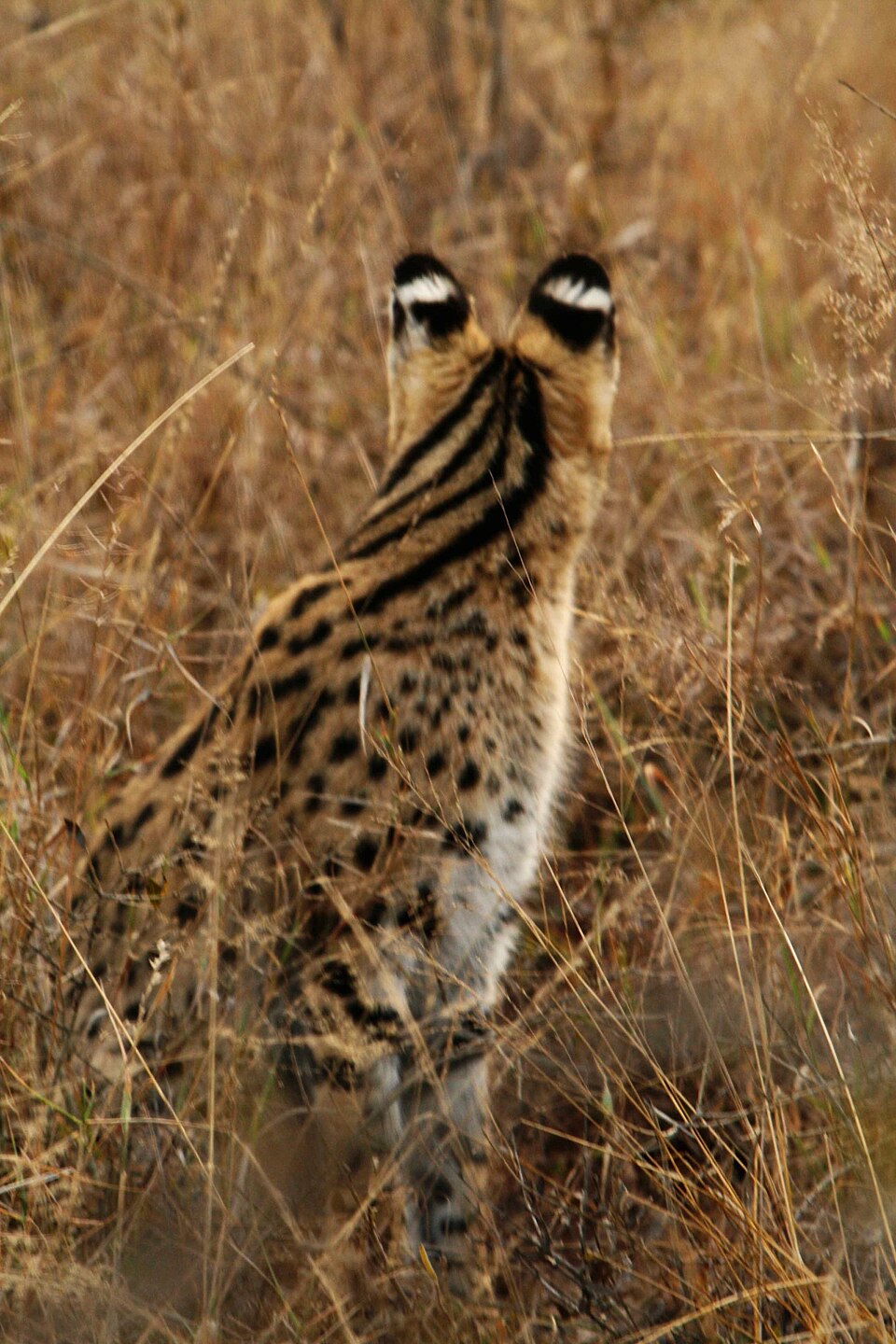
It is lightly built, with very large ears and long legs. The back of the ears is black with a big white spot, and the tip of the tail is black. These signs serve as signals to other servals, including kittens.
Habitat
The serval needs access to water, and dense grassland. Reed beds, scrub or high grass are typical habitats. It is territorial.
Hunting and diet
The serval is nocturnal, and hunts mostly at night. The serval is an opportunistic predator whose diet includes rodents, hares, hyraxes, birds, reptiles, insects, fish, and frogs.
As part of its adaptations for hunting in the savannas, the serval’s long legs help it achieve a top speed of 80 kilometres per hour (50 mph), and has large ears with acute hearing. Its long legs and neck allow the serval to see over tall grasses, while its ears are used to detect prey, even those burrowing underground. Servals have been known to dig into burrows in search of underground prey, and to leap 2 to 3 metres (7 to 10 ft) into the air to grab birds in flight. Using its spectacular jumping ability, the serval leaps into the air and bats the bird with its front paws. When the bird is on the ground, it bites its neck, killing it.
Like most cats, the serval is a solitary animal. It travels as much as 3 to 4 kilometres (1.9 to 2.5 mi) each night in search of food. The female defends home ranges of 9.5 to 19.8 square kilometres, depending on local prey availability. The male defends larger territories of 11.6 to 31.5 square kilometres, and marks its territory by spraying urine onto bushes.
Written for younger readers
Serval, in simpler words
This version comes from Wikijunior, a set of books written for children aged 8 to 11. It is shorter and uses plainer language than the article above.
From Wikijunior: Big Cats
NOTOC
The serval is a little-known but fascinating creature, a lightweight cat living in tall grass where the lions hunt gazelles and buffalo. It does not attempt to compete with the mighty “king of beasts”, content to tackle smaller prey. Gliding along on stilt-like limbs, with a long neck and large ears, the serval looks like no other cat, and for a reason… From the tall grass a startled flock of birds takes flight only to be chased in the air. With a spring of its powerful limbs, a serval shoots straight up, battering one of the birds back to earth with its long front limbs.
Servals live in the savannahs (grasslands) of Africa. This allows them to see both their prey and their predators. As a medium sized cat they have to be wary of lions and hyenas. Servals are good swimmers, and often live near open water where they can take an occasional dip to hunt for fish or swipe at the birds that stop by.
The serval’s lanky body gives them the most advantage for their bulk in coping with the tall grass where they roam. It gives them the appearance of being larger than they really are. In fact, the smaller female ranges from less than twenty pounds up to about thirty-five pounds. Males generally weigh thirty to fifty pounds. Their large ears give them an advantage in hearing their prey before it hears them. Their fur is yellow with black spots. On the back of the ears are horizontal gray bars. Servals use the position of their ears to communicate with each other. They also hiss a great deal, but this sound can have friendly meanings too. People often think a captive raised serval is being aggressive that is only trying to say hello.
Servals usually eat birds, fish and small rodents. When hunting a bird, the serval will jump up in the air and bat the bird with its front paws. This stuns the bird and makes it fall to the ground. When hunting rodents, the serval uses its large ears to listen for them under the ground. It then jumps straight up into the air six feet or higher, and comes straight down on its prey. Like most cats, a serval will take advantage of other opportunities that come along, taking on anything it feels it can safely subdue. However a serval never poses a threat to humans.
Servals can jump up to 10 feet straight up to catch birds.
Their hearing is so acute they can hear burrowing rodents underground and dig them up.
A cross between a male serval and a female domestic cat is called a savannah cat.
The mother will chase her male offspring away as soon as they can hunt, at about 8 to 10 months of age, but will let females stay with her for a little longer, up to a year.
Wikipedia: Serval Next Topic: Manuls
ca:Viquijúnior:Grans felins/Serval de:Wikijunior Großkatzen/ Serval
Where this page comes from
The article above is adapted from “Serval” on Simple English Wikipedia, by its contributors. We removed reference markers, navigation boxes and tables, expanded measurement templates into readable numbers, and kept the prose otherwise intact. The simpler version is adapted from Wikijunior on Wikibooks.
Both sources are published under CC BY-SA 4.0, so this page is published under the same licence. You may share and adapt it, including commercially, as long as you credit the original and keep the same licence.
Worksheets, answer keys and printable layouts elsewhere on K5Print are our own work and are not covered by this licence.