Snow leopard

Fast facts
- Conservation status
- Vulnerable
- Genus
- Panthera
- Species
- uncia
Scientific name
- Scientific name
- Panthera uncia
How to say it in other languages
- Arabic
- نَمِرُ الثُّلُوجِ
- Chinese
- 雪豹
- Dutch
- Sneeuwpanter
- French
- Léopard des neiges
- German
- Schneeleopard
- Hindi
- हिम तेंदुआ
- Italian
- Leopardo delle nevi
- Japanese
- ユキヒョウ
- Korean
- 눈표범
- Portuguese
- Leopardo das neves
- Russian
- Снежный барс
- Spanish
- Leopardo de las nieves
Facts from Wikipedia’s “Snow leopard” page and Wikispecies (CC BY-SA 4.0).
The snow leopard (Panthera uncia), also known as the Irbis and ounce, is a feline, which lives in central Asia. It used to be thought not to be closely related to the smaller leopard, which is why they were put in different genera before. However, recent research has discovered this is not correct. The cat is closely related to the other big cats in the genus Panthera.
Appearance
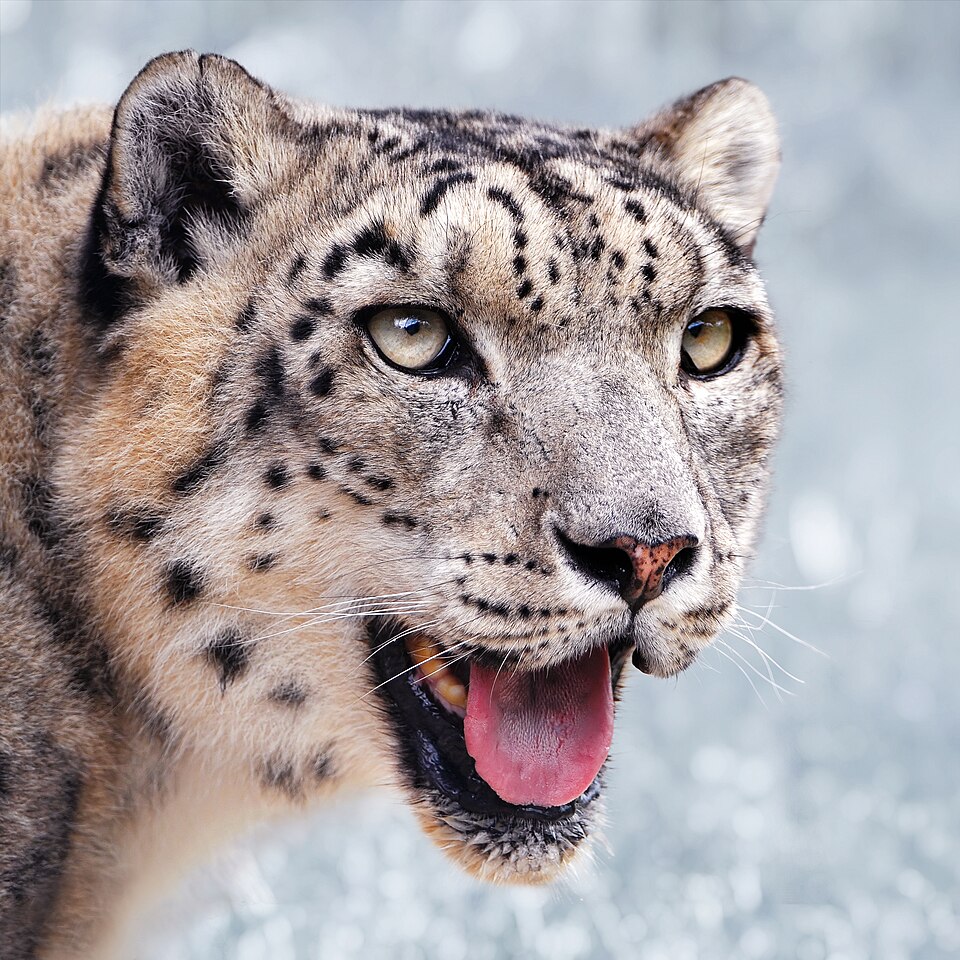
Snow leopards are about 2-5 meters long in the body, and have a 90-100 centimeter long tail. They weigh up to 75 kilograms. They have grey and white fur with dark rosettes and spots, and their tails have stripes. Its fur is very long and thick to protect it against the cold. Their feet are also big and furry, which helps them to walk on snow more easily. They use their long tails for balance and as blankets to cover sensitive body parts against the severe mountain chill.
Voice
They are one of the cats which cannot purr: “In five cat species (lion, tiger, jaguar, leopard and snow leopard) the epihyoideum is an elastic ligament, whereas in all other species of the Felidae the epihyal is completely ossified (bony)… those felids with an elastic epihyoid are able to roar but not purr, while species with a completely ossified hyoid are able to purr but not to roar”. Despite this, it seems now that snow leopards cannot roar, though they can make a number of other sounds.
Hunting
Snow leopards are well camouflaged, and are crepuscular (most active at dawn and dusk). They stalk and eat medium-sized prey like ibex, markhor, bharal (mountain sheep) and wild goats and awhile is hair yaks . It can survive on a single sheep for two weeks.
Snow leopards prefer to ambush prey from above, using broken terrain to conceal their approach. They try to land on the sheep, and kill it directly. If the sheep runs, they pursue it down steep mountainsides, using the momentum of their initial leap to chase prey for up to 300 m (984 ft).
They kill with a bite to the neck, and may drag the prey to a safe location before feeding. They consume all edible parts of the carcass, and can survive on a single bharal (blue sheep) for two weeks before hunting again. Annual prey needs is 20–30 adult bharals.
Habitats
In summer, snow leopards usually live above the tree line on mountainous meadows and in rocky regions at altitudes from 2,700 to 6,550 m (8,858 to 21,490 ft). In winter, they come down into the forests to altitudes around 1,200 to 2,000 m (3,937 to 6,562 ft). Snow leopards prefer broken terrain, and can travel without difficulty in snow up to 85 cm (33 in) deep, although they prefer to use existing trails made by other animals.
They live alone. After a pregnancy of about a hundred days the female gives birth to 2 or 3 cubs. Snow leopards are protected in most of the countries they live in. However, people do still kill them for their fur, or to protect their cattle.
Distribution
The snow leopard has a huge range in central Asia. It is in Afghanistan, Bhutan, China, India, Kazakhstan, Kyrgyzstan, Nepal, Pakistan, Russia, Tajikistan, Uzbekistan, Kashmir, Kunlun, and the Himalaya to southern Siberia, Mongolia, and Tibet.
Since many estimates are rough and outdated, its numbers could be falsely viewed as low. The total wild population of the snow leopard was estimated in 2008 as 4,510 to 7,350 individuals.
Taxonomy and evolution
The snow leopard was not thought closely related to the Panthera or other living big cats. However, recent molecular studies put the species firmly in the genus Panthera: its closest relative is the tiger (Panthera tigris). MSW3 still refers to the snow leopard as Uncia uncia, but the more recent IUCN classifies it as Panthera uncia.
In popular culture
The snow leopard is an official symbol of Kazakhstan.
Written for younger readers
Snow leopard, in simpler words
This version comes from Wikijunior, a set of books written for children aged 8 to 11. It is shorter and uses plainer language than the article above.
From Wikijunior: Big Cats
NOTOC
Snow leopards dare to live where icy gales would freeze a human’s blood in minutes. Their bodies are adapted to survive and thrive in an icy wilderness of breathtaking beauty and great danger. Until recently, no one had photographed a snow leopard in the wild.The first ever close-up pictures taken by humans were made by program Planet Earth, although very few people have had the privilege of seeing a snow leopard in its native habitat, much less taking its picture. The snow leopards seem to like it that way – they avoid humans with amazing skill. Their fur contains swirls of gray and black, much like the colors of the rocky outcrops where they live. This coloration provides such good camouflage that a snow leopard can seem to disappear just by staying still.
Snow leopards live in the high mountains of China and Central Asia, particularly throughout the Himalayas. They typically have a hunting range or territory of 100 square miles (260 square km), because very few prey animals live in the harsh, mountain habitat that is home to the snow leopard.
In contrast to most of the inhabited regions, population of the snow leopard in Spiti valley of Himachal Pradesh is increasing. Snow leopards can survive in very harsh conditions. They also live in snowy plains and Tundras
Snow leopards have grey-and-white fur with long tails and rosettes on the flanks and spots on the head and neck, like jaguars. This color resembles the rocks and snow of their environment and helps them stalk their prey. Their tails are unusually long, thickly furred, and striped. Their paws are covered in fur to keep them warm and to act like snowshoes. During blizzards, they wrap their tail around their face, using it like a muff, to keep warm. Their eyes are round in shape, ranging from pale green to grey in colour. Male snow leopards weigh between 90-115 pounds (40-52 kg), and females weigh between 75-90 pounds (34-40 kg).
Snow leopards eat almost anything they can catch, often hunting animals three times their size. Their main sources of food include wild sheep and goats, pikas, hares, and game birds. In the summer, they eat mostly smaller prey, such as marmots. At other times their prey includes wild boars, gazelles, markhor, Bobak, tahr, ibex, bharal, mice, and deer. The male and female snow leopards have slightly different food that they eat. They stalk their prey and usually begin their attack when they are 20 to 50 feet (6-15 m) away.
The snow leopard’s broad paws act as snowshoes and give them traction as they chase their prey across the stone, snow, and icy surfaces. They are at their best when they can run across the hard, icy crusts that form above banks of deep snow while their hooved prey breaks through the crust, getting mired in the soft, underlying snow.
- Snow leopards will attack prey weighing four times as much as themselves.
- The large, thickly furred paws of the snow leopard act as built-in snowshoes.
- Snow leopards have the thickest fur of all cats
- Unlike most other big cats such as the lion, snow leopards cannot roar.
- Snow leopards can run across rocky stone surfaces to get to their prey.
- Their unusually long tail helps maintain balance in the rocky terrains
- China is said to hold 60% of the snow leopard population—mostly along its far western border and across the Himalayas.
- Snow Leopard light fur colour and design is used for camouflage in the mountains
- They are almost extinct.
- Although concentrated mostly in Central Asia, they have a widespread distribution. They are also found in countries like India, Nepal, Bhutan, Pakistan Afghanistan, China, Mongolia, Kazakhstan Uzbekistan, Tajikistan, and Russia.
- They prefer living in ridges, cliffs and rock outcrops. These locations are convenient because they provide camouflage for stalking and sneaking up on prey.
- Although they share a similar name and appearance with the common leopard (Panthera pardus), genetic studies have suggested that snow leopards are more closely related to the tiger (Panthera tigris).
- Despite the genetic similarities with tigers, snow leopards cannot roar. Instead, they chuff, growl, hiss, mew, and wail.
Kingdom; Animalia (Animal, not plant or fungi)
Phylum: Chordata (Animals with backbones)
Class: Mammalia (Have backbones, nourished with milk from young)
Order: Carnivora (Only eat meat)
Family: Felidae (Biological family of cats)
Genus: Panthera (Large felines from African and Asian forests)
Scientific name/Species: Panthera uncia
- Wikipedia: Snow Leopard WWF wildlife Next Topic: Clouded leopards
ca:Viquijúnior:Grans felines/Lleopard de les neus de:Wikijunior Großkatzen/ Schneeleopard
Where this page comes from
The article above is adapted from “Snow leopard” on Simple English Wikipedia, by its contributors. We removed reference markers, navigation boxes and tables, expanded measurement templates into readable numbers, and kept the prose otherwise intact. The simpler version is adapted from Wikijunior on Wikibooks.
Both sources are published under CC BY-SA 4.0, so this page is published under the same licence. You may share and adapt it, including commercially, as long as you credit the original and keep the same licence.
Worksheets, answer keys and printable layouts elsewhere on K5Print are our own work and are not covered by this licence.