Spider

Scientific name
- Scientific name
- Araneae
- Kingdom
- Animalia
- Phylum
- Arthropoda
- Class
- Arachnida
- Order
- Araneae
How to say it in other languages
- Chinese
- 蜘蛛目
- Dutch
- Spinnen
- French
- Aranéides
- German
- Spinnen
- Hindi
- मकडी
- Italian
- Ragni
- Japanese
- クモ目
- Korean
- 거미목
- Portuguese
- Aranhas
- Russian
- Пауки
- Spanish
- Arañas
Facts from Wikipedia’s “Spider” page and Wikispecies (CC BY-SA 4.0).
Spiders (class Arachnida, order Araneae) are air-breathing arthropods. They have eight legs, and mouthparts (chelicerae) with fangs that inject venom. Most make silk. The spiders are seventh in number of species of all animal orders. About 53,000 spider species, and 136 families have been recorded by taxonomists. Over twenty different classifications have been proposed since 1900. p3
Spiders live on every continent except for Antarctica, and in nearly every habitat with the exceptions of air and sea. Almost all spiders are predators, and most eat insects. They catch their prey in several ways. Some build a spider web, and some use a thread of silk that they throw at the insect. Some kinds of spiders hide in holes in the ground, then run out and grab an insect that walks by. Others will make web ’nets’ to throw at passing insects. Or they go out and simply attack their prey. Some can jump quite well and hunt by sneaking close to an insect and then jumping on it.
Anatomy
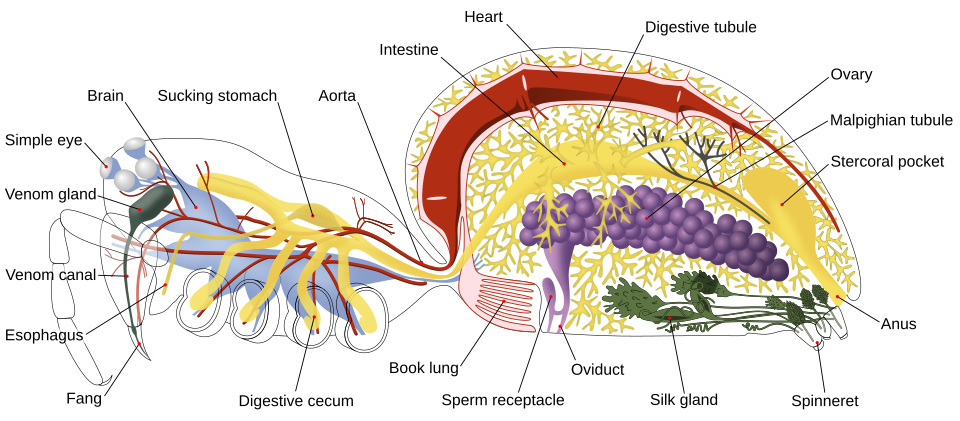
Spiders have a two-part body, the front part (cephalothorax) and the abdomen. Unlike insects, spiders do not have antennae. The more advanced spiders have a centralized nervous system, with their ganglia fused into one mass in the cephalothorax. Unlike most arthropods, spiders have no extensor muscles in their limbs, and extend them by hydraulic pressure.
Size range
The smallest of full-grown spiders can be less than 4 mm. (0.1 inch). The largest of spiders can have a body length of 10 cm. (4 inches) or more. The largest can weigh 150 grams (5.3 oz). The largest of spiders are the tarantulas and the huntsman spiders. Some huntsman spiders in South East Asia can have a leg span of around 250–300 mm (9.8–11.8 in).
Spider eyes and other senses
Most spiders have four pairs of eyes on the top-front area of the body, arranged in patterns that vary from one family to another. The main eyes at the front are capable of forming images. Jumping spiders have visual acuity which is ten times better than that of dragonflies, which have by far the best vision among insects. The spiders do this by a telephoto-like series of lenses, a four-layered retina. They can swivel their eyes and put together images from different stages in the scan. The downside is that the scanning and integrating processes are relatively slow.
Spiders and other arthropods have modified their cuticles into elaborate arrays of sensors. Various sensors, mostly bristles, respond to touch, from strong contact to very weak air currents. Chemical sensors provide equivalents of taste and smell. Spiders also have in the joints of their limbs sensors that detect forces and vibrations. In web-building spiders all these mechanical and chemical sensors are more important than the eyes. The eyes are more important to spiders that hunt actively. Like most arthropods, spiders lack balance sensors, and rely on their eyes to tell them which way is up.
Fangs
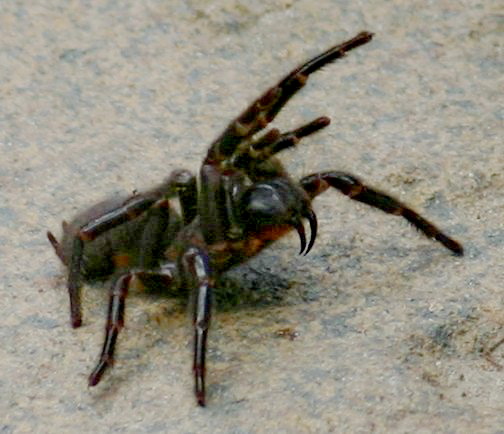
The fangs are hollow, like the needles used to give injections. Spiders use their fangs to inject toxins that kill the insects they will eat. Some kinds of spider venom attack the nervous systems of their prey, and other kinds of venom attack body tissues.
What most spiders eat
Spiders are predators, and eat insects and other arthropods (including other spiders). Most use venom from their fangs to kill their prey. It is rare for spiders to capture prey that are much larger than they are. It is also difficult for most spiders to capture prey that are very much smaller than they are. There are some spiders that form colonies. Spiders eat not only spiders of other species, but spiders of their own species.
The black widow spider got its name because the females sometimes eat the males that mate with them. This may also happen in other species. Each species of spider has its own way of communicating with other spiders they meet. Because of the danger of being eaten, in some species the males have special hooks on their front legs with which they hold the female while they mate. Others bring the female something to eat. There are a few species in which the male spiders construct their own little webs that are connected to the webs of the females. In these species, the male is so much smaller than the female that it would be difficult for her to actually capture the male.
Most spiders have such poor vision that they will not even notice a dead insect. Jumping spiders are one exception to this rule. They have such good vision that they can find recently dead flies or other insects to eat.
Some spiders are not predators
Spiders are basically predators, but some have other food sources. The jumping spider Bagheera kiplingi gets over 90% of its food from fairly solid plant material produced by acacias as part of a beneficial relationship with a species of ant.
Young spiders of several families feed on plant nectar. Studies have shown that they do this for long periods. They also clean themselves regularly while feeding. These spiders also prefer sugar solutions to plain water, which shows that they are looking for nutrients. Many spiders are nocturnal, they are most active during the night. The extent of nectar consumption by spiders may therefore have been under-estimated. Nectar contains amino acids, lipids, vitamins and minerals in addition to sugars. Studies have shown that other spider species live longer when nectar is available. Feeding on nectar also avoids the risks of struggles with prey, and the costs of producing venom and digestive enzymes. Since nectar is a flowering plant production, its consumption by spiders came quite late in their evolution.
Various species are known to feed on dead arthropods (scavenging), web silk, and their own shed exoskeletons. Pollen caught in webs may also be eaten, and studies have shown that young spiders have a better chance of survival if they have the opportunity to eat pollen. In captivity, several spider species are also known to feed on bananas, marmalade, milk, egg yolk and sausages.
Webs
The best-known method spiders use to capture prey is a sticky web. The placing of the web allows different spiders to trap different insects in the same area. Flat, horizontal webs allow them to trap insects that fly up from vegetation underneath, for example. Flat vertical nets allow them to trap insects in flight. The spiders that build webs usually do not see very well, but they are very sensitive to vibrations.
Underwater
Females of the water spider Argyroneta aquatica build underwater “diving bell” webs which they fill with air and use while eating their prey, molting, mating, and raising offspring. They live almost entirely within the bells, darting out to catch prey animals that touch the bell or the threads that anchor it. A few spiders use the surfaces of lakes and ponds as “webs”, detecting trapped insects by the vibrations that these cause while struggling.
Bola casting
Net-casting spiders weave only small webs but then manipulate them to trap prey. They stretch their webs and then release them when prey strike them. Those of the family Deinopidae weave even smaller webs, hold them outstretched between their first two pairs of legs, and lunge and push the webs as much as twice their own body length to trap prey, and this move may increase the webs’ area by a factor of up to ten. Experiments have shown that Deinopis spinosus has two different techniques for trapping prey: backwards strikes to catch flying insects, whose vibrations it detects; and forward strikes to catch ground-walking prey that it sees. These two techniques have also been observed in other deinopids. Walking insects form most of the prey of most deinopids, but one population of Deinopis subrufus appears to live mainly on tipulid flies that they catch with the backwards strike.
Mature female bolas spiders of the genus Mastophora build “webs” that consist of only a single “trapeze line”, which they patrol. They also construct a bolas made of a single thread, tipped with a large ball of very wet sticky silk. They emit chemicals that resemble the pheromones of moths, and then swing the bolas at the moths. They catch about the same weight of insects per night as web-weaving spiders of similar size. The spiders eat the bolas if they have not made a kill in about 30 minutes, rest for a while, and then make new bolas. Juveniles and adult males are much smaller and do not make bolas. Instead they release different pheromones that attract moth flies, and catch them with their front pairs of legs.
Using trapdoors
The primitive Liphistiidae, the “trapdoor spiders” (family Ctenizidae) and many tarantulas are ambush predators. They lurk in burrows, often closed by trapdoors and surrounded by networks of silk threads that alert these spiders to the presence of prey. Other ambush predators do without such aids, including many crab spiders. A few species that prey on bees, which see ultraviolet, can adjust their ultraviolet reflectance to match the flowers in which they are lurking. Wolf spiders, jumping spiders, fishing spiders and some crab spiders capture prey by chasing it, and rely mainly on vision to get their prey.
Capturing insects without using webs
Not all spiders use silk to net their prey. Instead, these spiders may capture insects by grabbing them and then biting them. Among these kinds of spiders the two best known are the wolf spiders and the jumping spiders.
Wolf spiders
A wolf spider will usually wait until an insect comes near to it, and then rush at the insect, grab it using its front legs, and then bite the insect so that its venom can do its work.
Female wolf spiders lay their eggs on a pad of silk and then draw the edges together to create a round ball that they carry along with them wherever they go. They hold their egg balls to their tail ends by using their silk. When the eggs hatch, the little spiders will crawl onto the mother’s back, and she will carry them along with her for days or weeks.
Wolf spiders are very good mothers and will strongly protect both their egg balls and their infants. When the time comes, the little spiders will leave the mother and each will go its own way.
Jumping spiders
Jumping spiders have very good eyes and can see well. They sneak as close to an insect as they can, and then they jump onto the insect and immediately bite it. Since they often hunt in trees, bushes, and on the sides of walls, if the jumping spider misses it may fall off. But they have a way to save themselves from harm. Before they jump they fasten their silk to the place where they have been standing, and as they jump they let out a silk safety line. So if they fall they will catch themselves when they reach the end of their silk safety line. Sometimes a jumping spider will catch an insect and then fall while still holding onto the insect. But the spider is still safe.
Jumping spiders make little silken “tents” for themselves to sleep in. When they lay eggs they keep them inside such a shelter. They do not take their eggs with them when they go out to hunt.
For all male spiders it is dangerous to seek a mate. The female spider may not realize that the male is a spider of her kind, so she may try to eat it. The jumping spiders not only have visual patterns that identify them to each other, but the male jumping spider will do a special dance when it approaches a female of the same species. That way, the female can recognize that it is a male of her species. She will generally forget about eating for long enough to mate with the visiting male spider.
Jumping spiders have such good eyes that they will usually watch any human who tries to watch them. Some species are very shy and will run away if the human gets too close. But some species, such as Phidippus audax (the audacious or brave jumping spider) and Platycryptus undatus, can become calm if the human comes close to them slowly. Sometimes they will jump onto one of your fingers and then jump from finger to finger and from hand to hand. They seem to want to explore.
Hunting other spiders
Some jumping spiders of the genus Portia hunt other spiders in ways that seem intelligent, outflanking their victims or luring them from their webs. Laboratory studies show that Portia’s instinctive tactics are only starting points for a trial-and-error approach from which these spiders learn very quickly how to overcome new prey species. However, they seem to be relatively slow thinkers, which is not surprising as their brains are vastly smaller than those of mammalian predators.
Disguising as ants
Ant-mimicking spiders face several challenges: they generally develop slimmer abdomens and false “waists” to mimic the three distinct regions (tagmata) of an ant’s body; they wave the first pair of legs in form to their heads to mimic antennae, which spiders lack, and to conceal the fact that they have eight legs rather than six. They have large color patches round one pair of eyes to disguise the fact that they generally have eight simple eyes, while ants have two compound eyes; they cover their bodies with reflective hairs to resemble the shiny bodies of ants. In some spider species males and females mimic different ant species, as female spiders are usually much larger than males.
Ant-mimicking spiders also modify their behavior to resemble that of the target species of ant, for example many adopt a zig-zag pattern of movement, ant-mimicking jumping spiders avoid jumping, and spiders of the genus Synemosyna walk on the outer edges of leaves in the same way as Pseudomyrmex. Ant-mimicry in many spiders and other arthropods may be for protection from predators that hunt by sight, including birds, lizards and spiders. However several ant-mimicking spiders prey either on ants or on the ants “livestock” such as aphids. When at rest the ant-mimicking crab spider Amyciaea does not closely resemble Oecophylla, but while hunting it imitates the behavior of a dying ant to attract worker ants. After a kill some ant-mimicking spiders hold their victims between themselves and large groups of ants to avoid being attacked.
Reproduction and life cycle
Spiders reproduce sexually and fertilization is internal but indirect. In other words, the sperm is not inserted into the female’s body by the male’s genitals but by an intermediate stage. Unlike many land-living arthropods, male spiders do not produce ready-made spermatophores (packages of sperm). Instead, they spin small sperm webs on to which they ejaculate and then transfer the sperm to structures on the tips of their pedipalps. When a male detects signs of a female nearby he checks whether she is of the same species and whether she is ready to mate; for example in species that produce webs or ‘safety ropes’, the male can identify the species and sex of these objects by smell.
Spiders generally use elaborate courtship rituals to prevent the large females from eating the small males before fertilization, except where the male is so much smaller that he is not worth eating. In some species males mate with newly molted females, which are too weak to be dangerous to the males.
In web-weaving species precise patterns of vibrations in the web are a major part of the rituals, while patterns of touches on the female’s body are important in many spiders that hunt actively, and may ‘hypnotize’ the female. Gestures and dances by the male are important for jumping spiders, which have excellent eyesight. If courtship is successful, the male injects his sperm from the pedipalps into the female’s genital opening on the underside of her abdomen. Female reproductive tracts vary. Some are simple tubes, but others have chambers where females store sperm, and release it when they are ready.
Males do get eaten in some species. Males of the genus Tidarren cut off one of their palps, and enter adult life with one palp only. The palps are 20% of male’s body mass in this species, and detaching one of the two improves mobility. In the Yemeni species Tidarren argo, the remaining palp is then torn off by the female. The separated palp remains attached to the female’s opening for about four hours. In the meantime, the female feeds on the palpless male. In over 60% of cases the female of the Australian redback spider kills and eats the male after it inserts its second palp into the female’s genital opening; in fact the males co-operate by trying to impale themselves on the females’ fangs. Observation shows that most male redbacks never get an opportunity to mate, and the ’lucky’ ones increase the likely number of offspring by ensuring that the females are well-fed. However males of most species survive a few matings, limited mainly by their short life spans. Some even live for a while in their mates’ webs. p176/212
Females lay up to 3,000 eggs in one or more silk egg sacs, which maintain a fairly constant humidity level. In some species the females die afterwards, but females of other species protect the sacs by attaching them to their webs, hiding them in nests, carrying them in the chelicerae or attaching them to the spinnerets and dragging them along.
Development of young
Baby spiders pass all their larval stages inside the egg and hatch as spiderlings, very small and sexually immature but similar in shape to adults. Some spiders care for their young, for example a wolf spider’s brood cling to rough bristles on the mother’s back, and females of some species respond to the “begging” behaviour of their young by giving them their prey, provided it is no longer struggling, or even regurgitate food.
Like other arthropods, spiders have to moult to grow as their cuticle (“skin”) cannot stretch. Most spiders live for only one to two years, although some tarantulas can live in captivity for over 20 years. p232
Spiders and humans
Of the 40,000 spiders, less than 12 are known to be dangerous to humans. Most of the time, being bitten by a spider is painful. Most spiders use venom to paralyse their prey; they kill it through eating, or through a bite. A few spiders have venoms that can be dangerous to weakened people and those allergic to it. Since 1927, 13 people have died, after a bite from a Atrax robustus spider from Australia.
The spider that kills the most people, the black widow and other spiders in the genus Latrodectus are around 1 cm. in body length. The Atrax and Phoneutria spiders, which are also capable of killing people, both average around 2.5 cm. or one inch, and even the Widow spiders are large enough to be easily noticed.
Even relatively small spiders like Phidippus audax can give a painful bite if you hurt them, but spiders are very helpful to human beings because they control insects that eat our crops.
Being afraid of spiders is a very common phobia (fear). The widow spiders (black widows and other members of their genus) never willingly leave their webs, so usually people get bitten when they touch the spider by mistake.
Written for younger readers
Spider, in simpler words
This version comes from Wikijunior, a set of books written for children aged 8 to 11. It is shorter and uses plainer language than the article above.
From Wikijunior: Bugs
Spiders are members of a group of animals without backbones, called the Arthropods, meaning “joint legged.” They are not insects. They belong to the Class Arachnida, along with the tick, dust mite, and scorpion.
Spiders never have antennae or wings. Their eight legs have seven segments each. The tip of each leg usually has two or three claws and many bristles or hairs.
Spiders do not have an internal skeleton or backbone. They instead have an external skeleton, called an exoskeleton. It is tough and fairly rigid like a suit of armour. It is flexible for ease of movement. Muscles are attached to the inside. The exoskeleton supports and protects a spider’s soft delicate internal organs.
The head and thorax are combined to form the cephalothorax. Sometimes there are spikes, lumps, or odd shapes on it. There is a narrow pedicel (waist) connecting the cephalothorax to the abdomen. When viewed from above a tough covering or shield called a carapace can be seen.
At the front of the head are chelicerae (jaws). There are sharp teeth and fangs to pierce the exoskeleton of a spider’s prey. Each fang has a tiny hole connected to poison sacs. The fangs move on hinges and inject poison when the spider bites.
Scientists use the number and arrangement of a spider’s eyes to identify its family. There is normally a group of six to twelve simple eyes. One pair of eyes forms an image, while the surrounding eyes detect movement.
The silk with which a spider builds webs comes from a special organ in the abdomen called a spinneret. Most spiders have three or four pairs of spinnerets to deliver liquid silk to the outside.
People often confuse spiders with their eight-legged relations called harvestmen which look similar but have a different body arrangement. Unlike spiders, harvestmen have a body with head, thorax and abdomen fused into a single structure.
Spiders range in size from very small to relatively large. The small Branch Tipped Spider is only 1/16 of an inch long. The Orb-Weaver Spider is 3/8 of an inch long. The large Black and Yellow Argiope is 1-1/8 inches long.
Tarantulas are large hairy spiders. They can be 1-3/8 inches or more in length. Female Cobalt Blue Tarantulas can be 2-3/4 inches long. Brown Recluse Spiders have a leg span about the size of a quarter. Their body is about 3/8 of an inch in length and about 3/16 of an inch in width. Females can be 2 to 7 inches. They are commonly referred to as “fiddleback” or “violin” spiders because of a violin-shaped marking on the back. Often, this feature is very faint depending on the species and on how recently it has molted. Their color ranges from light tan to dark brown. They are covered with many fine hairs that give them a velvety appearance. They have long, thin, brown legs also covered with fine hairs. Brown Recluse Spiders have six eyes instead of the usual eight.
Spiders are familiar predators found in nearly every habitat. Some species live in damp marshes and some live in dry deserts. Spiders that do not spin webs live in silk-lined burrows, while others have no permanent safe place. Some spiders live part of their lives on the surface of freshwater ponds and lakes. A few dive below the surface where they can survive for short periods of time. Spiders that live along the coastline are able to tolerate immersion in salt water when the tide is in. Only true water spiders, Argyroneta, are able to live completely under water.
Water Spiders build their homes underwater, spinning silken tents that they fill with bubbles of air. They are found throughout temperate Asia and Europe, including Great Britain and Ireland. They live in lakes, ponds, and ditches.
American House Spiders live in sheltered corners of houses, barns and other buildings. Their range is throughout the United States and Canada.
Brown Recluse Spiders are native to the United States. They are found mainly in the central Midwestern states southward to the Gulf of Mexico. Occasionally they are transported in materials and may be found outside this area. In favorable habitats, their populations are usually dense.
Brown Recluse Spiders seek and prefer seclusion. They usually occupy dark, undisturbed sites indoors or outdoors. Indoors, they may be found in attics and basements. They may seek shelter in shoes, folded linens, and behind furniture. Outdoors, brown recluse spiders may be found beneath logs and under loose stones in piles of rocks.
Southern Black Widows live among fallen branches and under many kinds of objects, including furniture and trash. Their range is from Massachusetts to Florida, west to California, Texas, Oklahoma, and Kansas. They are most common in the south.
Tarantulas are nocturnal and hide in dark cavities or burrows during the day. They come out to hunt by touch when it gets dark. They are sometimes called banana spiders, because tropical species arrive in cargoes of fruit. There are about 30 species in the United States.
All spiders feed almost entirely upon prey that they catch for themselves. A few species eat food which has been taken by other spiders. They usually eat other arthropods, mainly insects, woodlice and centipedes. One family feeds exclusively on other spiders. Very large species, such as the “bird-eating” spiders, are able to consume small animals.
Orb Weaver Spiders coat some of their silk with droplets of sticky liquid to catch prey. Other species create a bewildering maze of dry silk threads where insects get lost.
Water Spiders anchor their nests to water plants. During the day, they sit in the nest with their front legs in the water, waiting. When a water insect passes by, it is quickly pounced on, killed, and drawn into the nest. When they venture out of their nest to hunt, Water Spiders carry an air bubble on the abdomen to breathe from. Their genus name is Argyros, from the Greek for “silver” because the air bubble shines with a silvery hue through the water.
Some spider species stalk and ambush their victims on the ground. Most spin webs to catch prey in the air. Intricate spider webs can be seen between plants, branches, or buildings. There are many different web shapes, weaving patterns, and web locations. Each spider species spins only one kind of web. Scientists often identify a species by its distinctive web.
American House Spiders spin irregular webs made of sticky strands. Their webs catch dust as well as prey and are known as “cob webs”.
Southern Black Widows spin irregular meshed webs with a funnel-shape to hide in.
Most species of Tarantulas line the top of their burrows with silk, but do not spin webs to catch prey. They prey on insects, lizards, and other small animals.
Brown Recluse Spiders are largely scavengers, preferring dead insects and meat.
Most species have poor vision and feel movement through body hairs or slits in the exoskeleton. Brown Recluse Spiders are not aggressive, and normally bite only when crushed, touched or disturbed. There are reports of people having been bitten in bed after rolling over onto one of these spiders. Others have been bitten after accidentally touching one while cleaning storage area.
Southern Black Widows are the most feared of all spiders. Female Black Widow venom is very poisonous to people. Despite their reputation, they often escape rather than stab, unless they are guarding an egg. Males do not bite.
Some spiders defend themselves in strange ways indeed. … Orb spiders make body doubles of themselves out of dead bugs and silk to defend themselves from predators while in their webs. The green lynx spider can spit venom up to a foot away, so you don’t have to even come in contact with it to become a victim.
Spiders undergo simple metamorphosis with only three main growth stages, egg, spiderling, adult. The pupal stage is omitted and the young spiderlings often look like small versions of adults. Because the exoskeleton cannot stretch, spiders can grow only by shedding or molting the exoskeleton several times.
Most spiders lay eggs in silken sacs. Egg sacs may be placed in the web or attached to twigs or leaves. Some species carry the sac around until the eggs hatch. Young spiderlings are often cannibalistic, eating their own kind.
Female American House Spiders spin pear-shaped brownish silken cocoons around the egg mass and hang it in a web.
Female tarantulas continue to molt after reaching maturity and may live to twenty years.
Some spiders have up to six types of silk glands to make silk for different uses. They use silk to catch and bind prey, to build webs and cocoons, and to spin draglines. Many spiders pull a dragline when walking. It serves as a life line for jumping clear of danger. Dragline silk is twice as elastic as nylon.
All young spiders release long silken strands, which they use like a parachute to ride the wind from one place to another. This process is called parachuting.
Spiders save their prey for a later meal by wrapping it in hundreds of thin threads called a swathing band.
Female Southern Black Widows often eat the smaller males after mating with their leader, earning the name “widow.”
When young Water Spiders hatch, they leave the nest covered with bubbles trapped by hydrophobic (water repelling) hair so they can breathe under water until they find a nesting place of their own.
Few spiders bite people. The venom of most is harmless. Some South American species of Tarantulas have deadly venom, but the bite of North American Tarantulas is no more dangerous to people than a wasp or bee sting.
Spiders are part of folklore and legend in many parts of the world. They are considered beneficial to humans because they help keep insect populations in check. They help to balance nature in general.
Where this page comes from
The article above is adapted from “Spider” on Simple English Wikipedia, by its contributors. We removed reference markers, navigation boxes and tables, expanded measurement templates into readable numbers, and kept the prose otherwise intact. The simpler version is adapted from Wikijunior on Wikibooks.
Both sources are published under CC BY-SA 4.0, so this page is published under the same licence. You may share and adapt it, including commercially, as long as you credit the original and keep the same licence.
Worksheets, answer keys and printable layouts elsewhere on K5Print are our own work and are not covered by this licence.