Tiger

Fast facts
- Conservation status
- Endangered
Scientific name
- Scientific name
- Panthera tigris
- Kingdom
- Animalia
- Phylum
- Chordata
- Class
- Mammalia
- Order
- Carnivora
- Family
- Felidae
- Genus
- Panthera
- Species
- Panthera tigris
How to say it in other languages
- Arabic
- ببر
- Chinese
- 虎
- Dutch
- Tijger
- French
- Tigre
- German
- Tiger
- Hindi
- बाघ
- Italian
- Tigre
- Japanese
- トラ
- Korean
- 호랑이
- Portuguese
- Tigre
- Russian
- Тигр
- Spanish
- Tigre
Facts from Wikipedia’s “Tiger” page and Wikispecies (CC BY-SA 4.0).
The tiger (Panthera tigris) is the largest living member of the cat family, the Felidae. It feeds by hunting, and it lives in Asia. Tigers are solitary animals.
Appearance
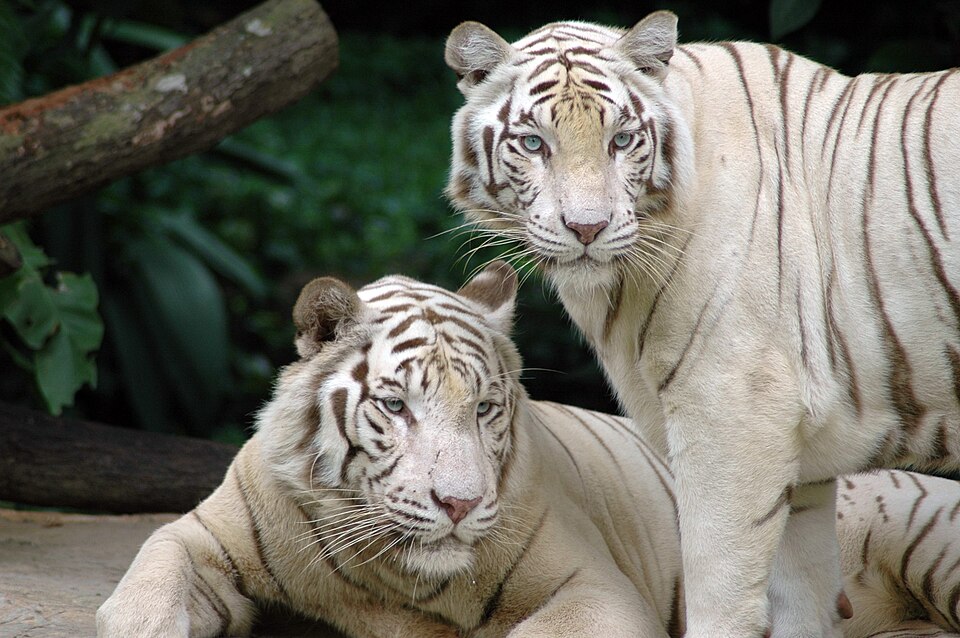
There are tigers with distinct colours. Most tigers have orange fur with black stripes, and a white belly. The black stripes usually extend to the white underside. The stripes are vertical on the tiger’s body, but the stripes are horizontal on the forehead, and the legs. The tail has rings, and the tail tip is black. The stripes are used to keep them camouflaged while hunting. No two tigers have the same pattern of stripes. Most Bengal tigers have orange fur, but some Bengal tigers have white fur with black stripes, or that even have pure white fur. These white tigers are not albino, but they are leucistic instead. The white coat only appears once in every 100 births. The Bengal tiger is the national animal of Bangladesh and India.
Tigers vary in size depending on their subspecies. Siberian tigers are the largest. Males can grow to at least 9 ft (2.7 m) long (body length) and weigh about 900 lb (408 kg). Females are a bit smaller. Record weight for males is claimed as 890 lb, but this cannot be confirmed.
Where they live
Tigers can live in a variety of habitats. Mostly they need to hide, to be near a water jungle source, and have enough prey to eat. Tigers are solitary and they all control large amounts of territory, the size of which depends on the availability of various food for tigers and prey. According to Tigers-World, a male tiger may live and hunt in an area of 60 to 100 square kilometers (23 to 39 square miles). A female tiger may have 20 square kilometers (8 square miles). According to the United States Fish and Wildlife Service, a single tiger can live in a territory as small as 21 square kilometers (8 square miles) to as large as 995 square kilometers (385 square miles).
Subspecies
As previously thought, the tiger had five living subspecies. In this context, ‘recently’ means in the last two centuries. Three tiger subspecies are extinct (†).
- Subspecies of Tiger (Panthera tigris)
- Bali tiger (Panthera tigris balica) †
- Bengal tiger (Panthera tigris tigris)
- Caspian tiger (Panthera tigris virgata) †
- Indochinese tiger (Panthera tigris corbetti)
- Javan tiger (Panthera tigris sondaica) †
- Malayan tiger (Panthera tigris jacksoni)
- Siberian tiger (Panthera tigris altaica)
- South China tiger (Panthera tigris amoyensis)
- Sumatran tiger (Panthera tigris sumatrae)
- White Bengal Tiger (Panthera tigris tigris)
However, in 2017, the Cat Classification Task Force of the IUCN Cat Specialist Group revised felid taxonomy and recognized the tiger populations in continental Asia as P. t. tigris, and those in the Sunda Islands as P. t. sondaica.
Tigers and humans
Tigers are becoming rare, because people hunt them for their coat (skin) and destroy the habitats they live in. The Bengal tiger has the largest population with 3,500 left in the wild. To help keep the tiger population, tigers are often placed in zoos. In order for tigers to survive into the next century, governments throughout the tigers’ range must show greater determination and commitment to conserve tigers and their habitats.
Chinese tigers have been used for centuries in traditional Chinese medicine. Body parts such as their whiskers and bones are used to treat things such as toothaches, malaria, and burns.
Tigers also kill and eat peoples’ livestock, which are easier to hunt than their typical prey, because they are often in fenced or closed areas and livestock may not be able to flee. Sometimes tigers hunt people as prey and eat them, because they are either too old, injured, or ill to hunt their typical animal prey which are much faster than people. These too are a reason why tigers are killed by people.
Diet
Tigers eat many types of prey, mostly ungulates. Some examples are deer, monkeys, wild rabbits, wild pigs, tapirs, water buffalo and other animals. They also eat birds, reptiles and fish. They also prey on other predators, including dogs, leopards, bears, snakes and crocodiles. All are carnivores (meat eaters). Some tigers may eat up to 50 pounds (23 kg) of meat a day. Tigers kill their prey by clamping down on the prey’s throat and suffocating it.
Written for younger readers
Tiger, in simpler words
This version comes from Wikijunior, a set of books written for children aged 8 to 11. It is shorter and uses plainer language than the article above.
From Wikijunior: Big Cats
NOTOC
Their speed and agility give the tiger the title of “Top Predator,” over the larger but slower grizzly bear. The tiger is the largest and most powerful cat species living today. A well rounded athlete, the tiger can climb (though not well), swim, leap great distances and pull with five times the force of a strong human. The tiger is in the same group (Genus Panthera) as lions, leopards, and jaguars. These four cats are the only ones who can roar. The tiger’s roar is not like the full-voiced roar of a lion, but more like a sentence of snarly, shouted words.
Tigers live in forests and grasslands of eastern and southeastern Asia. They live in countries such as Bangladesh, Bhutan, China, India, Nepal, Cambodia, Laos, Malaysia, Myanmar, Thailand and Vietnam, Indonesia (Sumatra), and the Russian Far East. The Bengal Tiger is the national animal of Bangladesh and India. They also live in West Bengal, India.
Like the other big cats, tigers are built much like the much smaller domestic cats that people often have as pets; they are just much bigger and more powerful.
Tigers are usually orange or reddish orange with very bold, uneven black stripes and white areas on the chest, neck, belly and inside of the legs. Their stripes act as camouflage, making it difficult for them to be seen when they are among the trees and shrubs of the jungle. The stripes will vary with each individual tiger.
A tiger usually is about 6 ft to 9 ft in length from nose to tail tip. A large tiger might be 10 ft (3 meters) long. The tail is about 36 inches (91 cm or 3 ft). Tigers weigh about 350 to 550 pounds (160 to 250 kg).
Tigers have very strong teeth and jaws. Their paws are soft and heavily padded, sheathing large, very sharp claws. They also have short, thick, and soft fur and thick long whiskers.
White tigers are those who are born with a certain genetic defect causing loss of pigment in their skin, eyes and fur. These tigers can be white with black, grey, very dark blue, or no stripes; they are not albino.
This loss of pigment is unfortunate for tigers in the wild because their camouflage becomes inadequate. However, this trait may be even more unfortunate for tigers held in captivity. White tigers held in captivity are often forced to breed with their mothers, fathers, siblings, etc. This is usually done to assure that another white tiger cub will be born due to the fact that they are rare and draw in large crowds to zoos, circuses and magic shows. Because these unusually colored tigers are so beautiful and rare, the majority of the public is oblivious to the horrible effects that inbreeding causes in tiger cubs.
These effects may include: an elevated incidence of recessive genetic diseases; reduced fertility both in litter size and in sperm viability; increased congenital defects such as cryptorchidism, heart defects, cleft palates, fluctuating asymmetry (such as crooked faces, or uneven eye placement and size); lower birthweight; loss of immune system function; slower growth rate, smaller adult size; mental retardation, and an increased risk of infant mortality.
Tigers mostly feed on plant-eaters, or herbivores, like elk, deer, wild pigs, and buffalo. Like the majority of cats, they are solitary hunters, meaning they hunt alone. When a tiger has spotted its prey, it may seek out a good location where it can hide, staying close to the ground, and wait for the perfect moment to pounce and ambush its prey. But when prey becomes scarce tigers also hunt peacocks and rabbits. Resourceful as they are, they also catch and eat fish, as tigers are good swimmers.
People who traditionally live in areas where tigers hunt have learned to avoid tiger attacks by wearing a face-mask on the backs of their heads. Tigers prefer to approach other animals from behind and think twice about pouncing when they can see a face. Fortunately, they rarely attack humans unless they are too ill to hunt their normal prey. . Tigers that attack humans are called man-eaters. Jim Corbett was a famous hunter and conservationist who killed many man-eating tigers in India.
Tigers are striped through and through. If you were to shave a tiger, and few ever have, you would see the stripes on the skin.
Tigers are superb swimmers, unlike most other cats. They have been known to board fishing boats from the waters in which they swim. Usually they swim because they want to cool off.
No two tigers have exactly the same pattern of stripes.
The Siberian tiger is the world’s largest naturally occurring cat.
A tiger was once measured to be 13 feet long.
Although the tiger is best known for killing with its jaws and teeth, a tiger is strong enough (like bears) to kill animals as large as cattle with a swipe of its paw.
A tiger named Shere Khan is the arch-villain of Rudyard Kipling’s The Jungle Book as the nemesis of the “man-cub” Mowgli.
A Bengal tiger named “Richard Parker” is a key character in the novel (and highly-successful movie) “The Life of Pi” who must share a boat with a young man cast adrift at sea after the sinking of a ship during a hurricane.
Tigers are orange because it helps them to camouflague in the grass to catch their prey because their prey are colourblind.
Tijgeritorium Everything you want to know about tigers!!!
Wikipedia: Tiger
Save the Tiger Fund Next Topic: Leopards
de:Wikijunior Großkatzen/ Tiger fr:Wikijunior:Les félins/Les tigres it:Wikijunior Grandi felini/Tigre zh:Wikijunior:大猫/老虎
Where this page comes from
The article above is adapted from “Tiger” on Simple English Wikipedia, by its contributors. We removed reference markers, navigation boxes and tables, expanded measurement templates into readable numbers, and kept the prose otherwise intact. The simpler version is adapted from Wikijunior on Wikibooks.
Both sources are published under CC BY-SA 4.0, so this page is published under the same licence. You may share and adapt it, including commercially, as long as you credit the original and keep the same licence.
Worksheets, answer keys and printable layouts elsewhere on K5Print are our own work and are not covered by this licence.