Walking Stick
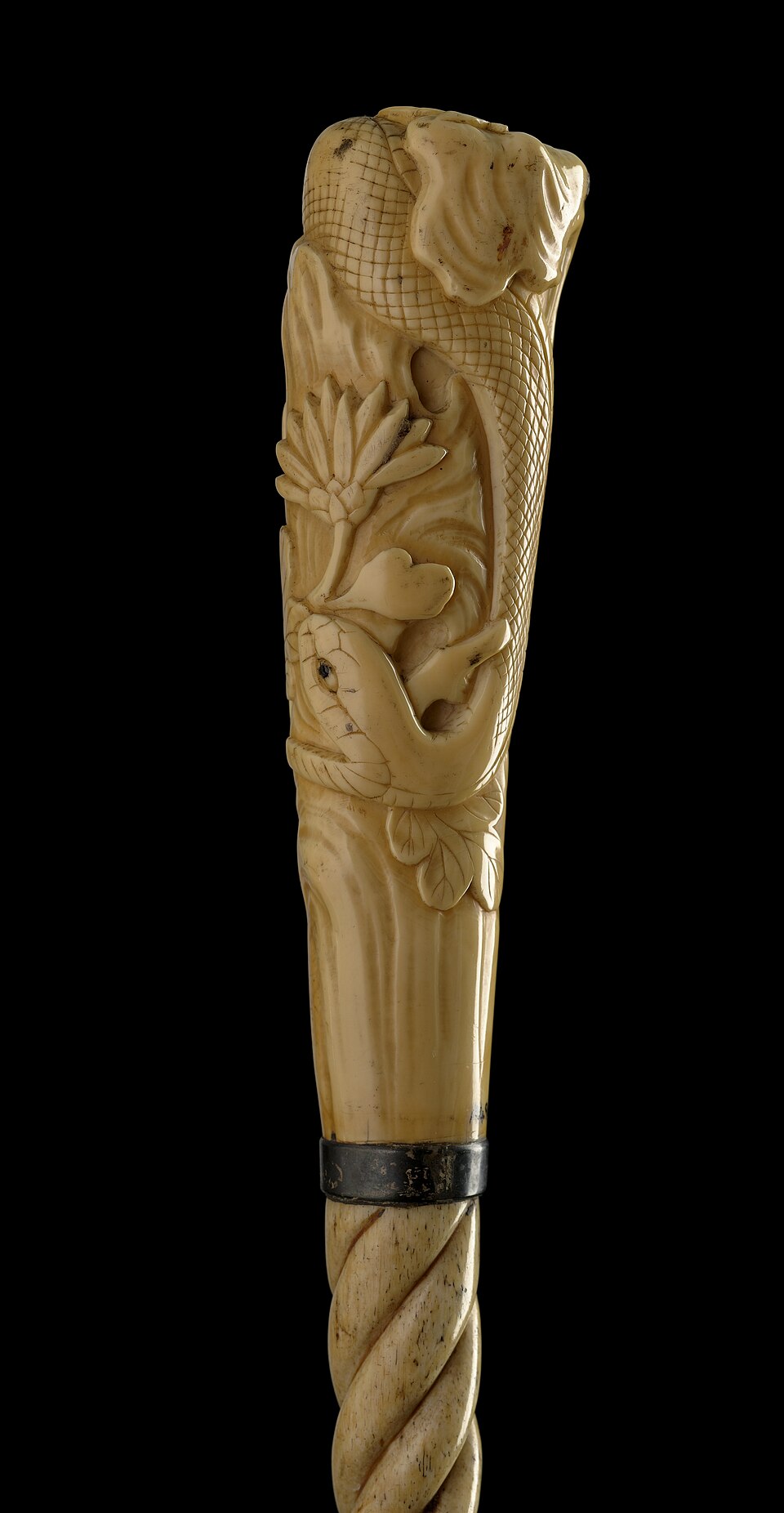

A walking stick is a device used by many people to help keep their balance while walking. Others use them as an accessory. Walking sticks come in many shapes and sizes, and can be sought by collectors. Some kinds of walking stick may be used by people with disabilities as a crutch or cane. The walking stick has also historically been known to be used as a defensive or offensive weapon, and may conceal a knife or sword as in a swordstick. The “tippling cane” contained a flask usually to hold a small amount of liquor. The Quarterstaff and the Shillelagh are also walking sticks.
Medieval quarterstaff
A quarterstaff was a traditional European walking stick/weapon used from the middle age to the Early Modern period. It was usually a shaft of hardwood from 6 to 9 feet (1.8 to 2.7 m) long. It was used the same as a walking stick but also as a weapon. It was later called a “short staff” as it became shorter. The term is best known from the legends of Robin Hood. In many versions of the story, he fights variously a monk, Little John or others with a quarterstaff. In most versions Robin Hood loses and ends up in the stream.
Fashion accessory
From about 1550 until 1930, walking sticks were a fashion accessory. They were not much used for walking but were more worn. A proper lady or gentleman would never be without their walking stick or cane. Many were elegant canes with highly decorated handles. Sometime during the 17th century, the decorated walking stick replaced the sword carried by aristocrats as a status symbol.
Hiking
Walking sticks, sometimes called a hiking stick or trekking pole, are used by hikers. They are used for support when going uphill or downhill. A good walking stick or pole helps hikers keep their balance while crossing streams or rocks. Modern hiking poles are made of aluminum (or composite materials). They can telescope to fit tall or short hikers. Many have shock absorbers to ease back, shoulder and knee strain.
Shillelagh
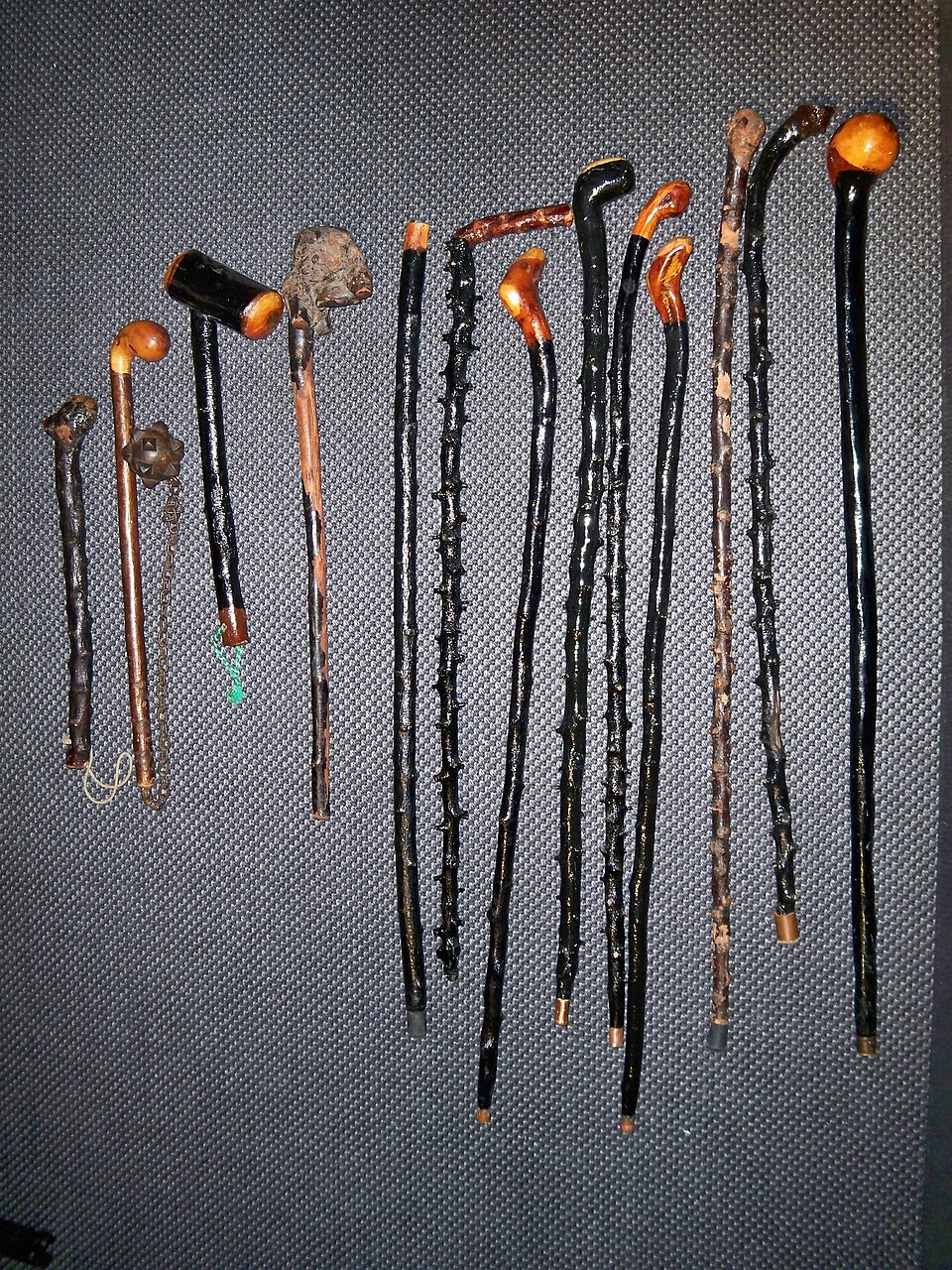
A shillelagh is a wooden walking stick and club or cudgel, typically a thick knotty stick with a large knob at the top. Many are made from oak or willow. Some are made from the blackthorn bush. In the British Army, blackthorn sticks are carried by commissioned officers of the Royal Irish Regiment. The Shillelagh is associated with Ireland and Irish folklore.
Martial arts
The walking stick is a weapon in martial arts. Both stick training and shinai (sword) training use the walking stick. Some are light but shinai-weight and heavier are more common. It can be less lethal than a sword but is deadly against a knife or similar weapons. With practice a walking stick user can deliver a kote-man or double-strike. Once to the wrist (holding the knife) followed instantly by a second blow to the assailant’s head. The walking stick has the added advantage it does not look like a weapon. It looks fairly harmless.
Swordsticks and sword-canes
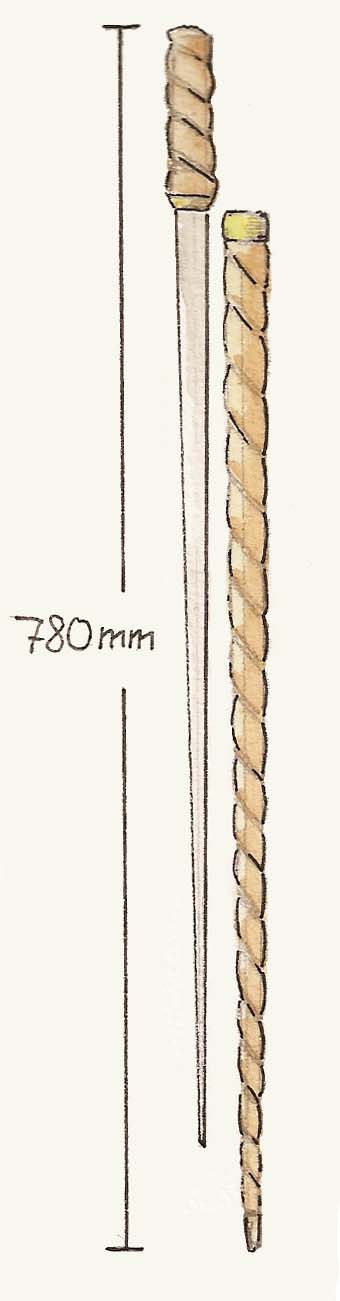
A sword cane was a long thin steel blade encased in a sheath. The sheath was the cane or, in the case of a swordstick, a walking stick. Andrew Jackson carried a sword-cane and was known to have used it. In many modern jurisdictions the ownership, carrying, manufacturing or trading in sword canes is restricted by law. In some places they are considered a concealed weapon.
Collectors
A collector of walking sticks is termed a rabologist.
Written for younger readers
Walking Stick, in simpler words
This version comes from Wikijunior, a set of books written for children aged 8 to 11. It is shorter and uses plainer language than the article above.
From Wikijunior: Bugs
Walking Sticks are long, thin, and slow-moving bugs, that looks like a stick, twig or branch. They are also called walking sticks. Males tend to be smaller than females. The colors are usually brown or green, but may be grey or shades of red. Also some are shaded orange, but in little places. Stripes, spots, and speckles are more common than solid. Males usually have wings, but females are most likely wingless. Short, tough forewings protect the larger fan-shaped hind wings.
The common American Walking Stick is slender and shiny with long antennas. The adult male is 2 to 3 inches long with bands of color,while the adult female is 4 to 5 inches long.
The New Guinea Spiny Stick Insect is big and bulky. It can grow to 4-1/2 inches to 6 inches long. It resembles a branch more than a slender stick. The colors are dark brown to black. Their legs are thick and prickly. Adult males have a long thorn on each hind leg. Nymphs, another type new type of walking stick, have green-and-brown patterns.
Two-striped Walking Sticks are also known as Prairie Alligators and Devil’s Riding Horses. They are large and relatively stout with three longitudinal black stripes down its back.
Walking Sticks are found in North America, Australia, and around the Mediterranean Sea in Europe. They are abundant in the rainforests of Asia, Africa, and South America. They live in tropical areas and warm temperate regions. Their natural habitat is woodlands and forested areas where there are many broadleaf trees. They live on the foliage of shrubs and bushes and on tree stems.
Common American Walking Sticks can be found east of the Mississippi River, from southern Canada to central Florida. They are also found in parts of Arkansas, Arizona and northern Mexico.
Giant Spiny Walking Sticks live on the ground instead of trees or bushes. They hide under bark and stones during the day.
Stick insects are herbivorous, eating only plants and vegetation. They eat berries, vines, and leaves. They feed at night.
Nymphs feed on oak leaves and various plants, berries and shrubs that grow under the oaks and also rose leafs.
They also eat fabric textiles.
Stick insects protect themselves by remaining motionless for hours. Sometimes, they gently sway back and forth like a small branch being blown by the wind. They hold their legs tightly along the body so they look like a stick or twig. The surrounding vegetation makes them almost invisible to predators. First-stage nymphs are tiny and have protective camouflage.
Other defense tactics include using unpleasant smells, noises, postures, protective coloration, and sharp spines on the legs.
Sometimes the undersides of the wings are brightly colored. When the stick insect senses danger, the wings will open very fast revealing a bright flash of color to scare away predators. Often, wings act as miniature parachutes. The stick insect can fall from a branch, unfold its wings, and glide to safety.
The Two-striped Walking Stick has bright stripes that act as warning coloration. It is also called “musk mare” because it squirts a strong-smelling defensive spray when threatened.
A Stick Insect undergoes incomplete metamorphosis, changing from egg to nymph to adult. There is no pupal stage. The female deposits eggs through a special tube (ovipositor) at the tip of the abdomen.
In a few species, the female lays eggs by hanging upside down from a branch. She arches her abdomen then straightens up and flicks the eggs away. The eggs are thrown some distance and scattered over a wide area. In the spring nymphs emerge from a tiny cap at one end of the egg.
About two weeks after mating, the female flicks, drops, or scatters her eggs. Some species take care to protect their eggs. They bury their eggs in the ground or hide them in the bark of a tree. Often eggs are attached to leaves or branches by a special sticky substance. Some eggs look like seeds, and ants take them to their nests where they are protected.
To grow bigger the nymph molts, growing a new skeleton under the old one. The old skin cracks open and the nymph emerges with a new cover. The new outer casing is soft at first, and the nymph must be careful to avoid danger until it hardens.
Finally, after several molts, the nymph becomes an adult. The average lifespan of a Walking Stick is 1 to 2 two years.
A Walking Stick adapts to its surroundings by appearing to be a stick. It is only active at night (nocturnal). It has claws and suction pads on its feet to climb stems and branches.
Nymphs can regrow or regenerate a leg pulled off while escaping a predator. Each time it molts, the lost limb gradually grows back. After three or four molts the lost limb is completely grown back, a little shorter than the original. When an antenna is lost, the Stick Insect grows a new leg in its place. Adults no longer molt, so only nymphs can replace body parts this way.
Males of the Giant Spiny Stick Insect species are also called Thorny Devils. They have large, sharp spines on their hind legs. Their legs are used as fishhooks in Papua New Guinea.
Female Two-striped Walking Sticks are large and carry the smaller males around for long periods.
Walking Sticks do not seem to have a great impact on humans. There may be problems when they are brought to areas where they do not belong naturally. Common American Walking Sticks are sometimes thought of as pests because large numbers feeding at once can eat most of the leaves on a tree.
The Indian Walking Stick is native to Madagascar where captive colonies are often kept on hedges. The Indian Walking Stick is often used as a study animal by scientists.
Some people keep Walking Stick insects as pets.
The Two-striped Walking Stick is capable of squirting a strong-smelling defensive spray that is painfully irritating to the eyes and mucous membranes
Where this page comes from
The article above is adapted from “Walking Stick” on Simple English Wikipedia, by its contributors. We removed reference markers, navigation boxes and tables, expanded measurement templates into readable numbers, and kept the prose otherwise intact. The simpler version is adapted from Wikijunior on Wikibooks.
Both sources are published under CC BY-SA 4.0, so this page is published under the same licence. You may share and adapt it, including commercially, as long as you credit the original and keep the same licence.
Worksheets, answer keys and printable layouts elsewhere on K5Print are our own work and are not covered by this licence.