Wolf Spider

Scientific name
- Scientific name
- Lycosidae
- Kingdom
- Animalia
- Phylum
- Arthropoda
- Class
- Arachnida
- Order
- Araneae
- Family
- Lycosidae
How to say it in other languages
- Chinese
- 狼蛛科
- Dutch
- Wolfspinnen
- French
- Lycosidae
- German
- Wolfspinnen
- Japanese
- コモリグモ科
- Korean
- 늑대거미과
- Spanish
- Lycosidae
Facts from Wikipedia’s “Wolf spider” page and Wikispecies (CC BY-SA 4.0).
A Wolf spider is a member of the group of spiders whose scientific name is the Lycosidae. Lycos means “wolf” in Greek. These spiders get their name from the way they hunt, which the people who named them thought was like the way wolves hunt. However, wolves hunt in packs but spiders are solitary animals. Their way of hunting is more like that of solitary cats such as the cheetahs. They generally wait for their prey to wander close by, and then they rush in to kill it.
The wolf spiders belong to a large group. The smallest are less than 0.04 inches (1 mm) in body length. The largest are around 1.5 inches (38 mm) in body length. Some wolf spiders spend all of their lives above ground (taking the best shelter they can find), others dig burrows but come out of the burrows to wander about and hunt, and some spend almost all of their lives waiting for passing insects in their burrows.
One species of wolf spider gives us the name that is now used in English for an entirely different kind of spider. This is Hogna tarantula because it found around Taranto, a city in Italy. People there once believed that if a human were bitten by one of these wolf spiders, they would surely die unless made to do a wild dance. Actually, Hogna tarantula does not give bites that need medical help. Any deaths from spiders in the area of Taranto probably came from the local Widow spider.
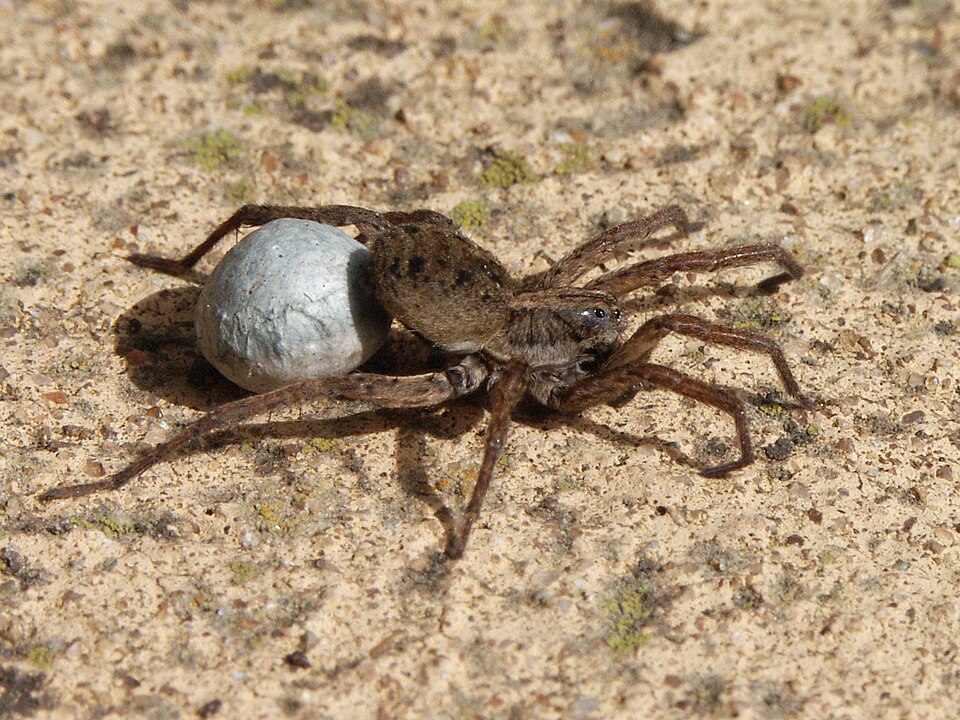
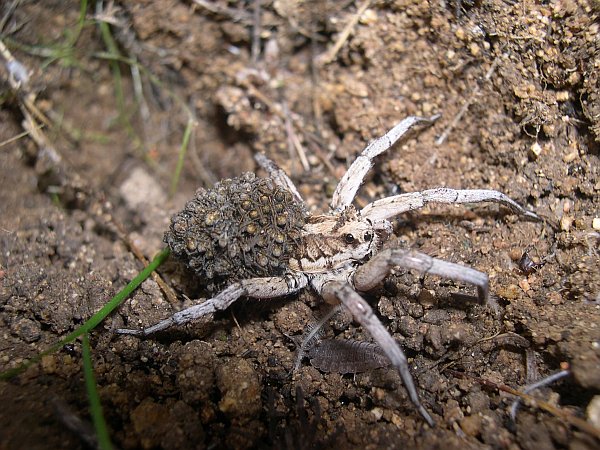
After a female wolf spider mates, she creates a clear space on the ground, lays down a rough sheet of silk, and on top of that sheet she makes a silken cup in which she lays her eggs. She next closes the cup, making a round ball, and holds onto it using her spinnerets until the babies begin to hatch. She then opens the silk ball and lets the baby spiders come out. They all run up her legs and cover the top part of her body.. There may be more than one hundred baby spiders on her back.
As you can see from the second photograph, mother wolf spiders carry their baby spiders around on their backs. They protect the babies for a few days, and then the babies leave her and go off on their own.
Is it a wolf spider?
There are several kinds of spiders that look almost like wolf spiders. The best way to be sure is to look at the eyes. There are four small eyes at the bottom, then two very large eyes, then two somewhat smaller eyes.
Various kinds of wolf spider
Wolf spiders come in various sizes, ranging from 2 millimeter to 40 millimeter in size (more than an inch in body size).
Written for younger readers
Wolf Spider, in simpler words
This version comes from Wikijunior, a set of books written for children aged 8 to 11. It is shorter and uses plainer language than the article above.
From Wikijunior: Bugs
Wolf Spiders belong to the Lycosidae family. Most are dark brown or gray, black, or tan. They are very hairy. Their name comes from the Greek word lycosa meaning wolf. Like all spiders they have 8 legs. They have a combined head and midsection (cephalothorax), and an abdomen. The hard outer covering is called an exoskeleton. It is flexible so the spider can bend and move. They are 1/8 to 1-3/8 inches long. Males are usually smaller than females.
There are 8 eyes. Two eyes are larger than the others. The jaw-like parts near the mouth are used to crush prey. They are called chelicerae and have fangs to inject venom. The long legs have 3 tiny claws at the tip. They have reflectors in their eyes to help them see at night. The light of a flashlight will reflect from the silvery eyes. Thin-legged Wolf Spiders and Burrowing Wolf Spiders have spines on their legs.
Wolf Spiders live almost everywhere in the world, including the Arctic and the tropics. Around 200 species live in North America. They can be found in mountains, deserts, rainforests, and wetlands. They are common in grasslands and meadows.
Most Wolf Spiders live on top of the ground. Some make holes under rocks. Burrowing Wolf Spiders live in sandy areas where they dig deep burrows in the sand. They cement the burrow walls with silk. They throw loose sand out the doorway. Forest Wolf Spiders and Rabid Wolf Spiders live in ground litter in the woods. Thin-legged Wolf Spiders live on surface soil in grassy fields. They do not build shelters. Carolina Wolf Spiders are found on the ground in open fields. Tropical Wolf Spiders make a sheet-like web for a home.
Wolf Spiders eat insects and small spiders. Most are hunters and do not spin webs. Some hunt in the day and some at night. They hunt alone and use their keen eyesight to spot prey. Their body hairs can sense touch and vibration. They can detect movement of insects or animals. They move very quickly. They can cover two feet per second when chasing prey. Some sit and wait for prey to pass near the mouth of a burrow. Forest Wolf Spiders use a dragline to hang in midair so they can pounce on their prey.
They blend into the background to hide from predators. Dark, spotted or mottled body colors help them hide in dead leaves and other debris. Some build trap doors over the burrow entrance. They use pieces of moss, dirt, silk, and twigs to camouflage the entrance of the burrow.
Wolf Spiders undergo simple, incomplete metamorphosis. In most Wolf Spider species, the female lays dozens of eggs. She spins a sheet of silk to lay her eggs on. She rolls them into an egg sac and attaches it to her spinnerets (web-producing organs). She drags it after her until the spiderlings hatch.
There is no larval or pupal stage. There is no “resting” stage before the baby spiderlings emerge from the eggs. They resemble adults when they hatch. They live on the mother’s back for several weeks until they are big enough to hunt on their own. They shed their skin several times as they grow. Most live for several years. They have been known to live up to 11 years.
Male Wolf Spiders court females by waving their pedipalps (feelers on the face). Some rub their bodies across leaves or click their legs to make sounds. Sometimes the male wraps a fly in silk and gives it to his mate. Different mating signals let the female spiders recognize their own species.
Rabid Wolf Spiders often bask in the sun, keeping warm, ready to pursue prey. Female Burrowing Wolf Spiders warm the egg sac in the sun at the doorway of the burrow.
Wolf Spiders communicate with each other using smell, touch, sight, and sound. Several species make sounds by rubbing their feet together. The sound can be heard up to 20 feet away and lasts less than a second.
Even though their eyes do not move, Wolf Spiders can see in four directions at once.
If a female Wolf Spider’s egg sac falls off, she reattaches it to her spinnerettes. If she cannot find it, she attaches another round object such as a ball of paper.
Wolf Spiders are helpful to people because they eat insects. California farmers keep them in rice fields to eat insects that harm the crops. Each spider eats between 5 and 15 insects each day.
They do not attack people but may bite if picked up. Their bites are as painful as a bee sting. Some of the most common symptoms from the venom are itching, swelling, and mild pain. People with allergies could develop more severe symptoms.
Wolf Spiders are important because they eat a great number of harmful insects. They are not considered pests themselves, but may wander into houses and frighten people.

Where this page comes from
The article above is adapted from “Wolf Spider” on Simple English Wikipedia, by its contributors. We removed reference markers, navigation boxes and tables, expanded measurement templates into readable numbers, and kept the prose otherwise intact. The simpler version is adapted from Wikijunior on Wikibooks.
Both sources are published under CC BY-SA 4.0, so this page is published under the same licence. You may share and adapt it, including commercially, as long as you credit the original and keep the same licence.
Worksheets, answer keys and printable layouts elsewhere on K5Print are our own work and are not covered by this licence.