Semitone
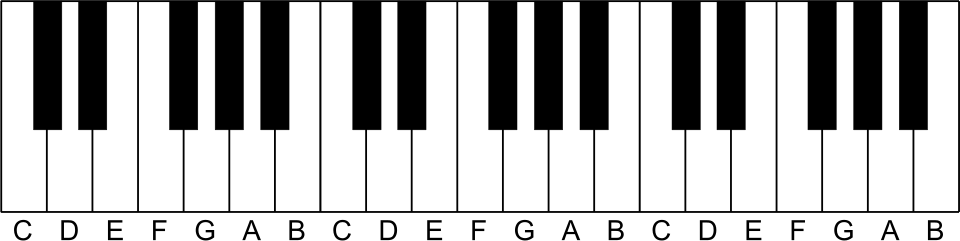

A semitone (British English) (also called a half step or a half toneSemitone, half step, half tone, halftone, and half-tone are all variously used. Aaron Copland, Leonard Bernstein, and others use “half tone”. One source says that step is “chiefly US”,and that half-tone is “chiefly N. Amer."[http://www.askoxford.com/concise_oed/halftone) is the smallest musical interval used in Western music. It is the distance between two notes which are next to one another in pitch.
A whole tone means a distance of two semitones, i.e. the distance between two notes which are separated by one other note in pitch.
This is easy to see with a picture of a keyboard. The distance between two white notes that are side by side may be a whole tone (if there is a black note in between them) or a semitone (if there is no black note between).
To go from a C to a C sharp (or D flat) is a semitone.
To go from a C sharp (or D flat) to a D is a semitone.
To go from a C to a D is a tone.
An octave is divided into twelve semitones. These semitones are exactly equal in size.
Musical intervals are defined by a ratio of frequencies. An octave is a ratio of 2:1, so from 100 Hz to 200 Hz, and from 200 Hz to 400 Hz, are both octaves. A semitone is a ratio of the 12th root of 2 to 1, which is equal to 1.05946:1, so 1000 Hz and 1059.46 Hz are a semitone apart. A musical interval sounds better if the two notes have a small integer ratio. For this reason, it can be approximated by a ratio of 16:15 in just intonation.
Where this page comes from
The article above is adapted from “Semitone” on Simple English Wikipedia, by its contributors. We removed reference markers, navigation boxes and tables, expanded measurement templates into readable numbers, and kept the prose otherwise intact.
Both sources are published under CC BY-SA 4.0, so this page is published under the same licence. You may share and adapt it, including commercially, as long as you credit the original and keep the same licence.
Worksheets, answer keys and printable layouts elsewhere on K5Print are our own work and are not covered by this licence.