Blood Vessels
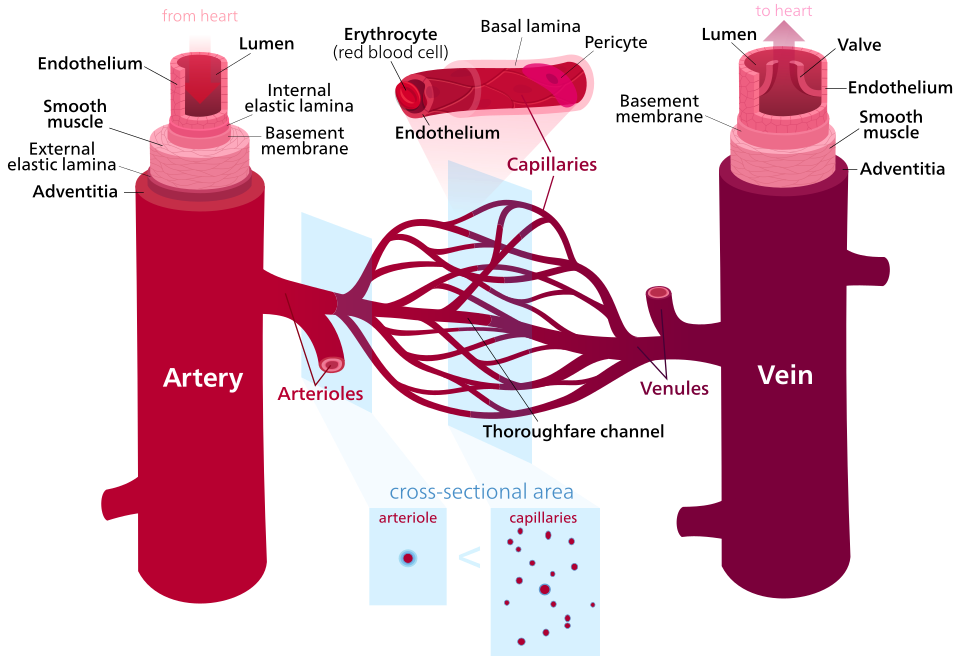

A blood vessel is a tube that carries blood around the circulatory system. Blood vessels that take blood away from the heart are arteries. Blood vessels that take blood back to the heart are veins. Capillaries are between veins and arteries and they supply tissue with blood.
The heart plus all of the blood vessels in the body together are called the circulatory system. Blood is moved by the pumping of the heart and carries oxygen to the tissues.
The expansion of blood vessels is called vasodilation, it helps the body to get rid of heat energy (vas- in Latin means “container” or “vessel”). The constriction of blood vessels is called vasoconstriction, it prevents the body from losing warmth.
Originally, August Krogh estimated that there was 100,000 km (60,000 miles) of combined blood vessels in the human body. However, his figure was based off of incorrect assumptions that the density of blood vessels in the human body was a lot more than what is known today. He based his calculations on the assumption of a 143kg body with 50kg of pure muscle, an unrealistic body, leading to unrealistic estimations. A new study determined that the actual is somewhere between 9,000 km - 19,000 km (5,600 miles - 11,800 miles).
Growing new blood vessels is called angiogenesis.
Structure
Different parts of the body have different kinds of blood vessels for different parts of their work. The vessel wall is made up of three shells:
- inner - represented by the endothelium (single-layer squamous epithelium), which is built of elongated endothelial cells located on the basement membrane, and the subendothelial layer, which is based on loose fibrous connective tissue
- middle - consists of circular bundles of smooth muscle cells with layers of elastic fibers
- external - is represented by loose fibrous connective tissue, which contains a lot of blood vessels and nerve fibers The structure of the vessel wall depends on hemodynamic conditions: blood flow velocity, blood volume and blood pressure. Arteries located close to the heart are characterized by a predominance of elastic elements that are able to counteract high hemodynamic parameters. As you move away from the heart, hemodynamic values decrease, the caliber of blood vessels decreases and the number of muscle elements in their walls increases, which are able to create additional force to push blood into the network of the smallest vessels.
Written for younger readers
Blood Vessels, in simpler words
This version comes from Wikijunior, a set of books written for children aged 8 to 11. It is shorter and uses plainer language than the article above.
From Wikijunior: Human Body
Blood vessels are tiny tubes inside your body that carry blood around your body.
TOC
Blood vessels are long thin tubes that run all through the body. Some are larger than others. Most are very small. Some are so small that you can’t even see them without a microscope. If you look at your wrist or leg, you can see blue lines just below the skin. These are your blood vessels. They look blue because of the way light goes through your skin and lights up the carbon dioxide rich cells in the blood stream, but the blood plasma remains red. Oxygenated blood is bright red because of the hemoglobin, deoxygenated blood is actually dark red but looks blue.
There are a huge number of blood vessels in your body. If they were all stretched out, there would be over 60,000 miles of blood vessels!
Blood vessels are hollow tubes that blood flows through. They have walls made of muscle. The hollow place inside of the blood vessel is called the lumen.
Veins have small flaps of tissue called valves. These keep the blood flowing the right direction by closing if any blood tries to flow backwards. Without these, our blood would be flowing in every direction possible.
What is the function of the blood vessels?
The main function of blood vessels is to carry blood through the body. The blood carries oxygen, nutrients, and wastes that need to circulate the body. The three kinds of blood vessels are: arteries, veins, and capillaries.
The arteries carry blood away from the heart and transport it to the rest of the body. The blood in arteries carries oxygen and nutrients to different parts of the body.(with the exception of pulmonary artery). They have valves to ensure that the blood flows only in one direction .
The veins carry blood the opposite direction, back to the heart from the rest of the body. The blood in veins carry wastes that need to leave the body.(with the exception of pulmonary vein)
Arteries have a thicker wall and a smaller inside hole than veins. The reason for this is that arteries carry blood that is pumped all over the body. That pumping requires a lot of power from the heart. This pumping causes high pressure, and so the walls of the artery need to be thick and strong.
The third kind of blood vessels is capillaries. They are very tiny. You would need a microscope to see one. They connect the arteries to the veins. They let oxygen and nutrients pass from the blood to body cells. They also let carbon dioxide and other wastes pass from the cells back into the blood. This is possible because the walls of the capillaries are so thin that substances can pass through easily. This happens through a process called diffusion.The capillaries are the smallest vessels have walls which are one - cell thick .
Blood vessels start at the heart and extend out to the rest of the body. The heart is important in pumping the blood through the blood vessels. The stomach and small intestine are where the blood picks up nutrients.
Blood vessels touch almost every part of the body. They carry oxygen and nutrients to every other organ. Without blood vessels, the rest of our body couldn’t survive, because there is no part of the body to carry the nutrients.
An important part of keeping your blood vessels healthy is eating right.
You may have heard of cholesterol. If you eat too much fatty food, like butter, cheese, chips, or crisps, some of this fat naturally builds up around the arteries and veins. This is known as cholesterol. If there is too much cholesterol, it can build up and eventually starts to clog or block your arteries. Here are two pictures showing this:
In the first picture, there is more blood and also less cholesterol. In the second picture, there is less blood in the arteries and more cholesterol. This is because the cholesterol clogs the arteries and reduces the amount of blood which flows in them. Because the arteries carry blood from the heart all over the body, this reduces the amount of blood supplied to your body cells.
This can have dangerous and life-threatening effects. Eventually, it may even cause a heart attack. Reducing the amount of fatty food you eat can reduce cholesterol though. It is especially important to avoid trans-fats, a very unhealthy kind of fat. Eating fruits and vegetables can also help reduce cholesterol. It is also helpful to get exercise. Playing outside, riding a bicycle, or playing your favourite sport are all good activities.
Where this page comes from
The article above is adapted from “Blood Vessels” on Simple English Wikipedia, by its contributors. We removed reference markers, navigation boxes and tables, expanded measurement templates into readable numbers, and kept the prose otherwise intact. The simpler version is adapted from Wikijunior on Wikibooks.
Both sources are published under CC BY-SA 4.0, so this page is published under the same licence. You may share and adapt it, including commercially, as long as you credit the original and keep the same licence.
Worksheets, answer keys and printable layouts elsewhere on K5Print are our own work and are not covered by this licence.