Brain

The brain is the part of the body which lets living beings think. It does some bodily functions, such as telling the rest of the body what to do. Almost all animals have a brain: the exceptions are sponges, cnidarians, and lancelets. Plants and fungi do not have brains, although they do react to changes in their environment.
The brain is made up of special cells called nerves, which are connected with each other and with other nerves in our body. The brain gets input from sense organs, and changes behavior in response to this information. In humans, the brain also controls our use of language, and is capable of abstract thought. The brain is the main control centre of the whole body.
In all animals, the brain is protected in some way. In ourselves, and all vertebrates, it is protected by the bones of the skull.
Function
The brain does the thinking, learning, and feeling for the body. For humans, it is the source of consciousness. The brain also controls basic autonomic body actions, like breathing, digestion, and heartbeat, that happen automatically. These activities, and much else, are governed by unconscious functions of the brain and nervous system. All the information about the world gathered by our senses is sent through nerves into the brain, allowing us to see, hear, smell, taste, and feel things. The brain processes this information, and we experience it as pictures, sounds, and so on. The brain also uses nerves to tell the body what to do, for example by telling muscles to move or our heart to beat faster.
This is generally true but some activity is caused by the spinal cord directly. For example, reflex actions do not involve the brain. In lower animals, a lot is done without their brain being involved.
All vertebrates have brains and, over time, their brains have evolved to become more complex. Some simple animals, however, like sponges, do not have anything like a brain. Segmented invertebrates have ganglions in each segment, and a ring of nervous tissue around the alimentary canal at the front. This acts to bring sense data from the front into play with the movement of the body.
Parts
In mammals, the brain is made of three main parts: the cerebrum, the cerebellum, and the brainstem. The surface of the cerebrum is the cerebral cortex, which all vertebrates have. Mammals also have an extra layer, the neocortex. This is the key to the behaviour which is typical of mammals, especially humans.
Cerebral cortex
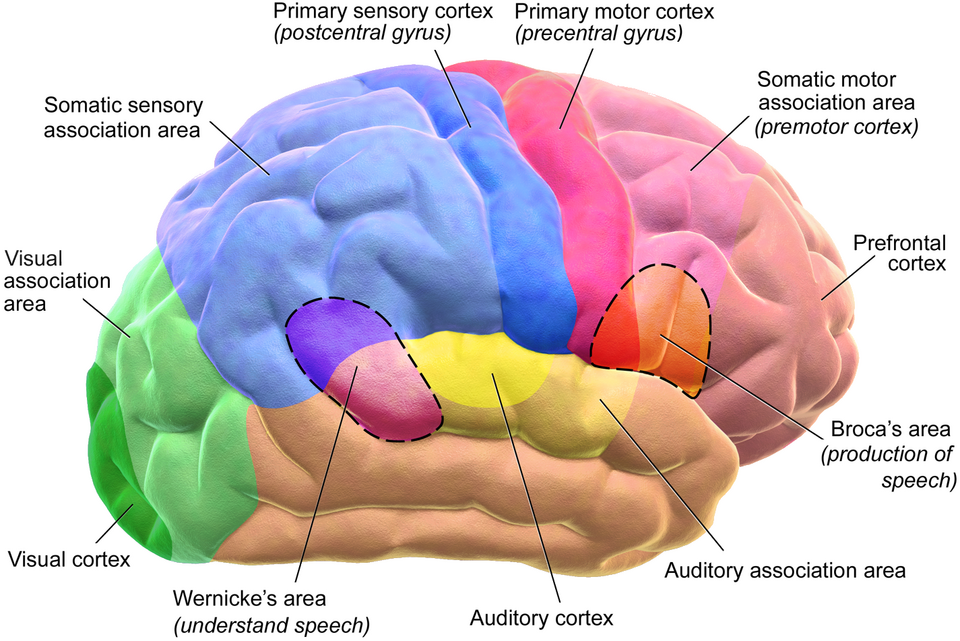
The cortex has sensory, motor, and association areas. The sensory areas are the areas that get and process information from the senses. The motor areas control voluntary movements, especially fine movements performed by the hand. The right half of the motor area controls the left side of the body, and vice versa. Association areas produce a meaningful experience of the world and supports abstract thinking and language. This enables us to interact effectively. Most connections are from one area of the cortex to another, rather than to subcortical areas; The figure may be as high as 99%.
Thalamus
The thalamus puts together the input from most of the senses. It is the place in the brain which makes the “picture” we have of the world outside us. The thalamus sits centrally under the cerebral cortex.
Cerebellum
The cerebellum coordinates muscles so they work together. It is also the centre of keeping position and balance, and motor skills. It is one of the most ancient parts of the brain and sits at the back underneath the cerebral cortex.
Brain stem
The brain stem is at the back of the brain (actually underneath it in humans). It joins the rest of the brain with the spinal cord. It has lots of different parts that control different jobs in the body: for instance, the brain stem controls breathing, heartbeat, sneezing, eye blinking, and swallowing. Body temperature and hunger are also controlled by parts of the brain stem. Roughly speaking, it deals with the more automated aspects of nervous function.
Size
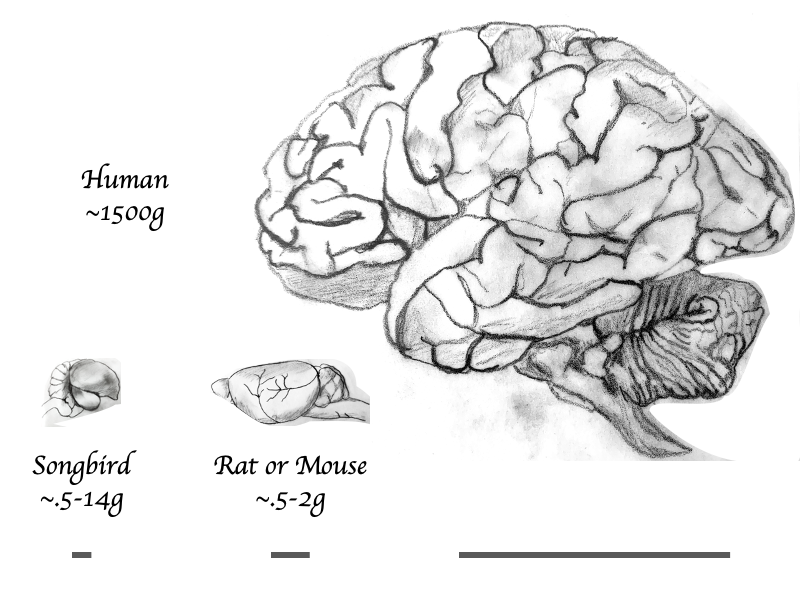
The volume of the human brain (relative to the size of the whole body) is very large, compared to that of most other animals. The human brain also has a very large surface (called cortex) for its size, which is possible because it is very wrinkled. If the human cortex were flattened, it would be close to a square meter in area. Some other animals also have very wrinkled brains, such as dolphins and elephants. Here is a rule of thumb: the larger an animal is, the larger its brain will be. p15 Even allowing for that, the human brain, and in particular the neocortex, is very large. We know it increased in size four-fold over the last several million years of evolution. p79 There are ideas about why this happened, but no-one is quite sure. Most theories suggest complex social activity and the evolution of language would make a larger brain advantageous. p80 As an additional note, Einstein’s brain weighed only 1,230 grams, which is less than the average adult male brain (about 1,400 grams). The detailed organisation of a brain obviously matters, but in ways which are not understood at present.
Number of cells
A human brain accounts for about 2% of the body’s weight, but it uses about 20% of its energy. It has about 50–100 billion nerve cells (also called neurons), and roughly the same number of support cells, called glia. The job of neurons is to receive and send information to and from the rest of the body, while glia provide nutrients and guide blood flow to the neurons, allowing them to do their job. Each nerve cell has contact with as many as 10,000 other nerve cells through connections called synapses.
Written for younger readers
Brain, in simpler words
This version comes from Wikijunior, a set of books written for children aged 8 to 11. It is shorter and uses plainer language than the article above.
From Wikijunior: Human Body
The brain is the organ that sits in our head and harbors our selves, our thinking, feelings, personalities and consciousness. We conclude this from experiments that demonstrate activity of the brain. How the brain works in detail is a great mystery to this day for most of the aspects mentioned, however.
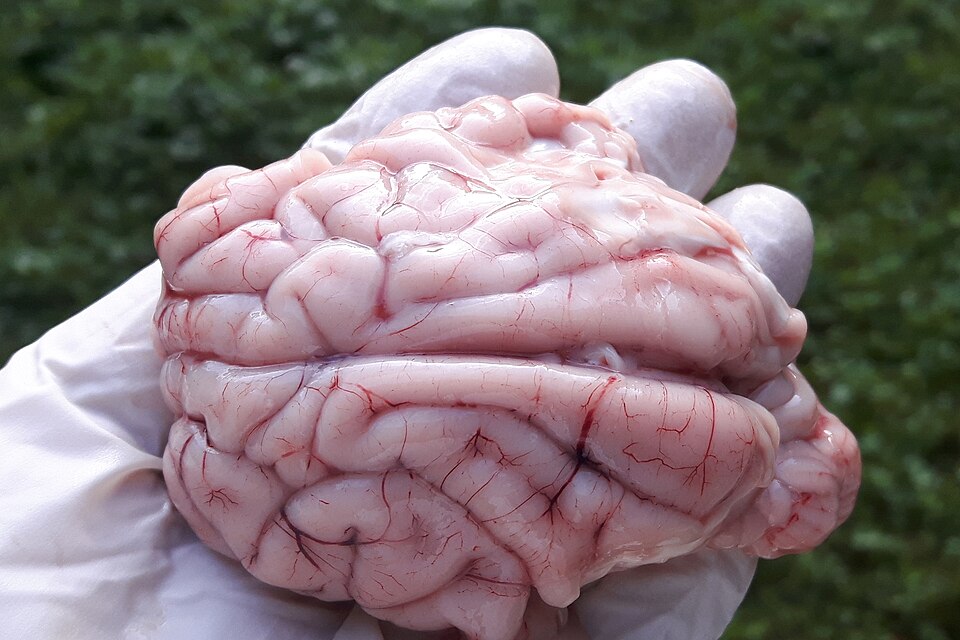
The brain fills the interior of our skulls and is composed of several lobes (round shaped parts that are interconnected). There is an exterior part - the grey substance (grey matter) - and an interior part - the white substance (white matter), as revealed by a cross section.
The brain is mainly composed of neurons (cells that can transmit electrical signals) and supporting cells (glia). As for most other organs, there are blood vessels and immune cells too. Neurons have a main body and many extensions.
Dendrites are extensions of a neuron that receive signals and then the axon transmits electrical signals to other neurons. The main body is a bit darker than dendrites or axons and is predominantly located in the grey substance, thereby giving it its color. Axons are covered by white fatty substance (myelin sheath made up of lipids) and makes the white matter of our brains.
The brain receives input from cranial nerves and the medulla. These signals are processed by our brain. You can actually feel it right now, because you consciously know, that you are reading this page - which is a conscious visual input.
Also you hear sounds, you feel emotions, you feel being touched, tickled and so on. All these are conscious reactions to input. Of course, we react to these inputs by changing our mood, position or thinking. Body movements are being commanded by the brain through the nerves and the medulla, too. Cranial nerves and medulla, therefore, have fibers dealing with input and others that deal with output.
There are many other functions of the brain that are sub-conscious like breathing for which we do not need to think consciously. The brain controls all other body organs systems and their functions like digestion, respiration, etc.
The brain is actually connected through nerves with almost every other organ of the body. We can sense the top of our head, our toe-tips and we can frown as well as walk. Also organs like the stomach, thymus or spleen are connected with the brain. We cannot feel these organs, which is an example of unconscious processing of input and output by the brain.
The brain connects to other organs by means of long nerves that are comprised of neurons. Electrical signals trigger reactions in connected organs, whereas sensory nerve endings (dendrites or other specialized structures) help to collect input. For example, in muscles electrical signals are converted into chemical signals eliciting muscular contraction via the sliding filament hypothesis.
Exercising your brain will keep it in great shape and will help you to continue learning and become quicker in understanding. This includes reading, solving riddles or just being active: outdoors exploring nature, indoors doing sports. Watching TV, however, is passive and will not help you improve your brainy skills. You should have a healthy balance of different activities to keep you fit and smart. Some sports like boxing or bungee jumping are known to damage brain and you should avoid them.
Eating healthy food is another way to keep the brain healthy.
Where this page comes from
The article above is adapted from “Brain” on Simple English Wikipedia, by its contributors. We removed reference markers, navigation boxes and tables, expanded measurement templates into readable numbers, and kept the prose otherwise intact. The simpler version is adapted from Wikijunior on Wikibooks.
Both sources are published under CC BY-SA 4.0, so this page is published under the same licence. You may share and adapt it, including commercially, as long as you credit the original and keep the same licence.
Worksheets, answer keys and printable layouts elsewhere on K5Print are our own work and are not covered by this licence.